
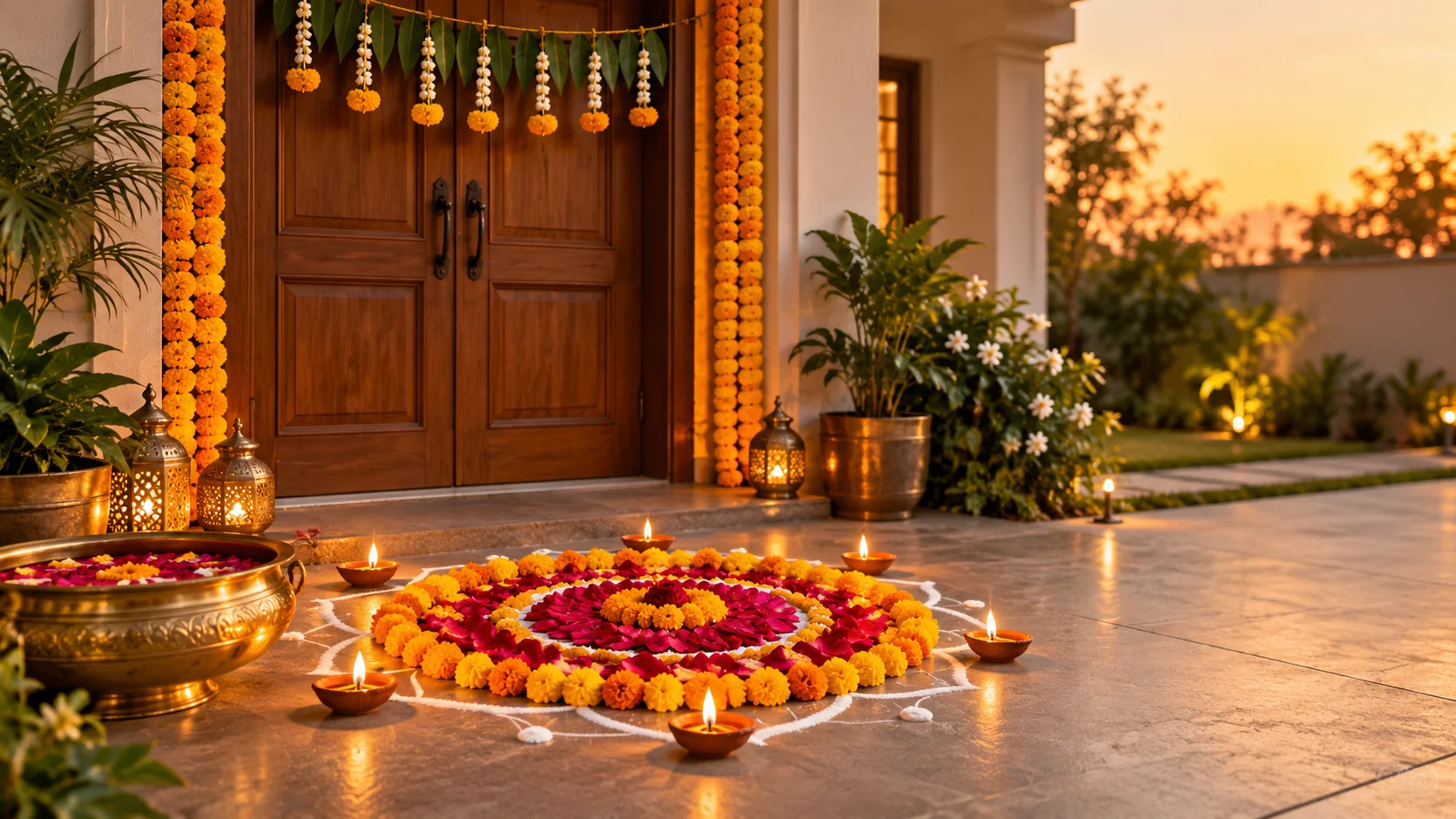
Most Navratri decorating goes wrong on night four, not night one. The marigolds that looked glorious on the first evening are drooping, the rangoli has been scuffed by a dozen pairs of feet, and half the diyas have burnt out or been blown out by the evening breeze.
The best navratri decor ideas are therefore less about what to buy and more about what to build, and how to keep it alive for nine nights. Hang a fresh marigold and mango leaf toran, make the rangoli from rice flour, turmeric or real petals, and mix handmade clay diyas with a few LED tea lights. Plan to refresh the flowers every two to three days, because each of these three elements ages on its own clock.
Table of Contents
Hang a Marigold and Mango Leaf Toran Above the Door
Look closely at a well-dressed festive doorway and the toran does the framing. Marigold garlands run down both edges of the door frame, a row of green mango leaves hangs across the top, and short strands of white flowers and marigold drops dangle between the leaves. That layering of orange, yellow and deep green is why a home reads as festive from the street, before anyone sees the rangoli.
Build it in proportion to the door. A toran that stops short of the frame looks apologetic, while one that spans edge to edge looks deliberate. Mango leaves tend to curl and dry faster than marigolds, so thread them on a firm cotton string with a flower between each cluster instead of hanging a leaf-only row. If stringing feels fiddly, a ready-made fresh toran from a flower seller takes minutes to hang. If you will be travelling for part of the festival, a reusable fabric toran is a sensible fallback: it will not wilt, and you can drape a few fresh marigold strands over it on the nights you are home.
Check the weight before you fix it. Fresh garlands feel light in the hand but get heavier once they are damp, so use hooks or tape rated for the load, and let the lowest drop clear the tallest person in the household. If you would like the traditional reasoning for dressing the entrance first, our guide to Vastu tips for the festive season looks at the main door and the corners around it.
Make a Rangoli From Turmeric, Rice Flour and Petals
Rangoli has a long written history. Britannica’s entry on rangoli describes it as floor art traditionally made at the thresholds of front doors and for festivals, and notes that an early literary hint of lines made from rice powder and flowers appears in the Kamasutra.
The eco-conscious navratri decor ideas this year lean on that same kitchen-cupboard palette. Turmeric gives yellow, rice flour gives white, and real petals supply the rest: marigold for orange and yellow, rose for pink and magenta. It looks just as vibrant as synthetic coloured powder, and it is easier to sweep up and compost afterwards.
Work outwards from a centre point. A single small flower sits in the middle, a ring of petals surrounds it, a white rice-flour outline separates the petal sections, and a loose marigold border closes the circle. The white outline is what makes coloured petals look crisp, and it catches the light well after sunset. Keep the finished design to about the width of the open door, since anything wider becomes a trip hazard for guests. On an open porch a breeze can lift loose flour, so press petals down gently and keep the white outline thin.
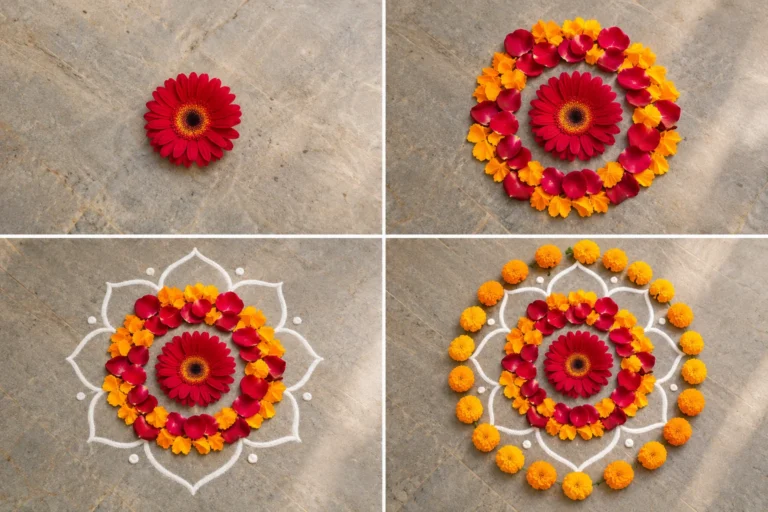
One mistake is worth avoiding. Turmeric can stain light, porous floors such as unsealed stone, so test a small corner first or lay the pattern over a thin layer of rice flour.
Place Diyas Where They Add Warmth, Not Risk
Diyas do their best work at the edges of the scene. Set one at each outer point of the rangoli, a pair on the doorstep, and a row along a windowsill or the edge of a staircase. Spacing them unevenly, in small clusters rather than a ruler-straight line, looks more natural. A wide brass bowl of floating petals with a few diyas in it makes a second, table-height rangoli beside the door.
Handmade clay diyas are among the simplest navratri decor ideas to get right. Choose them over plastic ones, which has become a small and popular sustainability swap. Many households soak clay diyas in water for a few hours before first use so the clay absorbs less oil, though this is a household habit rather than a rule. Wipe out the old wick and soot between nights.
Nine consecutive nights is where open flames get risky, because you are tired and guests are in and out. Keep real flames for the hours when someone is at home and awake, and use LED tea lights in any spot that has to stay lit unattended. Place the LED lights nearest the toran, because dry leaves, garlands and loose fabric are the likeliest things to catch. If your diyas also belong in a puja corner, our prayer corner Vastu guide explains how to keep flame away from curtains and enclosed shelving.
Small-Space Navratri Decor Ideas for Flats and Rentals
Flat doors open onto shared corridors, which changes three decisions. There may be no floor space for a full circle, no permission to drive a nail into the frame, and a building rule about flames outside your door.
Shrink the rangoli instead of skipping it. A compact design on a large plate or wooden tray, placed just inside the threshold, gives you the same ring-by-ring pattern in half a metre of floor and can be lifted and carried away each morning. For the toran, adhesive hooks or a slim tension rod just inside the doorway avoid marks on a rented frame, and a short marigold strand on each side still frames the opening. A flat with a neighbour’s door a couple of metres away calls for a calmer scale anyway: one strand, one tray and one lantern are enough.
Check the rules of your residents’ association or building management before any flame goes into a shared corridor. Where flames are not allowed, LED tea lights in a brass bowl or lantern give the same warm glow. Once the doorway is done, the changes inside the home are covered in our 5 smart Navratri home decor ideas, which looks at cushions, lighting and a reusable fabric toran.
Navratri Decor Ideas That Stay Fresh for Nine Nights
Treat the nine nights as three short jobs rather than one big one. Hang the toran fresh on the eve of the first night, replace its flowers around night three or four, and replace them again around night six or seven. That is three hangings in total, not nine.
The rangoli needs a lighter touch more often. If remaking it every morning feels like too much, sweep away the scuffed edge and refill only the petal ring on alternate days, leaving the white outline and centre in place. To echo each day’s colour, change only the accent petals.
Diyas and flowers each need a small nightly check. Refill the oil and trim the wicks before dusk, and lightly mist the toran with water in the evening, keeping it out of harsh afternoon sun. Keep a spare marigold strand in a cool, shaded corner so a tired section can be swapped in a minute, which stops one wilted patch from spoiling the whole doorway.
If a busy evening means you can only manage one refresh, choose the toran. A scuffed rangoli can be tidied in two minutes, but a wilted toran hangs at eye level and is the first thing every visitor sees.
Think of these navratri decor ideas as three layers on three clocks: a toran that lasts two to three days, a rangoli you refresh at the petal ring, and diyas that burn only while someone is watching. Gather the flowers the evening before the first night, hang the toran first, and let the rangoli and lights build around it.
Related Blogs
- Vastu Main Door Threshold Tips for Wealth
- Vastu Mirror Placement Tips for Foyer Energy
- Navratri 9 Colours 2026: A Smart, Stylish Guide to Outfit Planning for All 9 Days
Frequently Asked Questions
What are the easiest navratri decor ideas on a small budget?
Start with three things: a marigold and mango leaf toran, a rangoli made from rice flour and petals, and a row of clay diyas. All three use inexpensive, seasonal materials, are quick to set up, and can be refreshed cheaply on later nights.
Which flowers hold up longest on a toran?
Marigolds are generally sturdier than delicate blooms such as jasmine, so they usually form the main garland, with softer white flowers added as short accents. In warm weather, expect to refresh any fresh toran every two to three days regardless of the flower.
What should I do with the flowers and diyas after Navratri?
Compost petals and flowers that are free of synthetic colour, and sweep rice flour rangoli into the garden or bin instead of washing it into drains. Clean and dry your clay diyas and store them, since they can be used again for Dussehra and Diwali.
Can children help with the decorations?
Yes. Children can sort petals by colour, fill in a rangoli outline with flowers, and thread marigold heads onto string. Keep flames, oil and matches for adults, and use LED tea lights for any spot children can reach.
How early should I put the decorations up before Navratri begins?
Hang the toran and lay the rangoli on the eve of the first night or that morning, so the flowers are at their freshest for the opening evening. Diyas and LED lights can be positioned a day earlier, which makes checking safe spacing easier.