
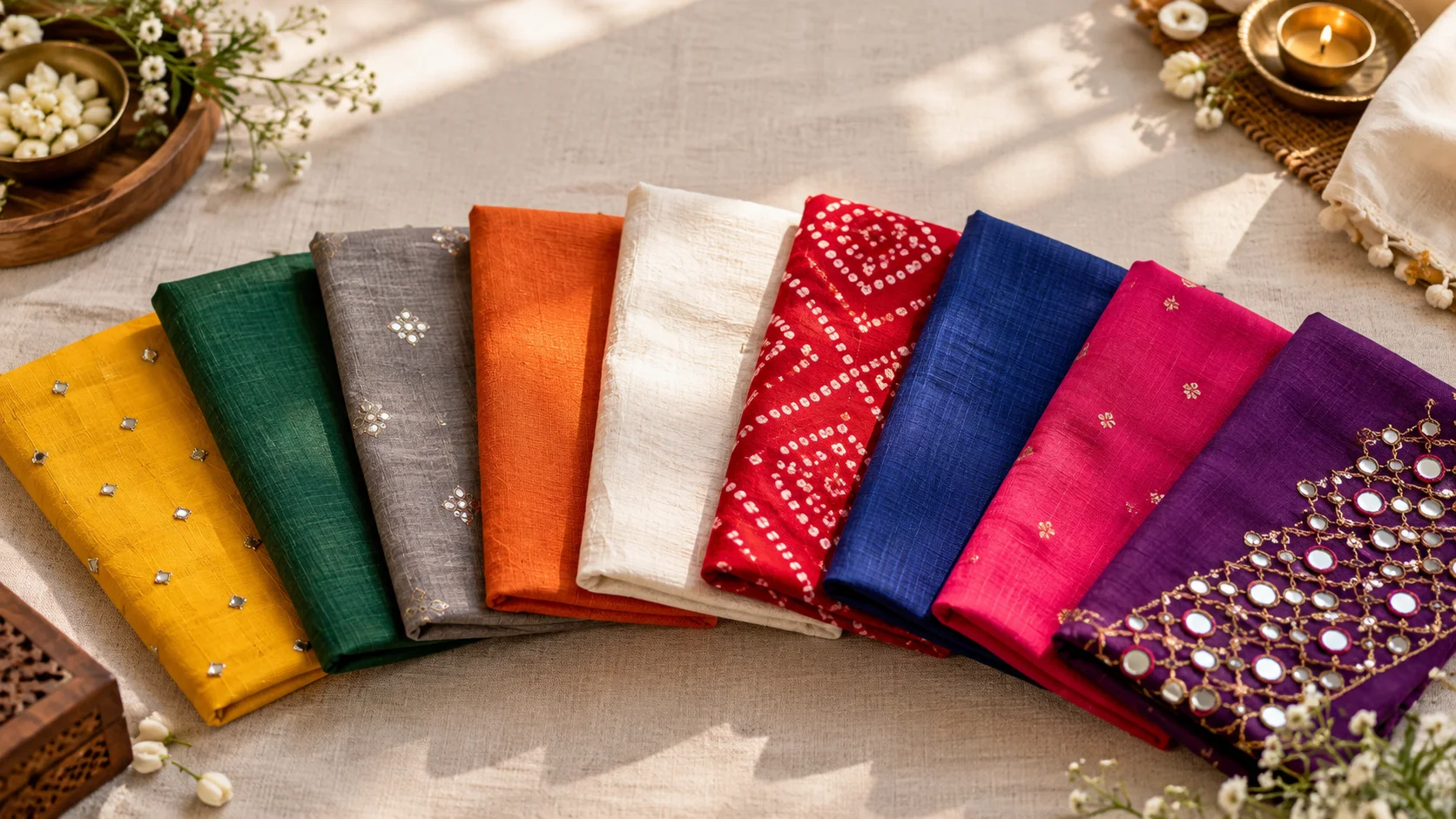
Planning your outfits around Navratri 9 colours 2026 is one of the simplest ways to feel ready for the festival without a last-minute shopping scramble. The simplest way to plan a Navratri wardrobe is to match what you already own to each day’s colour family, rather than rushing out to buy nine new outfits. Every day of the festival carries its own colour, tied to a different form of Goddess Durga, and dressing in that shade is considered auspicious. Exact sequences vary a little depending on the source you check, so it’s worth confirming the current-year chart closer to the date — but the underlying idea, and the styling opportunity, stays the same.
This year’s Navratri runs across late September to October, with the nine nights typically falling somewhere around 11–20 October 2026 depending on the regional calendar you follow, so there’s still time to plan properly rather than shopping in a panic the week before.
In This Guide
What the Navratri 9 Colours Actually Represent
Navratri means “nine nights,” and each one is dedicated to a different form of Maa Durga — Shailputri, Brahmacharini, Chandraghanta and so on through to Siddhidatri on the final night. The colour assigned to each day is meant to reflect the mood or energy of that particular goddess: fierce reds for strength, soft whites for purity, deep blues for calm.
Wearing the day’s colour isn’t a strict rule anywhere outside temple or puja settings, but it’s a tradition that’s carried through generations, and it gives the whole nine days a natural rhythm — a reason to reach for a specific corner of your wardrobe each morning instead of starting from scratch every day. If you’d like the fuller religious and cultural background beyond the styling angle, Britannica’s overview of Navratri is a solid place to start.
The Navratri 9 Colours Chart Problem (And How to Work Around It)
Here’s the honest bit: if you look up “Navratri 2026 colours” on a few different sites, you’ll find charts that don’t fully agree with each other. Some list yellow as day one, others start with orange or white. The order shifts depending on the calendar tradition, the region and sometimes the publication itself.
Rather than committing hard to one chart months in advance, the more practical approach is this: sort your existing wardrobe into colour families now — yellow, green, grey, orange, white, red, royal blue, pink and purple are the shades that show up most consistently — and confirm the exact day-by-day order against a current calendar in the first week of October, once the dates are locked in for certain. That way, your planning work is already done, and you’re only checking a sequence, not scrambling for outfits.
What’s Trending in 2026: Mirror Work, Bandhani and Fusion Silhouettes
On the styling side, this year’s chaniya choli edits are leaning hard into mirror-work embellishment and bandhani prints, paired with fitted corset-style blouses and a wide, flared skirt. It’s a silhouette that photographs beautifully under garba lighting and gives you movement on the dance floor, which is half the point of a good Navratri outfit.
For anyone who wants something a little less traditional, fusion options are having a strong year too. Sharara sets — that fitted-top-and-flared-trouser combination — and jacket-style cholis, where a structured open jacket sits over a fitted blouse and skirt, are both showing up across festive edits as contemporary alternatives to the classic chaniya choli.
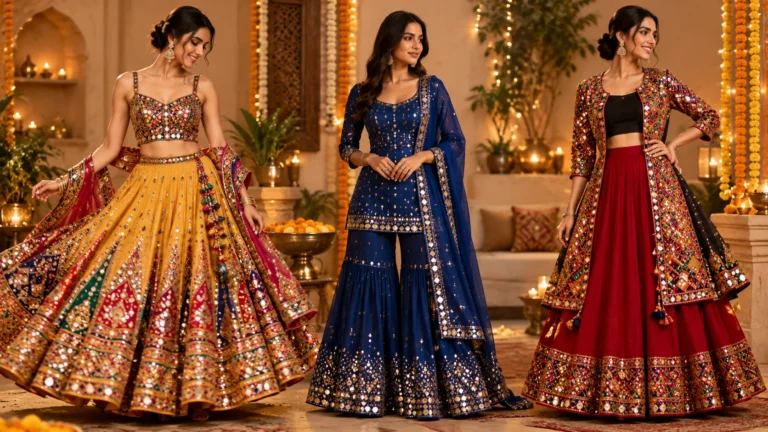
If you’re drawn to a specific colour for one of the nine nights, it’s worth looking for it in one of these trending silhouettes rather than a generic fit — an orange kurta sharara set works nicely for a day, for instance, while a yellow festive ethnic set covers another without needing two separate shopping trips.
Comfort matters more than most people plan for, too. Garba and dandiya nights involve hours of movement, so a wide flared skirt genuinely earns its place beyond looking good in photographs — it moves with you rather than restricting your steps. If a corset-style blouse is new territory, try it on and actually raise your arms and twist before deciding on a size; a snug fit that looks sharp standing still can feel very different two hours into dancing.
Styling Tips to Make Each Colour Work for You
Picking the right shade is only half the job — how you wear it matters just as much. A few starting points that tend to hold up across most of the nine colours:
- Balance a bold colour with simpler jewellery. A saturated red or royal blue outfit already does most of the visual work, so statement earrings or a single stack of bangles usually reads better than layering on multiple heavy pieces.
- Use a contrasting dupatta to lift a plain base. If your existing outfit in a given colour feels a little flat, a dupatta in a complementary shade — gold with yellow, silver with grey — adds festive polish without any new stitching.
- Lean into mirror work for evening wear. Mirror embellishment catches the light beautifully once the sun goes down, which is exactly when most garba and Navratri gatherings happen.
- Keep footwear practical. A low block heel or flat embellished juttis will get you through hours of dancing far more comfortably than anything you can’t walk fast in.
None of this needs to be expensive. A single well-placed accessory swap or a borrowed dupatta can do more for a day’s colour story than an entirely new outfit — which is really the whole point of planning ahead rather than shopping under pressure.
Build Your Nine-Day Plan From What You Already Own
Before you buy anything new, lay out what’s already in your cupboard sorted by colour family. Most people are surprised by how much ground they can cover — a mustard kurta from last summer covers yellow, a forest-green dupatta works for green night, and so on.
A few practical starting points:
- Treat “the day’s colour” as a family, not one exact shade. A blush pink dupatta counts for pink night just as well as a hot pink one.
- Accessories count too. A green bangle set or a red bindi can shift an outfit’s colour story without a full new outfit.
- Layering with a jacket-style choli or a contrasting dupatta lets one base outfit stretch across two colour days.
- Keep a running list of which colours you’re genuinely short on — that’s your actual shopping list, not “nine new outfits.”
Realistically, most wardrobes can cover five or six of the nine colours without any new purchases at all, which is worth knowing before you open a shopping app.
It helps to do this sorting properly rather than eyeballing it from memory. Pull everything — kurtas, sarees, co-ord sets, even scarves and dupattas — out onto the bed in one go, group by colour family, and take a quick photo of each pile on your phone. That photo becomes a reference you can check against a colour chart later without having to dig through your cupboard twice.
Think about which nights you’re actually dressing for, too. A quiet family puja evening calls for something comfortable and modest, while a garba or dandiya night rewards movement and shine. There’s no need for every one of the nine days to be an equally elaborate outfit — save your strongest pieces for the two or three nights you know will be the biggest.
Where to Spend on Something New
Once you know your genuine gaps, focus new buys on one or two of the silhouettes covered above rather than trying to fill every colour with a brand-new outfit. A single well-chosen mirror-work chaniya choli or sharara set, in a colour you’re actually missing, does more for your festive wardrobe than three rushed, generic buys.
If you want a broader grounding in how colours work together before you shop, our practical guide to colour theory for women’s fashion is a useful starting point — it covers how to pair unexpected shades without the outfit looking mismatched, which is handy when you’re mixing existing pieces with new ones.
It’s also worth browsing our Women’s Fashion Guides & Trends section for more seasonal styling ideas beyond Navratri, since a lot of the same colour-planning logic carries over into other festive occasions later in the year.
Related Blogs
- Colour Theory Made Practical for Women’s Fashion
- Off-White Sharara Suit Styling Made Effortlessly Elegant
- Elegant Festive Kurta Set Styling With Essential Impact
Frequently Asked Questions
What are the Navratri 9 colours for 2026?
Charts vary by source, but the nine shades that recur most consistently are yellow, green, grey, orange, white, red, royal blue, pink and purple. Confirm the exact day-by-day order against a current calendar closer to the festival.
Do I have to wear the exact colour each day?
No — it’s a tradition rather than a strict rule outside religious settings. Treating each colour as a family of shades, rather than one precise tone, makes planning far easier.
How many new outfits do I actually need for Navratri?
Most wardrobes can already cover five or six of the nine colours. Focus new buys on one or two trending silhouettes for the colours you’re genuinely missing, rather than nine separate outfits.
What styles are trending for Navratri 2026?
Mirror-work and bandhani chaniya cholis with corset-style blouses are leading, alongside fusion pieces like sharara sets and jacket-style cholis for a more contemporary look.
When does Navratri 2026 fall?
The nine nights fall broadly across mid-to-late October 2026, though exact start and end dates vary slightly by regional calendar — check a current source in early October to confirm.