
The week before Navratri always arrives faster than anyone plans for. Between cleaning, cooking, guest lists and last-minute shopping, redecorating the house quietly slides to the bottom of the list — and then the first night arrives and the living room looks exactly as it did in August.
The fix is smaller than most people expect. A festive-looking home rarely comes from buying more; it comes from changing a few things you already have. The most useful navratri home decor ideas are swaps rather than additions — five changes across colour, focus, materials, light and entrance that shift the mood of a room in a single afternoon, while your furniture stays exactly where it is.
Table of Contents
Why Swaps Beat a Full Festive Makeover
Indian interiors have been moving in a helpful direction for a while now. The prevailing mood leans earthy and uncluttered — sand, clay, oatmeal, warm wood — with personality added through a few chosen objects rather than wall-to-wall pattern.
That matters during festive season, because a calm base is the easiest thing in the world to decorate on top of. Magenta, deep green and marigold all read as richer against beige than they do against an already-busy room.
Swaps also solve the problem nobody mentions: what happens afterwards. Nine nights of celebration (Navratri runs across nine nights, usually falling in September or October — in 2026 it lands in the middle of October) are followed by Dussehra and then Diwali. Decor you can take down, fold up and bring back out in three weeks is worth far more than decor you throw away.
So the guiding rule for everything below is simple. Change the layer, not the room. If you want more ideas along these lines once the festival is over, the Home Styling Guides & Tips section covers the same approach for everyday spaces.
Swap 1 — Neutral Base, Festive Colour on Top
Leave the walls and the sofa alone. Seriously — repainting a room for a nine-day festival is the single most common overcorrection, and it rarely looks as good as the plan sounded.
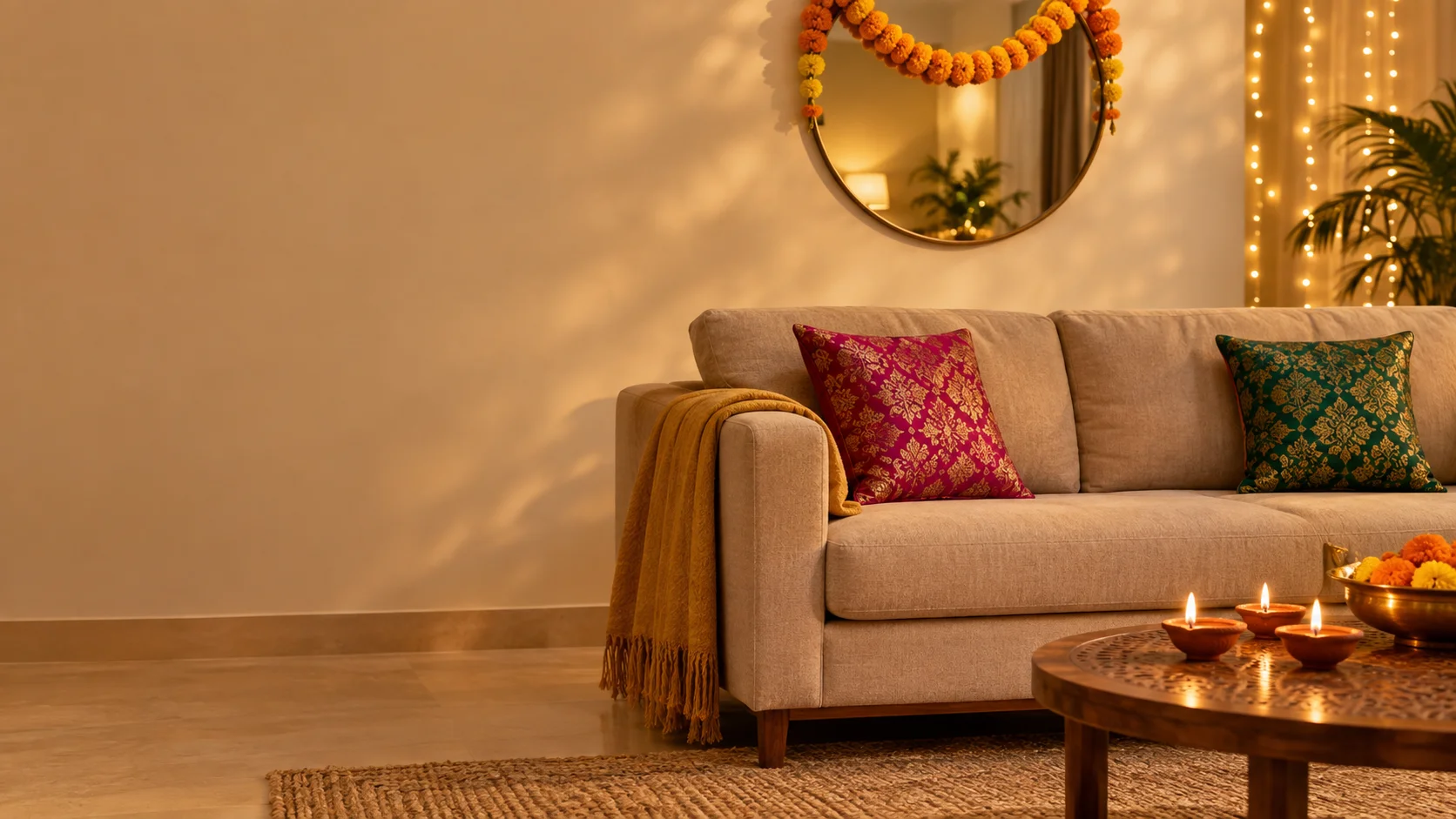
Instead, treat your existing neutrals as a stage. Sand beige, clay brown and off-white are flattering backdrops for exactly the colours Navratri calls for, so the festive work happens in the soft furnishings.
Three things usually do it:
- Cushion covers. Two or three in jewel tones — magenta, emerald, deep mustard, or a gold-threaded brocade — swapped onto the cushions you already own.
- One throw. Draped over the arm of the sofa or the foot of the bed. Choose a shade that sits opposite your cushion colour rather than matching it exactly.
- A table runner or dhurrie. A narrow strip of pattern on a plain dining table changes a room more than most people believe.
Keep a rough ratio in mind: about three-quarters neutral, one quarter festive colour. When the colour is a guest rather than the host, everything looks deliberate.
If you want one more low-effort layer, a fresh marigold garland draped along a shelf edge or over a mirror frame supplies the orange note without committing anything permanent.
Swap 2 — One Statement Piece Instead of Ten Small Ones
The instinct during festive season is to scatter — a small idol here, a tea light there, four little brass pieces along the console. The result is usually visual noise rather than atmosphere, and it takes an hour to dust.
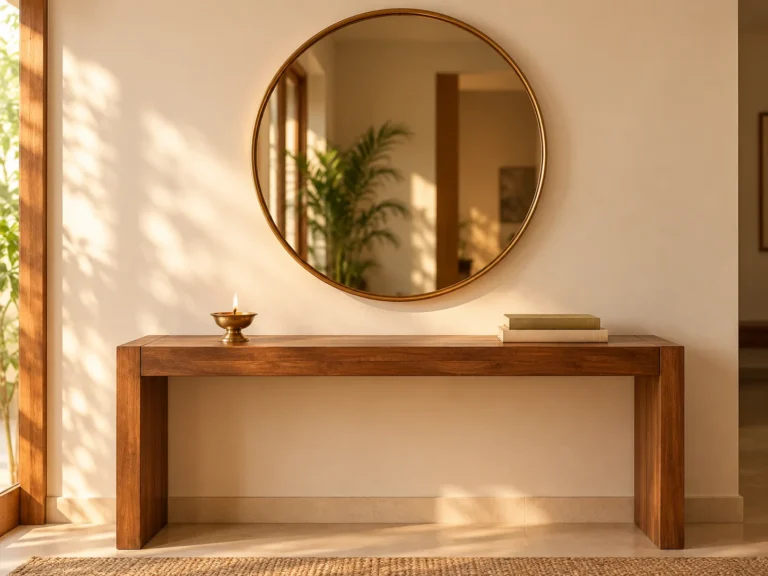
One large piece does the work of ten small ones. A single oversized wall painting, a bold canvas, or a generous mirror gives the eye somewhere to land, and the rest of the room can then stay quiet.
A few practical notes on getting the scale right:
- Aim for a piece roughly two-thirds the width of the furniture beneath it. Under-scaled art is the most common mistake in Indian living rooms.
- Hang the centre of the piece at eye level — about 145 to 150 cm from the floor works for most homes.
- A mirror placed to catch daylight from a window pushes light back into the room, which is genuinely useful in flats with one bright side.
- Clear the surface below it. A statement piece needs breathing room to read as one.
If you own a large mirror already, this swap costs nothing at all. Move it, clean the frame, drape a garland along the top edge, and it becomes the festive centre of the room.
Swap 3 — Reusable Fabric Torans Over Single-Use Paper
Paper and foil decorations are cheap for a reason: they last one season, tear on the way down, and go straight into the bin. Fabric behaves differently.
A brocade or cotton toran, a cloth lantern, a beaded door hanging — these fold flat, store in a single labelled box, and come out again for Dussehra, Diwali and next year’s Navratri. Across three or four uses, the better piece is usually the cheaper one.
This is one of the few navratri home decor ideas that actually saves money over time rather than costing it. Fabric also photographs and ages better. It catches lamplight instead of reflecting it harshly, and it does not curl in humidity the way paper does.
This is not an argument against fresh flowers. A marigold and mango leaf toran at the main door is one of the oldest and loveliest parts of the festival, and it takes minutes to string. The sensible split is fresh at the entrance, where it is seen and appreciated daily, and reusable fabric everywhere else.
One small habit makes this work long term: when you take everything down, store it labelled by location — door, living room, puja corner — rather than in one jumbled bag. Next year’s setup takes twenty minutes instead of an evening.
Swap 4 — Warm Ambient Lighting After Sunset
Most Indian homes have one bright ceiling light per room, and during festive evenings that single source flattens everything. Turning it off is the fastest decor change available to you.
Replace it with three smaller sources at different heights. A string of fairy lights along a curtain rail or balcony railing. A table lamp or floor lamp at seated height. And brass diyas or terracotta candles at surface level, which put warm light exactly where people gather.
Warm bulbs matter more than the fittings. Anything described as warm white, around 2700K, gives the golden tone that suits jewel colours and marigold; cool daylight bulbs make the same room look clinical.
A few safety points worth following, since fabric decor and open flames are now in the same room:
- Keep diyas and candles well clear of torans, curtains and dupattas.
- Set them on stable, heat-tolerant surfaces — stone, metal or ceramic rather than a wooden shelf edge.
- Never leave a flame burning unattended, and keep them out of reach of children and pets.
- Battery-operated diyas are a reasonable substitute in high-traffic corners and balconies.
Swap 5 — One Considered Entryway Moment
Of all the navratri home decor ideas here, this is the one guests notice first. Your entrance sets expectations for everything behind it, and it is the one area guests always look at properly. It is also, in most homes, where footwear, umbrellas and delivery boxes accumulate. 📖
Start by clearing it completely. Shoes into a rack or cupboard, one clean mat, floor visible. That alone reads as festive readiness.
Then add exactly three things — no more. A toran above the door frame. A small rangoli on the threshold, in turmeric, rice flour and petals if you would rather not use synthetic colours. And a single lit diya beside it in the evening.
If you have a mirror near the entrance, place it on a side wall rather than directly facing the door, and let it bounce the diya light down the hallway. Small foyers gain a surprising amount of depth this way.
Leave walking space. A beautifully decorated entrance that people have to edge past defeats itself on the first evening of guests.
How to Use These Navratri Home Decor Ideas in a Weekend
None of this needs a project plan, but a rough order helps.
Friday evening: declutter the entryway and one main surface. Order or pick up cushion covers, a toran and warm white bulbs if you need them.
Saturday: handle the big visual moves — hang or reposition the statement piece, swap cushion covers, add the throw and the runner.
Sunday: set up lighting layers, place diyas and candles safely, and finish the entrance with the toran and rangoli.
What to skip entirely: repainting, buying new furniture, and any decoration you know you will not want to store. The point of working with swaps is that your home returns to normal painlessly, and comes back to life just as easily for Diwali.
Done well, these navratri home decor ideas leave you with a house that looks considered rather than simply covered — and with an afternoon free before the first night of garba.
Navratri Home Decor Ideas — Your Questions Answered
Which navratri home decor ideas work best in a small flat? Focus on light and one focal point. A single large mirror positioned to catch daylight, warm ambient lighting instead of one ceiling bulb, and two jewel-toned cushion covers will do more in a small flat than multiple small decorations, which quickly make compact rooms feel crowded.
What colours suit a neutral home during Navratri? Jewel tones read best against sand, beige and off-white — magenta, emerald, deep mustard and royal blue. Add gold as an accent through brocade or metal rather than as a main colour, and let marigold orange come in through fresh flowers.
Are fabric torans really better than paper ones? For anything you plan to reuse, yes. Fabric torans fold flat, store easily and survive several seasons, so the cost per use drops sharply. Paper and foil still have a place for one-off details, but they rarely last beyond a single festival.
How many decorations does one room actually need? Far fewer than most people use. One statement piece, one layer of festive textile, one lighting change and one fresh element is usually enough for a living room. Adding more tends to reduce the effect rather than increase it.
Can I set up festive decor with a very small budget? Yes. Rearranging an existing mirror, swapping cushion covers, changing to warm white bulbs and stringing a fresh marigold toran costs very little. Most of the visual impact comes from clearing, repositioning and lighting rather than from buying anything new.