
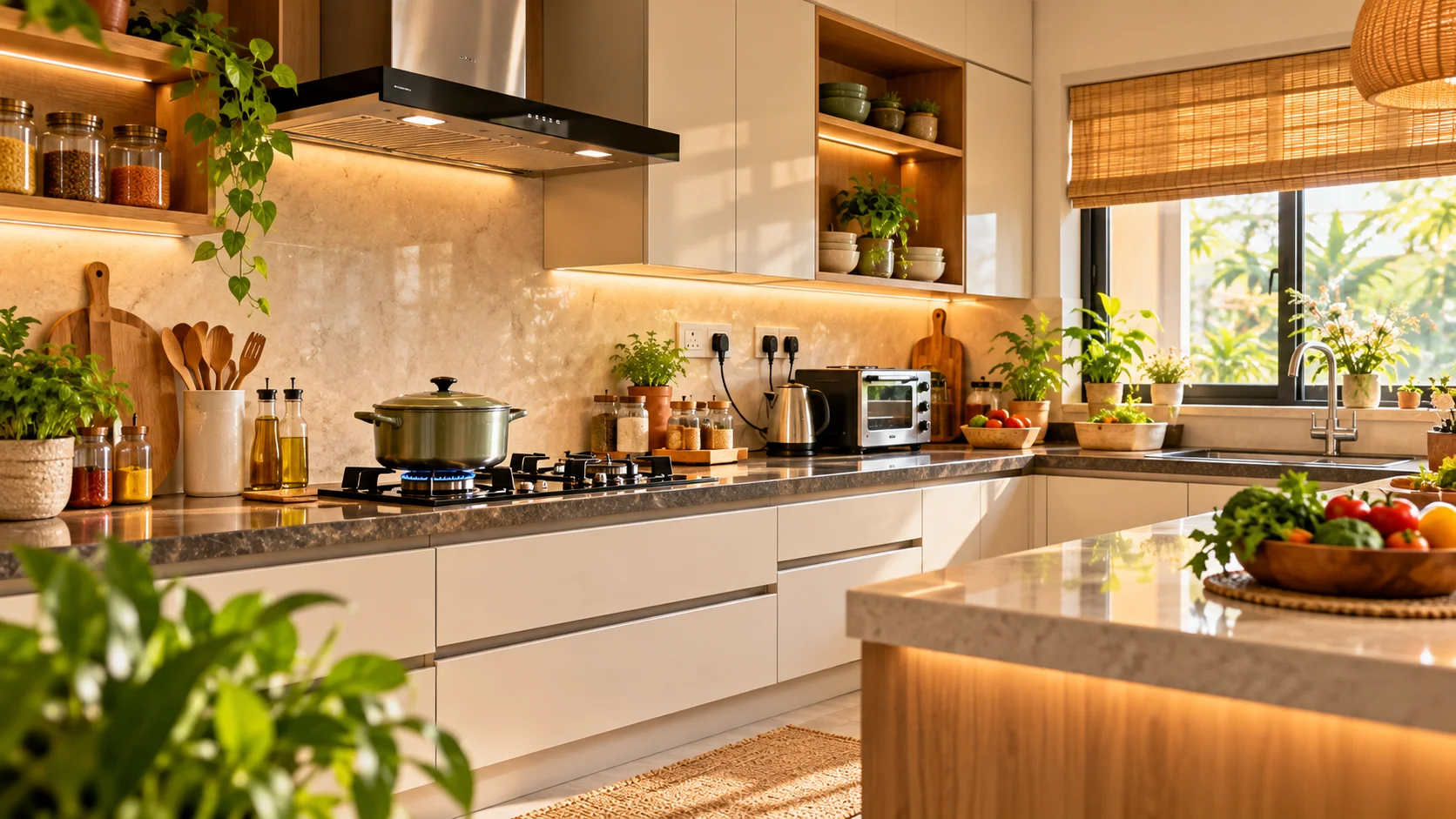
This article may contain affiliate links. We may earn a commission at no extra cost to you.
A kitchen can reflect traditional Vastu ideas and still be a modern, practical cooking space—but the two should not be treated as equal rules. When a Vastu preference conflicts with safe gas installation, electrical work, ventilation, clear access or manufacturer instructions, the safety requirement takes priority.
The useful approach is to treat kitchen Vastu as an optional cultural design framework. Traditional texts discuss house form, orientation and spatial divisions, while modern kitchens also have fixed services, appliances and safety requirements. Traditional preferences should fit around a safe, functional layout.
Table of Contents
What Kitchen Vastu Can and Cannot Decide
Vastu traditions contain detailed ideas about house planning, orientation and spatial divisions. The Brihat Samhita includes a dedicated chapter on house-building, describing prescribed house forms, divisions and directional relationships. Such material helps explain the tradition, but it is not modern engineering or safety guidance.
For an existing kitchen, that distinction matters. If a traditional recommendation suggests moving a cooking area, sink, socket, gas connection or fixed cabinet, do not make the change simply to satisfy a directional rule. Plumbing, electrical systems, gas appliances, ventilation and structural elements have practical requirements that should be assessed first.
Vastu Weight Principles for Kitchen Layout Balance can provide additional context on how traditional layout ideas are applied to storage and room organisation.
Separate decisions into two layers: safety and function first, traditional preference second. If a Vastu idea fits the existing room without creating a problem, you can adopt it. If it conflicts with a technical requirement, keep the safe arrangement.
Fire and Gas Safety Comes Before Direction
The cooking zone makes the priority especially clear. A gas hob or other heat source needs appropriate installation, ventilation, clearance and safe operation. Exact requirements vary by appliance and location, so manufacturer instructions, applicable local requirements and qualified professional guidance should take precedence over a Vastu recommendation.
Avoid changes that make the cooking area harder or riskier to use. Do not place storage, decorative objects or plants where they obstruct controls, ventilation or safe movement around the hob. Keep combustible materials away from heat sources, and ensure gas appliances and connections are installed and maintained appropriately.
Traditional Vastu can still influence the room after these requirements are satisfied. If a preferred direction happens to suit the existing cooking zone, work with it. If it does not, there is no need to compromise a safe installation for directional alignment.
Kitchen Vastu and Electrical Safety
Modern kitchens combine sockets, lighting, refrigerators, small appliances and other electrical equipment. Their placement needs to work with the actual installation, moisture exposure, appliance requirements and applicable regulations.
That makes electrical safety a firm boundary for Vastu-inspired planning. Do not move a socket, cable, switch or fixed appliance connection solely because a traditional principle suggests another position. Electrical changes should be handled by an appropriately qualified professional, particularly where fixed wiring is involved.
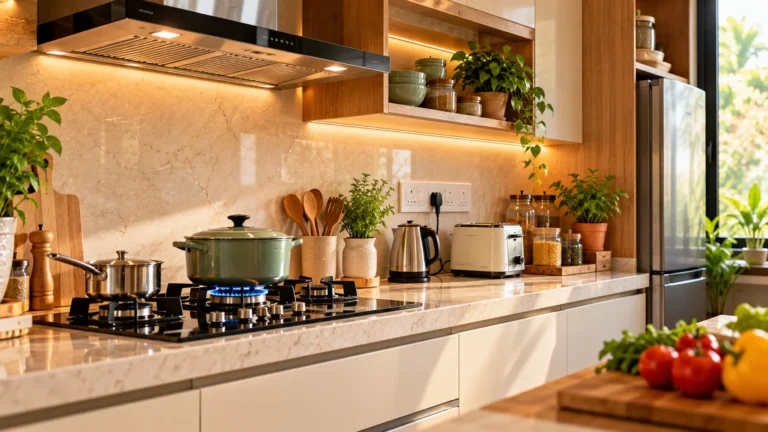
You can still improve the room without touching the electrical system. Keep cables orderly, avoid unsuitable overloading, maintain clear access to switches and controls, and position everyday appliances so they can be used without awkward movement or clutter. If a major electrical change is required, treat the electrical plan as the starting point and consider Vastu preferences around the finished safe arrangement.
North East Vastu Remedies for Electronic Tech Clutter offers a related approach to organising modern technology.
How to Combine Kitchen Vastu With a Real Layout
The easiest combination is to make low-risk, reversible adjustments. Start with decluttering and storage zoning: keep frequently used tools close to preparation and cooking areas, with bulkier items stored securely.
Traditional Vastu guidance can then be used as an optional layer. When planning a new kitchen, discuss directional preferences with the architect or kitchen designer, but keep gas, electrical, plumbing, ventilation, accessibility and appliance requirements in the professional brief. In an existing kitchen, favour changes that do not require moving fixed services.
Décor and organisation can also help without promising luck, health or wealth. Practical storage, suitable lighting and clear worktops can make the room feel more considered while leaving the technical installation alone.
Vastu-Inspired Kitchen Organisation Made Effortlessly Practical is a useful next read for non-structural organisation and storage ideas.
When Kitchen Vastu Conflicts With a Fixed Layout
If a preferred Vastu arrangement cannot be achieved without moving gas lines, electrical connections, plumbing or structural elements, do not treat renovation as the automatic answer. First ask whether the proposed change solves a genuine functional problem and obtain the appropriate professional assessment.
For a simple refresh, the decision is much easier: organise storage, improve useful lighting, keep walkways unobstructed and choose décor that suits the existing room. Vastu can remain a cultural layer rather than a set of rules controlling every technical decision.
Conclusion
The most practical priority order is safety and applicable professional requirements first, appliance instructions second, and traditional Vastu preferences after that. Used in this way, Vastu can inform optional choices about organisation and atmosphere without overriding the requirements that keep a kitchen safe and usable.
Related Blogs
Kitchen Vastu Balance for Family Harmony and Peace
Simple Dining Layout Fixes for Harmonious Living
North East Vastu Remedies for Electronic Tech Clutter
Further Reading
For historical context, see the English translation of the Brihat Samhita’s house-building chapter.
For an academic treatment of Vastu Vidya and its contemporary uses, see Indian Architectural Theory and Practice: Contemporary Uses of Vastu Vidya from Routledge.
Frequently Asked Questions
What is Kitchen Vastu?
Kitchen Vastu refers to traditional Vastu-based ideas about kitchen placement, direction and spatial organisation. These ideas are cultural and traditional rather than scientifically established safety requirements, so they should be considered alongside—not instead of—practical kitchen design and professional safety guidance.
Should Vastu or gas safety take priority in a kitchen?
Gas safety should take priority. Gas appliances require appropriate installation, ventilation, operation and maintenance. If a traditional Vastu preference conflicts with those requirements, follow applicable safety guidance, manufacturer instructions and local professional advice.
Can I follow Vastu without moving my kitchen?
Yes. Treat Vastu as an optional layer and focus on non-structural choices such as decluttering, storage organisation, colour and décor. There is no need to move gas, electrical or plumbing services simply to satisfy a traditional directional preference.
Should electrical sockets be moved to follow Vastu?
Not solely for Vastu reasons. Socket and fixed electrical work should be planned around the kitchen’s electrical requirements, moisture exposure, appliance use and applicable regulations. Use a qualified professional for electrical changes, then consider traditional preferences around the safe finished layout.
What should I do if my existing kitchen conflicts with Vastu advice?
Keep the existing safe installation and work with what can be changed without creating risk. Improve organisation, access, lighting and visual order first. If a structural or service change is being considered, obtain appropriate professional advice before making the change.