
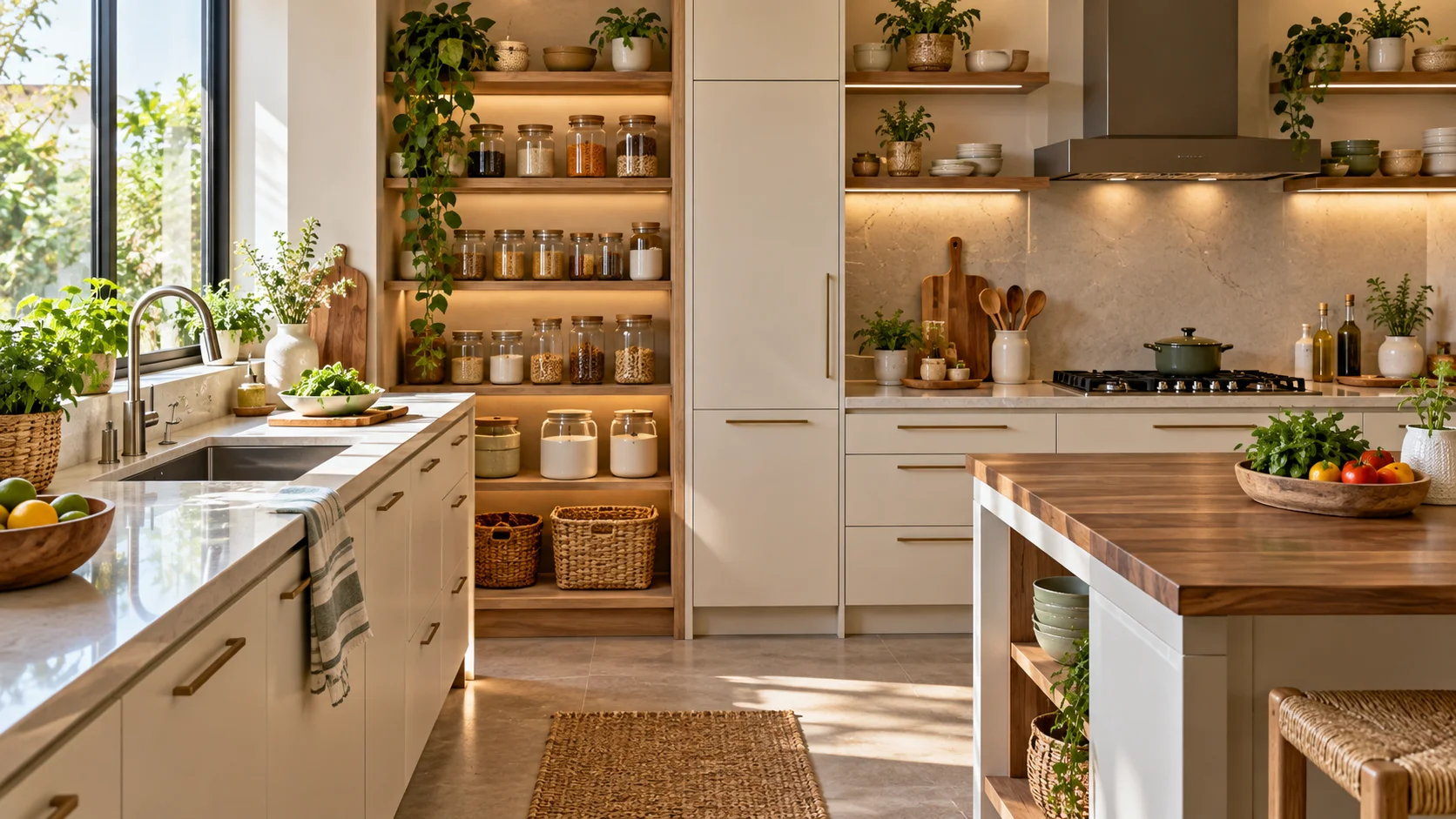
A well-organised kitchen does more than look tidy. When everyday items have logical homes, worktops stay clearer, cooking becomes easier and the room can feel calmer. Vastu-inspired kitchen organisation adds another layer to this idea by considering traditional directional principles alongside practical storage and decluttering.
Traditional Vastu guidance commonly associates the south-east with the kitchen and the fire element, with the north-west often considered an alternative. These are traditional design principles rather than scientifically established rules, so the most useful approach in an existing home is to treat them as optional guidance while prioritising safety, ventilation, hygiene and an efficient layout. 📖
The good news is that you do not need to rebuild your kitchen to explore these ideas. Start with what you can realistically change: clutter, storage zones, worktop organisation and the relationship between the things you use every day.
Table of Contents
Why Vastu-Inspired Kitchen Organisation Starts With Function
A beautiful kitchen can still feel frustrating when the things you reach for every day are scattered across several cupboards.
Before thinking about directions, colours or decorative details, consider movement. Where do you prepare ingredients? Where are pans taken from? Which cupboard holds everyday plates? How far do you travel between the fridge, sink, preparation surface and cooking area?
A useful organisation system reduces unnecessary movement and keeps frequently used essentials accessible.
This practical approach also prevents a common problem with traditional home guidance: changing a perfectly functional kitchen simply to satisfy a directional preference.
Traditional Vastu references commonly connect the kitchen with the south-east or Agni zone. D’Source, an educational resource from IDC at IIT Bombay, documents the south-east as the traditional preferred kitchen location and the north-west as an alternative.
For more background on these traditional Indian kitchen practices, see D’Source’s kitchen resource.
Create Clear Zones Before Rearranging Anything
Instead of treating every cupboard independently, organise the kitchen around activities.
Cooking zone
Keep frequently used pans, cooking utensils and appropriate ingredients reasonably close to the cooking area, provided their placement is safe.
The objective is simple: you should not need to cross the kitchen repeatedly to complete one basic cooking task.
Preparation zone
Protect some clear worktop space for chopping, mixing and assembling food. A worktop covered with rarely used appliances, decorative containers and miscellaneous objects leaves little room for the activity the surface was designed to support.
Try relocating occasional-use items to cupboards or another suitable storage area.
Washing zone
Keep washing and cleaning essentials organised near their point of use while separating household cleaning products appropriately from food and food-contact items.
Pantry zone
Group similar foods together rather than allowing packets and containers to spread through every available cupboard.
For example, keep everyday grains together, create a defined area for spices and another for snacks or breakfast foods. Transparent or clearly labelled containers can make it easier to see what you already have, helping to reduce forgotten duplicates.
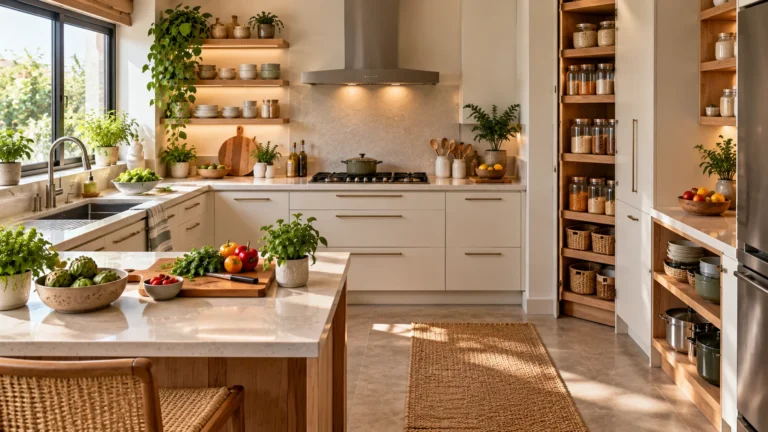
Use Traditional Directional Ideas Practically
If you want the organisation itself to reflect Vastu tradition, begin with the principles that can be adopted without disruptive structural work.
Give the cooking area visual priority
The south-east is traditionally associated with fire and cooking in commonly followed Vastu practice. 📖
If your existing stove is elsewhere, that does not mean you need to move gas, electrical or structural services simply for this article’s organisational approach. Those changes involve practical and safety considerations that are more important than decorative rearrangement.
Instead, concentrate on keeping the existing cooking area clean, accessible and free from unrelated clutter.
Consider heavier storage towards south or west
Some contemporary Vastu guidance places heavier kitchen storage and grain cabinets along southern or western areas. 📖
If your kitchen already provides suitable cupboards there, you can use the idea as an organisational framework. Heavy pots, large containers and bulk pantry items are often more practical in secure lower cupboards anyway.
Do not place a heavy object somewhere inconvenient or unsafe purely because of compass direction.
Keep lighter areas visually open
Traditional Vastu approaches often favour keeping the north-east relatively light and open rather than filling it with heavy storage. 📖
You can interpret this gently rather than literally. An uncluttered section of worktop, a visually lighter shelf or simply fewer bulky objects can create breathing space without requiring renovation.
The useful principle is restraint.
Declutter the Kitchen Without Making It Impractical
A decluttered kitchen does not have to look empty.
The aim is to remove friction rather than personality.
Begin with a straightforward question:
Does this item deserve the space it occupies?
Take one cupboard or drawer at a time and separate its contents into four practical groups:
- used frequently;
- used occasionally;
- duplicates;
- no longer useful or appropriate to keep.
Move everyday objects to the easiest positions. Occasional-use pieces can go into less accessible cupboards, while unnecessary duplicates can be reconsidered.
Pay particular attention to the worktop. It naturally becomes a landing area for post, bottles, shopping bags, spare containers and appliances that rarely move.
Removing even a few unrelated objects can make the whole kitchen look more intentional.
Do not confuse organisation with hiding everything, either. A frequently used utensil holder or everyday spice selection can earn its position if it genuinely makes cooking easier.
Build an Organisation System You Can Maintain
The best kitchen organisation is not the one that looks perfect immediately after a major clear-out. It is the one that still works several weeks later.
Try organising according to frequency.
Daily-use items: keep them within comfortable reach.
Weekly-use items: place them in standard cupboards or drawers.
Occasional items: move them to higher, deeper or less prominent storage where appropriate.
This simple hierarchy prevents prime storage space from being occupied by equipment used only a few times a year.
Containers can help, but avoid buying organisers before you understand the problem. Adding more baskets to an overcrowded cupboard sometimes organises the clutter rather than reducing it.
Measure the available space, identify what genuinely needs grouping and then add storage accessories only when they solve a specific problem.
A small monthly pantry review is useful too. Check what needs using soon, return misplaced items to their zones and remove packaging or objects that have accumulated unnecessarily.
Keep Tradition and Modern Living in Balance
Vastu-inspired kitchen organisation works best when tradition informs the space rather than controls every practical decision.
Many contemporary kitchens are already fixed by plumbing, electrical connections, ventilation, cabinetry and the overall apartment plan. Current Vastu-oriented design guidance itself acknowledges that existing structural limitations often require practical adaptation. 📖
That makes a non-structural approach especially useful.
You can:
- keep the cooking area orderly;
- reduce worktop clutter;
- organise storage according to frequency;
- use existing south or west storage for heavier items when convenient;
- create lighter, less crowded areas;
- improve everyday movement between preparation, cooking and washing zones.
None requires you to promise that moving a jar or cupboard will produce health, wealth or other outcomes.
Instead, the immediate benefit comes from something much more tangible: a kitchen that is easier to navigate, clean and maintain.
A simple weekend reset
If you want to try the approach without turning it into a major project, spend one session on three areas.
First, clear the main preparation surface.
Second, reorganise one pantry cupboard so that frequently used ingredients are immediately visible.
Third, move rarely used equipment away from prime everyday storage.
Then live with the arrangement for a week.
The test is not whether the kitchen looks perfectly styled. Ask whether cooking feels less cluttered and whether things are easier to find.
That is where thoughtful organisation earns its place.
A More Thoughtful Kitchen Starts With Less Friction
Vastu-inspired kitchen organisation does not have to mean remodelling a home around rigid rules. Traditional Vastu concepts can instead provide an optional framework for thinking about cooking, storage, openness and placement while modern practical considerations determine what actually works.
Start with decluttering. Give frequently used items sensible homes. Keep work areas functional, respect safety requirements and adopt directional ideas only where they comfortably fit your existing layout.
The result can feel both considered and contemporary — without turning a traditional design philosophy into promises it cannot substantiate.
FAQs
What is Vastu-inspired kitchen organisation?
Vastu-inspired kitchen organisation combines traditional Vastu placement ideas with practical decluttering, storage zoning and everyday kitchen functionality. Directional recommendations can be treated as traditional guidance rather than scientifically proven requirements.
Which direction is traditionally preferred for a kitchen?
The south-east is commonly preferred in Vastu tradition because it is associated with Agni, or fire. North-west is also cited as an alternative in some traditional and contemporary guidance.
Do I need to renovate an existing kitchen to follow Vastu?
Not necessarily. You can concentrate on non-structural changes such as decluttering, reorganising cupboards, clearing preparation surfaces and improving storage without moving plumbing, electrical connections or fixed cabinetry.
Where should heavy kitchen storage go according to Vastu?
Contemporary Vastu guidance commonly recommends southern or western areas for heavier storage and grain cabinets. Treat this as optional traditional guidance and prioritise safe, accessible storage.
Can a modern kitchen still use Vastu principles?
Yes. Traditional ideas can be selectively incorporated into a modern kitchen where they fit the existing layout. Safety, ventilation, hygiene, ergonomics and practical everyday use should remain the priority.