
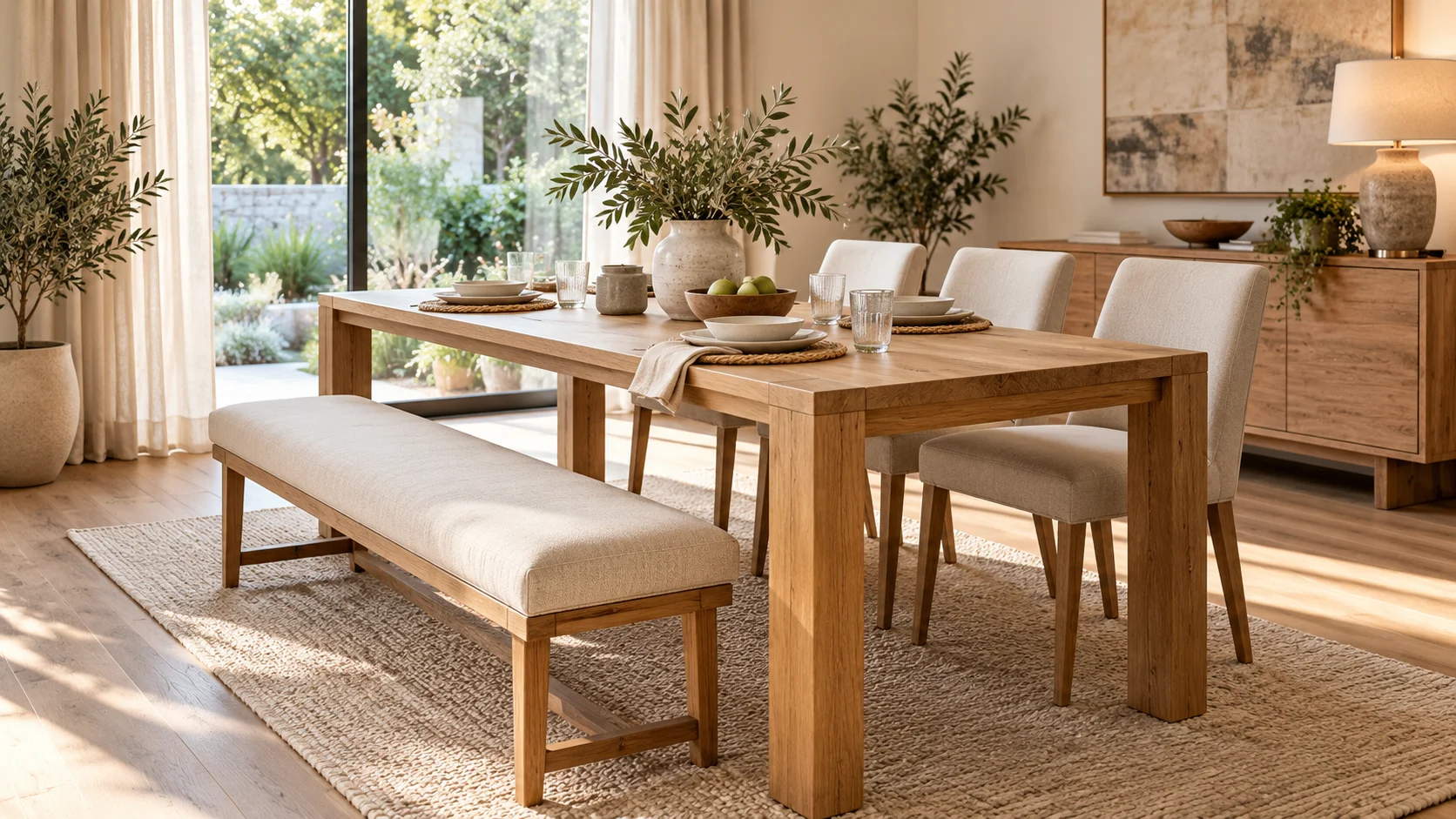
Choosing between a dining bench vs dining chairs is not simply a style decision. The seating you choose affects how easily people move around the table, how comfortable longer meals feel, how flexible the room is when guests arrive and how much visual space the dining area appears to occupy.
For everyday use, dining chairs usually make individual movement and back support easier, while a bench can create flexible shared seating and a cleaner visual line. Neither is automatically the right choice. Your room layout, table design, household routines and the amount of time people spend sitting should guide the decision. 📖
Table of Contents
Dining Bench vs Dining Chairs for Everyday Living
A beautiful dining room still needs to work at breakfast on a busy weekday, during a long weekend meal and when an extra guest arrives.
That is why it helps to think beyond the photograph of the finished room.
A bench creates one continuous seating surface. Depending on its design and relationship with the table, it may tuck underneath when not in use and reduce the number of separate furniture pieces visible around the table. Shared seating can also be useful when the number of diners changes occasionally.
Dining chairs work differently. Every person has an individual seat, can reposition it independently and, in most conventional designs, has a backrest. That independence becomes particularly useful when people frequently enter and leave the table. Recent furniture guidance makes the same distinction: bench seating can favour flexible, compact arrangements, whereas chairs tend to favour individual access and support. 📖
The important point is that space efficiency is not just about the dimensions of the furniture. You also need to consider the space required while people are actually sitting down, standing up and walking behind the seating.
When a Dining Bench Makes Sense
A dining bench becomes particularly interesting when you want the dining area to look visually quieter.
Instead of several chair backs creating repeated vertical lines, a backless bench can create a lower, uninterrupted profile. In an open-plan room, that may help the dining zone feel less visually crowded.
A bench can also be practical when it genuinely fits underneath the table. However, do not assume that every bench will tuck away simply because it is narrower than a group of chairs. Table legs, aprons, stretchers and pedestal structures can all interfere with the available space. 📖
Consider a bench when:
- you want flexible shared seating;
- the bench can fit properly between or around the table supports;
- reducing visual clutter is important;
- meals are generally informal;
- you occasionally need to accommodate a changing number of diners;
- one side of a rectangular table lends itself naturally to shared seating.
There is also a styling benefit. A simple timber or upholstered bench can soften a very symmetrical dining arrangement and create a more relaxed atmosphere without requiring every piece of furniture to match.
But flexible seating should not be confused with guaranteed seating capacity. The number of people who can physically fit on a bench and the number who can sit comfortably are not necessarily the same.
Where Dining Chairs Have an Advantage
For many households, the strongest argument for chairs is independence.
One person can move a chair without requiring everyone else on the same seat to shift. That can matter during everyday family meals, especially when different people sit down or leave at different times.
Most conventional dining chairs also provide a backrest, while a simple backless bench does not. General ergonomic guidance supports choosing seating that allows the feet to be supported, avoids excessive pressure behind the knees and provides appropriate back support where longer sitting is involved.
Cornell Ergonomic Workstation Advisor
Although workstation guidance should not be treated as a dining-furniture specification, the underlying point is useful: the way a seat supports an individual matters more as sitting time increases.
This is worth considering if your dining table regularly doubles as a place for homework, laptop use, hobbies or long conversations after dinner.
Chairs can also be rearranged independently. You can move one to another room, add occasional seating or change the orientation of individual diners without moving an entire shared seat.
Measure the Table Before Choosing
This is the step that can prevent an attractive seating idea from becoming inconvenient.
Do not measure only the tabletop.
Look underneath it.
Table aprons, legs, stretchers and pedestal bases determine how much usable knee and seating space actually exists. Current dining-furniture guides consistently emphasise that the lowest structure beneath the tabletop can matter as much as the overall table height. 📖
Check these measurements before buying
Seat height
Compare the height of the bench or chair with the actual usable underside of your dining table.
Many contemporary guides use roughly 25–30 cm or 10–12 inches as a starting point for the vertical relationship between a dining seat and the table area above it, but this is a practical convention rather than a guarantee of comfort for every person or every table. 📖 📖
Usable width
Measure the clear space between table legs or other supports rather than assuming the full tabletop length is available.
This is especially important if you want a bench to disappear underneath the table when it is not being used.
Movement space
Imagine the seating occupied, not simply pushed neatly underneath the table.
Can someone stand up comfortably? Can another person walk behind them? Would someone sitting in the middle of the bench need other diners to move first?
These everyday movements often reveal more than the furniture dimensions alone.
Table base
A central pedestal, corner legs and a trestle base create very different seating conditions. Check where knees, feet and the bench or chair legs will actually go.
Why a Mixed Seating Layout Can Work
There is no rule saying you must choose benches or chairs for the entire table.
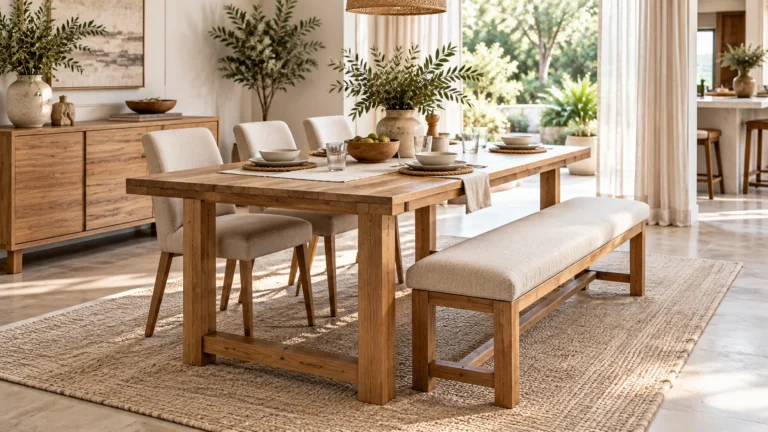
For a rectangular dining table, one of the most adaptable arrangements is a bench along one long side with individual chairs opposite and, where space allows, chairs at the ends.
This arrangement combines two different functions.
The bench gives the room a relaxed, continuous seating line. The chairs retain individual seating, back support and easier independent movement.
It can also create a more layered interior. Instead of making the dining set look like a single matching block of furniture, you can create visual cohesion through repeated colour, timber tone, upholstery or shape.
For example, a natural wood bench can sit comfortably with neutral upholstered chairs if both relate to the table through colour temperature or material. Alternatively, a simple upholstered bench can soften a dining area dominated by hard timber surfaces.
The goal is not perfect matching. It is intentional coordination.
Dining Bench vs Dining Chairs in a Small Room
A bench is often presented as the obvious answer for a small dining room, but that needs a qualification.
It saves useful space only when the particular layout allows it to do so.
A backless bench that slides completely under a compatible table can reduce its visible footprint when nobody is seated. But a large fixed bench that cannot tuck underneath may occupy valuable circulation space continuously. Recent 2026 comparisons make this distinction explicitly. 📖
Chairs create several separate footprints, but they may make entry and exit easier because each diner controls their own seat.
So for a compact room, ask:
Where does the seating go when nobody is using it?
Then ask the more important question:
What happens to the walkway when everyone is using it?
The second answer is usually more useful than the first.
Think About Who Actually Uses the Table
Furniture should suit the household rather than an idealised dining-room photograph.
If your table is mainly used for short, informal family meals, flexible bench seating may fit the routine well.
If people regularly sit for extended meals, work at the table or prefer defined personal seating, supportive chairs may be more practical.
Access needs deserve particular attention too. A shared bench can require sliding sideways or asking another diner to move, whereas individual chairs generally permit more independent entry and exit. 📖 📖
There is therefore no universal formula based solely on room size.
Two homes with identical dining rooms can reasonably make different choices because the people and routines inside them are different.
A Simple Decision Checklist
Before deciding between a dining bench vs dining chairs, walk through the actual room and answer these questions:
- Can the proposed bench genuinely fit beneath or alongside the table supports?
- Is there enough room for people to sit and stand without blocking an important walkway?
- Do diners frequently enter and leave the table independently?
- Are meals usually short and casual or longer and more leisurely?
- Is back support an important priority for regular users?
- Does the table double as a workspace, homework station or hobby surface?
- Would flexible shared seating be genuinely useful?
- Could one bench plus individual chairs solve the problem better than choosing only one seating type?
Do this before making the style decision.
A seating layout that works smoothly every day will usually look more convincing in the room because the furniture has been chosen for a reason rather than simply arranged to follow a trend.
The Practical Takeaway
The dining bench vs dining chairs decision becomes much easier once you stop asking which option looks better in isolation.
A bench can bring flexible shared seating, a relaxed appearance and potentially a cleaner footprint when its dimensions and the table structure allow it to tuck away. Chairs provide defined individual seating, independent movement and, in conventional backed designs, greater support.
For many homes, the most practical answer may be a combination of both.
Measure the real usable space, consider how people move around the table and choose the arrangement that supports your everyday routine. That is more reliable than selecting dining seating purely from a styled photograph.
FAQs
Is a dining bench vs dining chairs better for a small dining room?
Neither is automatically better. A bench can be useful when it genuinely tucks beneath a compatible table, while chairs can make individual entry and exit easier. Measure the occupied layout and circulation space before deciding.
Can I use a bench and chairs at the same dining table?
Yes. A bench on one long side with chairs opposite is a practical way to combine shared seating with individual seats, particularly around rectangular tables.
Are dining benches comfortable for everyday meals?
They can be suitable for casual everyday meals, but comfort depends on seat height, depth, cushioning, back support, the table geometry and individual preferences. Longer sitting may make supportive seating more important.
What should I measure before buying a dining bench?
Measure bench height and length, the clear distance between table supports, the lowest point beneath the tabletop or apron, and the surrounding space required for people to enter, sit and leave.
Does a dining bench always save space?
No. A bench is most space-efficient when its dimensions and the table structure allow it to tuck away or occupy a genuinely useful part of the layout. A bench that remains permanently in a circulation route may provide little practical space advantage.