
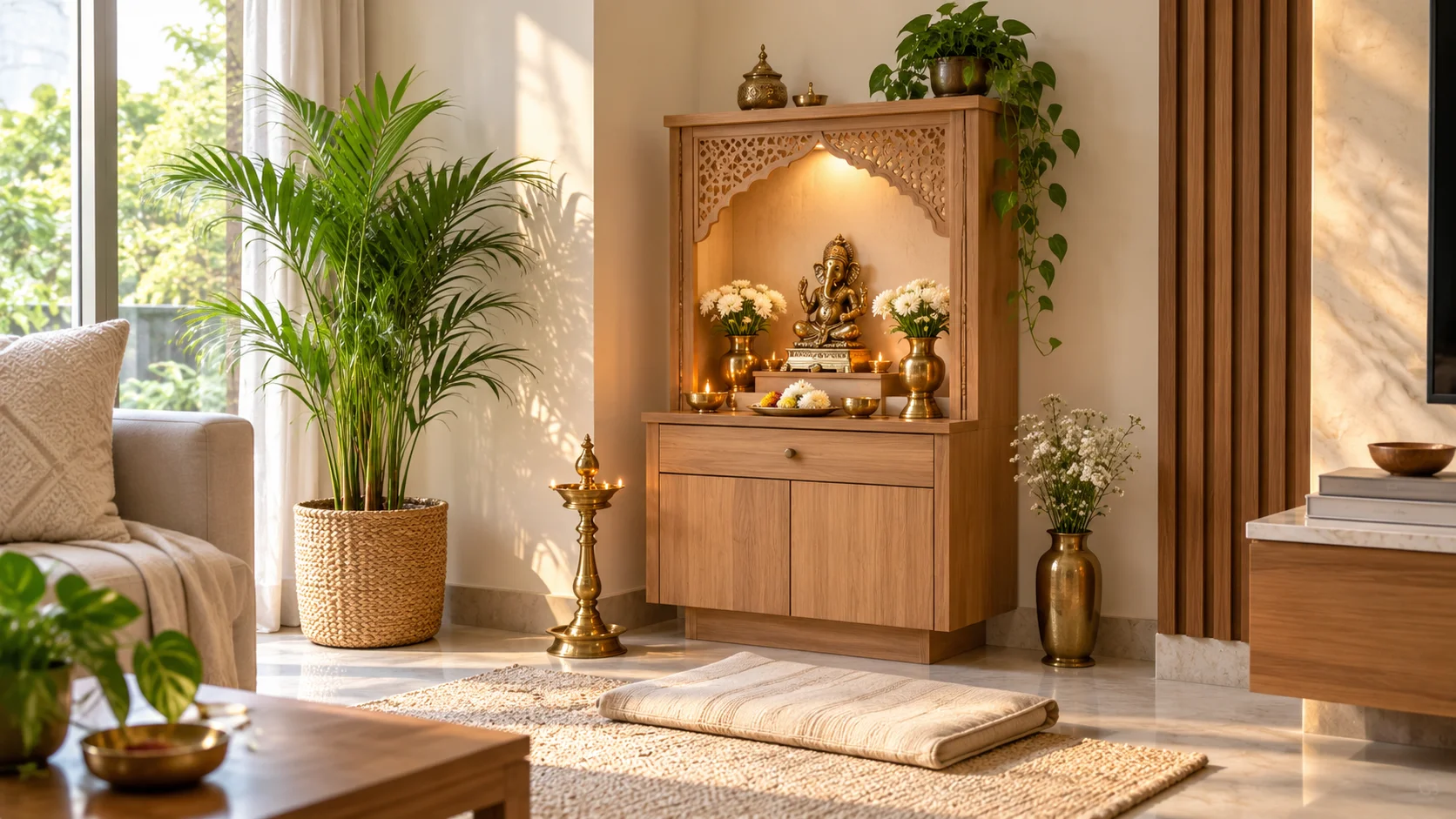
A thoughtfully arranged prayer corner Vastu setup is less about turning your home upside down and more about creating a calm, respectful place for prayer, reflection and daily rituals. Traditional Vastu guidance commonly gives importance to direction, cleanliness, light and the relationship between a sacred space and the rest of the home.
One of the best-known traditional recommendations is the north-east area of the home. Historical Vastu material documents the family chapel or deva-griha in the north-east, although traditions and interpretations can differ.
For a modern home, however, the practical priority is equally important: your prayer corner should be peaceful, easy to maintain and appropriate for your family’s own religious practices.
Note: Vastu Shastra is a traditional belief and architectural system. The placement suggestions below should be understood as cultural and traditional guidance rather than scientifically established claims about health, wealth or future outcomes.
Table of Contents
Why Prayer Corner Vastu Focuses on Placement
A prayer corner is different from ordinary home décor because its purpose is intentional. It may be used for prayer, meditation, reading sacred texts or simply spending a few quiet minutes away from the distractions of the home.
Traditional Vastu treats direction and spatial organisation as meaningful parts of residential design. IGNCA’s material on Vastu describes it as a broad tradition encompassing buildings, dwellings and interior considerations rather than merely decorative rules. IGNCA’s overview of Vaastu publications provides useful historical context.
That does not mean a contemporary apartment needs to be redesigned around every traditional prescription. A useful approach is to understand the principle first and then apply it in a way that works with the home you actually have.
This same practical interpretation is useful across other rooms too. For example, Nimon Group’s guide to North East Vastu Remedies for Electronic Tech Clutter explores how the north-east can be treated thoughtfully in a modern household.
Choosing the Right Location for a Prayer Corner
The north-east is one of the most frequently referenced directions in traditional prayer corner Vastu. Historical architectural material catalogued by IGNCA describes a house plan in which the family chapel, or deva-griha, occupies the north-east corner.
If your home’s layout makes that practical, the north-east can therefore be a natural starting point when deciding where to establish a dedicated prayer area.
But treat it as a traditional preference rather than a reason to create an awkward or unusable room.
When the north-east is available
Consider a small, clearly defined area rather than filling the entire corner. A compact wall-mounted mandir, a freestanding prayer unit or a simple dedicated surface may be enough.
Leave some visual space around it. A sacred corner generally feels more intentional when it is not squeezed between unrelated storage, charging cables and everyday clutter.
When the ideal direction is not available
This is where modern practicality matters.
Many apartments have fixed kitchens, bathrooms, wardrobes and doors. If the traditionally preferred location cannot comfortably accommodate a prayer area, choose a quiet, clean and respectful alternative rather than making disruptive structural changes solely to achieve a compass direction.
A prayer corner that your family can comfortably use every day is more practical than a theoretically preferred location that is inaccessible or constantly disturbed.
Creating a Calm and Uncluttered Sacred Space
The visual character of a prayer corner can strongly influence how the area feels during everyday use.
Start with restraint.
Keep frequently used prayer essentials together and give them a defined home. Avoid allowing paperwork, keys, chargers, shopping bags or unrelated household objects to migrate into the area.
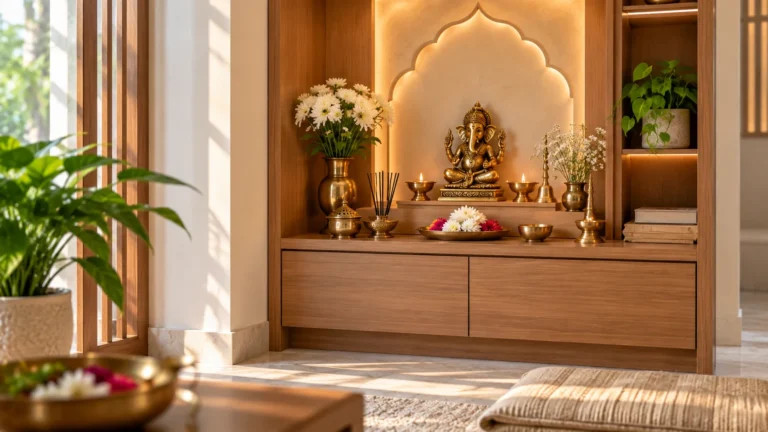
A small tray or drawer can organise appropriate accessories without dominating the prayer space. If you use flowers, lamps, incense or other ritual items, arrange them according to your own tradition and make sure anything involving flame or heat is used safely and never left unattended.
This is also where contemporary styling can work particularly well with traditional ideas. Natural-looking materials, soft neutral backgrounds and uncluttered surfaces can make even a compact prayer niche feel visually distinct without requiring elaborate decoration.
If you are interested in applying similar traditional placement thinking elsewhere in the home, see Vastu Seating Arrangement Rules for Living Room Harmony.
Light, Materials and Everyday Practicality
Good lighting can make a small prayer corner considerably more usable.
Natural daylight is ideal when the room already provides it, but you do not need to reconstruct the space to obtain it. A warm, gentle artificial light can create clear visibility without making the corner feel harsh.
If your setup includes an oil lamp, diya, candle or incense, practicality must take priority over aesthetics. Keep flames away from curtains, papers, loose fabrics and enclosed shelving that could trap heat.
Choose surfaces that are easy to clean. Prayer areas often involve flowers, water, ash, oil or incense, so an attractive but highly delicate finish may create unnecessary maintenance.
Storage deserves attention too. Concealed or neatly integrated storage can preserve the calm appearance of the corner while keeping frequently used items close at hand.
Adapting Traditional Vastu to a Modern Home
Modern prayer corner Vastu works best when tradition and real-world living are considered together.
A large independent house may have a dedicated prayer room. A city apartment may offer only a wall niche, shelf or compact cabinet. Both can provide a meaningful sacred space.
Instead of asking whether your home follows every possible Vastu prescription, consider three practical questions:
- Is the area respectful and reasonably quiet?
- Can it be kept clean and organised?
- Does its placement support the way your household actually prays or reflects?
These questions help prevent Vastu guidance from becoming an impractical renovation checklist.
Traditional sources themselves represent Vastu as a substantial body of architectural and cultural knowledge. IGNCA’s current Vastu Shastra course, for example, covers residential architecture, directions, environmental relationships and historical texts including Samarangana Sutradhara and Mayamatam. 📖
That broader context is useful because it reminds us that Vastu is not simply a collection of viral décor rules.
For another Nimon Group example of balancing traditional concepts with practical contemporary living, read Vastu-Inspired Kitchen Organisation Made Effortlessly Practical.
A Prayer Corner Should Ultimately Support the Ritual
The most successful prayer corner Vastu arrangement is not necessarily the most elaborate one.
Begin with the traditionally preferred location when your home’s layout allows it, particularly the north-east. Then consider cleanliness, accessibility, light, storage and safety.
Most importantly, avoid treating traditional placement guidance as a guarantee of prosperity, health or other outcomes. A prayer corner’s practical value lies in providing a dedicated, respectful environment for the spiritual or reflective practices that matter to your household.
Related Blogs
North East Vastu Remedies for Electronic Tech Clutter
Essential Vastu Tips for a Positive Festive Season
Vastu Seating Arrangement Rules for Living Room Harmony
Frequently Asked Questions
1. What is the preferred direction for prayer corner Vastu?
Traditional Vastu sources commonly associate the north-east with sacred or devotional space. Treat this as traditional guidance rather than a scientifically proven requirement, and adapt it sensibly to your home’s layout.
2. Can I create a prayer corner if I do not have a separate prayer room?
Yes. A compact wall niche, cabinet or dedicated shelf can create a clearly defined prayer space without requiring a separate room.
3. What if the north-east corner is unavailable?
Choose a clean, calm and practical alternative that suits your household’s religious practices. Avoid disruptive renovation simply to follow a directional preference.
4. Should a prayer corner have natural light?
Natural light can make the space pleasant, but it is not essential. Appropriate artificial lighting can work well, especially in compact apartments or internal rooms.
5. Can a modern prayer corner still follow traditional Vastu ideas?
Yes. Traditional placement concepts can be combined with modern storage, lighting and compact furniture while keeping the area respectful, practical and easy to maintain.