
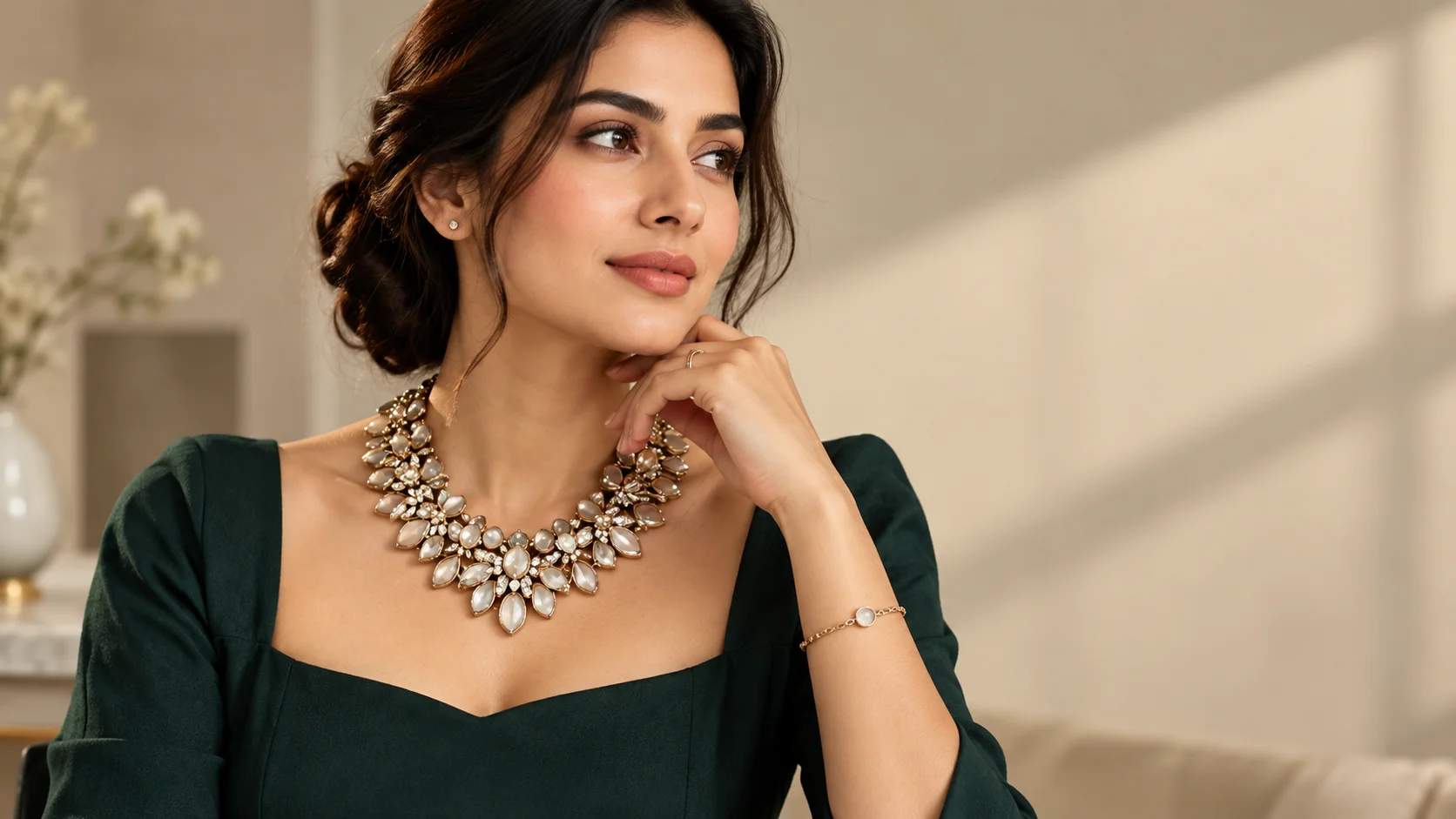
A bold necklace can transform even a simple outfit, but statement necklace styling becomes more interesting when you decide what the rest of your jewellery should do. The goal is not automatically to remove every other accessory. It is to create enough visual hierarchy for the necklace to lead while the remaining pieces support the overall look.
The simplest approach is to decide on your focal point first. If the necklace is meant to attract attention, earrings, rings, bracelets and other details can usually become quieter supporting elements. For a more expressive layered look, you can add more jewellery—but each piece needs a clear visual role rather than competing for the same attention.
Table of Contents
Why Statement Necklace Styling Starts With a Focal Point
A statement necklace is designed to occupy visual space. Scale, colour, texture, shape or multiple strands can naturally draw the eye towards the neckline.
That makes the first styling decision surprisingly simple: what should people notice first?
If your answer is the necklace, allow it to establish the hierarchy of the look. Everything else can then be judged by whether it strengthens that focal point or distracts from it.
This approach is especially useful with sculptural collars, colourful beaded designs, chunky chains, layered pendants and elaborate traditional-inspired neckpieces.
Nimon Group’s Turquoise Statement Necklace 7 Effortless Styling Ideas explores the same principle through a bold multi-strand necklace, where giving the piece visual space helps it establish the outfit direction.
The idea also fits current styling rather than relying on an outdated “one accessory only” rule. Recent 2026 fashion coverage shows both statement necklaces and jewellery layering in contemporary looks. The useful distinction is intentional composition: a bold necklace can remain the visual anchor even when other jewellery is present.
Balance Earrings Around the Statement Necklace
Earrings sit close to a necklace, so they are usually the first accessory to reconsider.
When the necklace is large, intricate or strongly coloured, small studs, compact hoops or another visually restrained earring can create an easy balance. They finish the area around the face without introducing another equally dominant focal point.
You can also skip earrings when the necklace already creates enough impact.
This does not mean bold earrings and a bold necklace can never work together. They can, particularly in deliberate maximalist or occasion styling. The difference is that the pairing should look composed rather than accidental.
Ask three questions:
- Are both pieces competing at almost the same scale?
- Do they occupy the same visual area?
- Is there another element—such as heavy embroidery—already demanding attention?
If all three answers are yes, removing or reducing one jewellery element can make the entire look clearer.
Nimon Group’s guide to statement beaded earrings demonstrates the reverse version of this principle: when earrings become the focal point, nearby jewellery can become more restrained.
Let the Neckline Create Breathing Space
Statement necklace styling is not only about jewellery. Your clothing neckline changes how much visual space the necklace has.
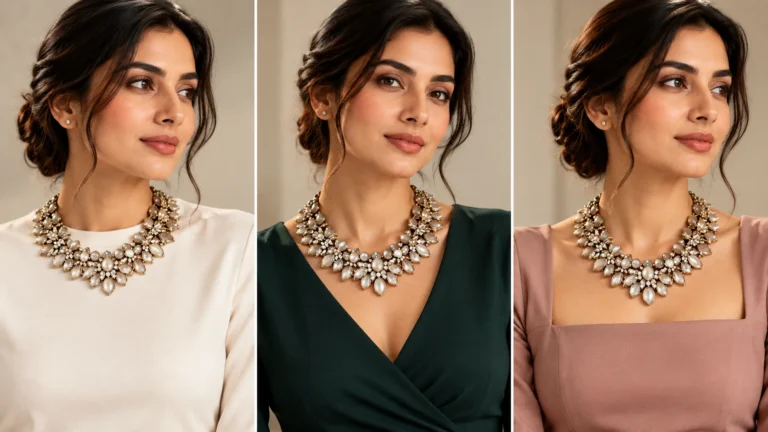
A clean crew neck, simple V-neck, strapless neckline, square neckline or understated shirt can provide a relatively quiet frame. The exact combination depends on the necklace’s length and shape.
For example, a collar-style necklace can sit prominently around an open neckline, while a longer pendant can create a strong vertical line over simpler clothing. With a heavily embroidered neckline, however, the clothing and necklace may begin competing in exactly the same area.
That is when visual breathing space becomes valuable.
Rather than asking whether a neckline is technically “allowed”, look at the combined silhouette in a mirror. Can you immediately identify the focal point? If not, the necklace may need a simpler backdrop.
Current styling coverage similarly emphasises proportion and the relationship between necklace shape and neckline rather than a single universal pairing rule. 📖 📖
Use Rings and Bracelets as Supporting Details
Wrist and hand jewellery sits farther from the necklace, which gives you more flexibility.
A slim bracelet, watch, delicate bangle or thoughtfully chosen ring can complete the look without crowding the neckline. This is particularly useful when you still want the outfit to feel accessorised rather than stripped back.
Instead of matching every piece exactly, look for a connection.
That connection might be:
- a related metal tone;
- one repeated colour;
- similar geometric shapes;
- a shared traditional or contemporary mood;
- or simply a comparable level of polish.
Exact matching is not essential. In fact, mixed metals and more individual combinations continue to appear in current jewellery styling. What matters more is whether the pieces feel intentional together. 📖 📖
The practical rule is support rather than duplication. Your bracelet does not need to become a smaller version of your necklace, and every ring does not need to repeat its colours.
When Layering More Jewellery Can Work
Minimal supporting jewellery is the easiest route, but it is not the only route.
Layered necklaces and expressive jewellery combinations remain visible in 2026 fashion styling. Harper’s Bazaar, for example, highlighted layered necklaces over crisp shirting, while Vogue has covered intentionally abundant jewellery styling. 📖
The distinction is between layering and crowding.
If you want to layer around a statement necklace, establish hierarchy first. One piece can carry the strongest scale, colour or texture while finer chains provide secondary detail.
Try varying necklace lengths enough for each layer to remain visible rather than allowing several pieces to collect in the same narrow area.
The same idea applies beyond the neck. A statement necklace with rings or bangles can feel intentionally maximalist when the elements have visual rhythm. But adding a bold necklace, oversized earrings, heavy bangles, multiple large rings and highly embellished clothing without hierarchy can make it difficult to know where the eye should land.
For another jewellery-led approach, Nimon Group’s gold-tone stone-studded chain styling ideas provides complementary inspiration for building an outfit around a noticeable neckpiece.
The Finishing Test Before You Leave
Once the jewellery is on, stop adding pieces for a moment and look at the complete outfit.
Ask yourself:
Where does my eye go first?
If it lands naturally on the statement necklace and then moves through the rest of the look, your visual hierarchy is probably working.
If your attention jumps simultaneously between the necklace, earrings, wrists, neckline and clothing details, decide whether that complexity is intentional. If it is, embrace it. If it is not, remove or quieten one element and look again.
This is why successful statement necklace styling is less about counting accessories and more about assigning them roles.
The necklace can be the hero. Earrings can frame the face. Rings and bracelets can provide finishing detail. Clothing can provide either a quiet background or a deliberate second layer of visual interest.
Once every element has a purpose, a statement necklace feels much easier to wear.
Related Blogs
Turquoise Statement Necklace 7 Effortless Styling Ideas — a practical next read for styling a bold necklace as the focal point.
Read the article
Beautiful Statement Beaded Earrings for Effortless Boho Style — useful for understanding the same focal-point principle when earrings, rather than a necklace, take the lead.
Read the article
Gold-Tone Stone-Studded Chain Styling Ideas — complementary inspiration for building outfits around noticeable neck jewellery.
Read the article
The uploaded Nimon Group export confirms the turquoise necklace article as a published post and identifies its exact URL.
FAQs
What is the easiest rule for statement necklace styling?
Choose the main focal point first. If the statement necklace is meant to lead, keep nearby jewellery relatively restrained or deliberately coordinate additional pieces so the necklace still has a clear visual role.
Can I wear statement earrings with a statement necklace?
Yes. For an easy balanced look, make one piece more dominant. For intentional maximalist styling, both can be bold, but their scale, clothing and other accessories should create a coherent composition rather than accidental competition.
Should my bracelet match my statement necklace?
Not necessarily. A shared metal tone, colour, shape or overall mood can create enough connection. Exact matching is optional.
Can I layer chains with a statement necklace?
Yes. Use noticeably different lengths and let one necklace remain the dominant element. Finer secondary chains generally make the hierarchy easier to read.
What should I do if my jewellery looks too busy?
Identify what you want people to notice first. Then reduce, relocate or simplify the accessory competing most strongly with that focal point.