
This article may contain affiliate links. We may earn a commission at no extra cost to you.
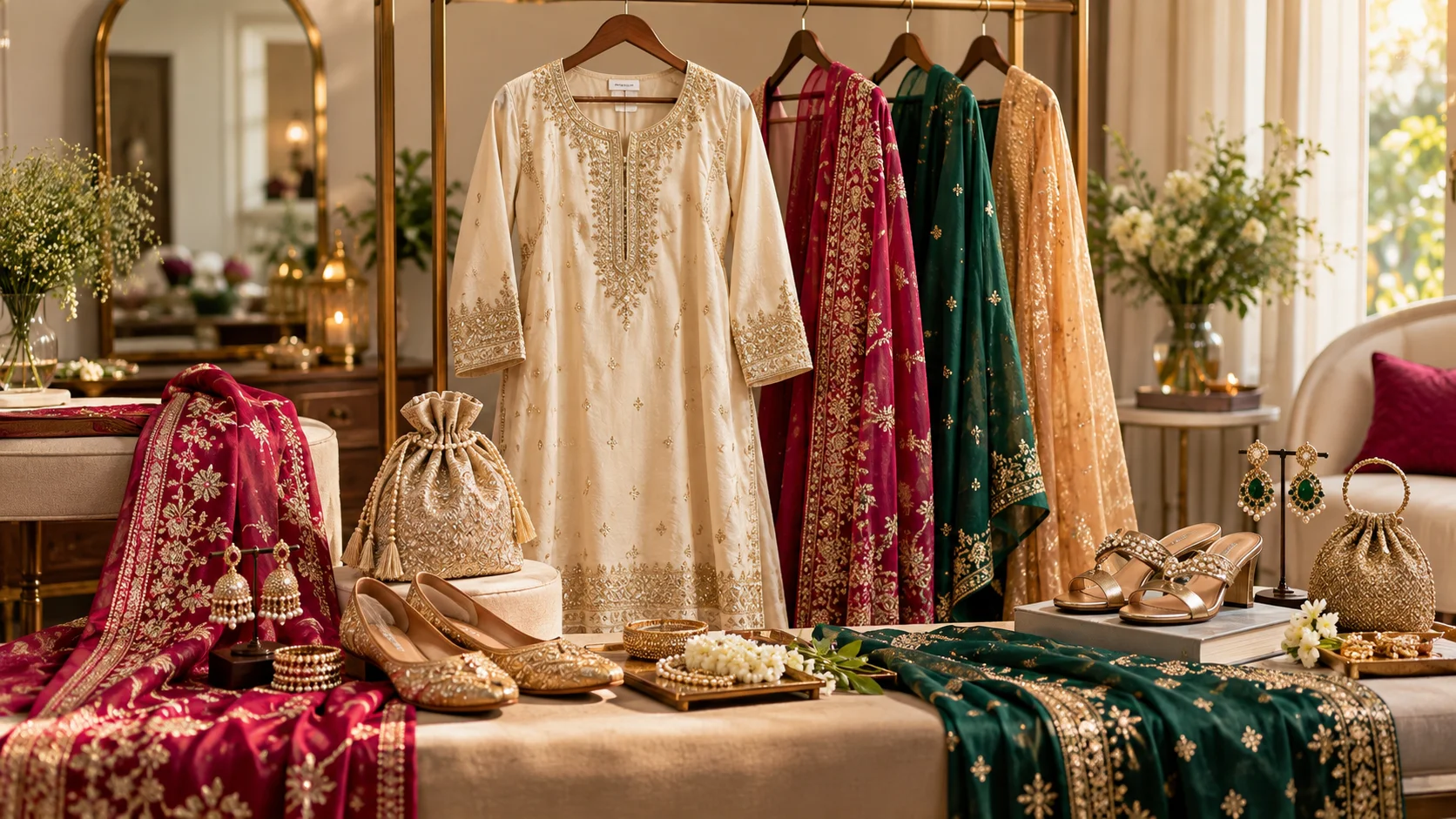
Festive outfit planning does not have to begin with a completely new outfit. Often, the pieces already in your wardrobe have enough colour, texture and character to create a fresh celebration-ready look — they simply need a different supporting cast.
The most effective approach is to choose one strong wardrobe foundation, then change the visual focus through jewellery, layering, footwear, accessories, draping or colour. It is a practical way to make familiar festive clothing feel intentional rather than repeated.
Recent festive-fashion coverage has also highlighted wardrobe auditing and creative restyling as alternatives to automatically buying another complete ensemble. For a useful overview of this approach, see Mid-day’s festive wardrobe audit.
Table of Contents
Start Festive Outfit Planning With a Wardrobe Audit
Before deciding that you need something new, look at what you already have.
Take out the pieces that could realistically work for the occasion: sarees, kurta sets, skirts, trousers, co-ords, dresses, jackets, dupattas and festive separates. Do not judge them as complete outfits yet. Think of each one as a styling component.
Then divide them mentally into three groups:
- Foundation pieces: garments you already enjoy wearing and know fit the occasion.
- Statement pieces: embroidered dupattas, striking jackets, bold jewellery, textured bags or distinctive footwear.
- Supporting pieces: simpler separates and accessories that allow the statement element to stand out.
This changes the question from “What new outfit should I buy?” to “What can I create from the strongest pieces I already own?”
That small shift can reveal combinations you may have overlooked.
Choose One Piece to Become the Hero
A familiar outfit can look surprisingly different when its visual hierarchy changes.
Suppose you already own an elegant kurta set. If you previously styled it with matching jewellery, matching footwear and its original dupatta, repeating exactly the same combination will naturally feel familiar.
Instead, decide what deserves attention this time.
It might be:
- a contrasting dupatta,
- statement earrings,
- an embroidered potli,
- an interesting jacket,
- metallic footwear, or
- the garment’s own colour or detailing.
Once you choose the hero, allow the remaining pieces to support it.
For example, a richly patterned dupatta generally needs less competition from jewellery. Conversely, a relatively simple neckline can give statement earrings more visual space.
This is also why accessory editing matters. More festive detail does not automatically produce a more polished outfit.
For another example of building an occasion look around a single accessory, see Nimon Group’s Elegant Potli Bag Styling With Standout Occasion Appeal.
Change the Colour Story, Not the Entire Outfit
Colour is one of the quickest ways to alter the impression of a familiar garment.
Imagine an ivory, cream or muted kurta that was previously worn with neutral accessories. The same foundation can move in a richer festive direction with one controlled accent — perhaps ruby, emerald, deep blue, maroon or another shade that genuinely complements the garment.
You do not need several competing colours. A useful formula is:
existing base + one accent colour + one restrained metallic or neutral
For example, an ivory outfit could be paired with a coloured dupatta and understated metallic accessories. A vibrant garment may work better with neutral accessories rather than another equally dominant colour.
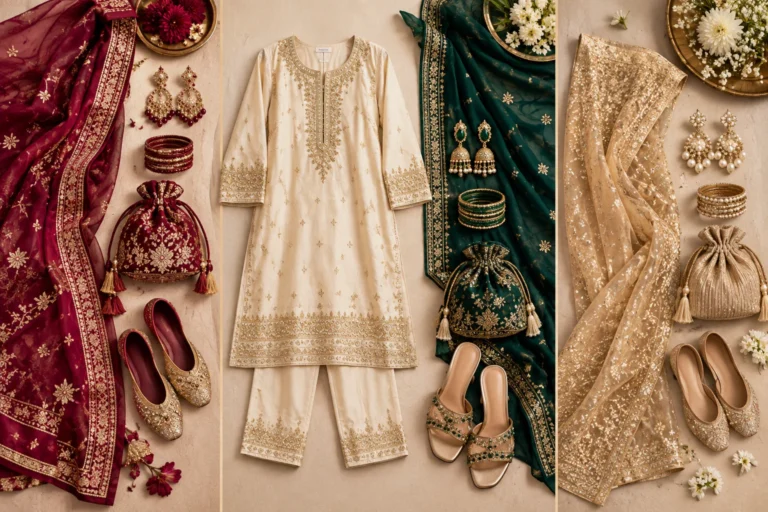
The objective is not to follow a rigid colour rule. Look at undertone, print, embroidery and overall visual balance before deciding what belongs together.
If you want to explore how one festive garment can carry the styling rather than every accessory competing for attention, see Nimon Group’s Elegant Festive Kurta Set Styling With Essential Impact.
Use Accessories to Shift the Visual Focus
Accessories are particularly useful when you want a repeat outfit to feel different without changing its foundation.
Consider how much these swaps can alter the overall impression:
Statement earrings instead of a necklace.
This moves attention upwards and can make the neckline feel cleaner.
A potli instead of an everyday handbag.
The outfit immediately gains a stronger occasion cue without changing the clothing itself.
Different footwear.
Embellished flats, refined sandals or another occasion-appropriate pair can change the finishing character of an outfit.
A belt or structured layer where appropriate.
On suitable silhouettes, these can change proportion and create a different focal point.
A different jewellery balance.
Instead of wearing several decorative pieces together, choose one area to emphasise.
The secret is not the number of accessories. It is deciding which accessory gets to lead.
Restyle Traditional Pieces in a More Current Way
A traditional garment does not need to lose its identity to feel current.
In fact, recent 2026 fashion coverage continues to show traditional textiles and silhouettes alongside more individual styling, expressive colour and statement details.
The practical lesson is simple: change the styling context before replacing the garment.
A saree, for example, may feel different with a blouse you have not previously paired with it, provided the fabrics, colours and occasion work together. A kurta can take on another character with different trousers or a carefully chosen layer. A dupatta from one set may complement another outfit if its colours and scale genuinely coordinate.
The same principle can work outside Indian festive wear. A simple occasion dress may change through a jacket, footwear, jewellery or bag rather than another dress purchase.
However, avoid making changes purely for novelty. The finished outfit should still look coherent.
Build a Simple Festive Outfit Formula
When you are short on time, use this sequence:
1. Pick the foundation.
Choose the garment that fits the occasion and that you genuinely want to repeat.
2. Identify what looked dominant last time.
Was it the jewellery, dupatta, blouse, bag or the garment itself?
3. Change that focal point.
Give another element the lead this time.
4. Introduce one meaningful contrast.
This could come from colour, texture, jewellery scale or layering.
5. Remove one unnecessary element.
Editing is often what makes the new combination look deliberate.
This formula works because you are changing the relationship between familiar pieces, rather than expecting one new purchase to solve the whole outfit.
When Buying Something New Does Make Sense
Restyling is useful, but it does not mean you should never buy anything new.
A new piece can make sense when it fills a genuine wardrobe gap, solves a fit or comfort problem, or can work with several items you already own. The difference is that you are shopping for a useful component rather than automatically replacing an entire outfit.
Ask three questions before adding something:
- Can I wear it with at least a few pieces I already own?
- Does it solve a real styling gap?
- Would I still want it after this particular celebration?
If the answer is consistently yes, the purchase has a clearer role in your wardrobe.
The Fresh-Look Test
Before you finish, look at the complete outfit rather than each component individually.
Ask yourself:
Is there one clear focal point?
If everything demands attention, simplify.
Does the colour palette feel connected?
Contrast can be beautiful, but it should look deliberate.
Can I comfortably move through the actual event?
A festive outfit needs to work beyond the mirror.
Does this combination feel different from how I wore it before?
If not, change one visually meaningful element rather than adding several minor details.
A repeat outfit does not need to disguise the fact that it has been worn before. Good styling gives it a new point of view.
Related Blogs
- Elegant Festive Kurta Set Styling With Essential Impact
- Elegant Rani Pink Kurta Set With Essential Festive Styling
- Elegant Potli Bag Styling With Standout Occasion Appeal
Frequently Asked Questions
1. What is the easiest festive outfit planning method without buying new clothes?
Start with one existing foundation garment, choose a different focal point and change one meaningful element such as jewellery, colour, layering, footwear or a dupatta. Keep the remaining elements restrained so the change looks intentional.
2. How can I make an old festive outfit look different?
Change its styling hierarchy rather than everything at once. Different jewellery, a contrasting layer, another bag, alternative footwear or a new colour pairing can noticeably change the overall impression.
3. Is repeating festive outfits acceptable?
Yes. Repeating clothing is a normal wardrobe choice. Restyling simply gives you the option to create a different visual result from pieces you already own.
4. Should jewellery match the colour of a festive outfit?
Not necessarily. Jewellery can complement rather than exactly match the clothing. Consider the neckline, garment detailing, colour palette and desired focal point before choosing it.
5. When should I buy a new festive piece?
Consider buying when it fills a genuine wardrobe gap, works with several existing pieces or solves a practical fit or styling problem. A versatile addition can be more useful than replacing the complete outfit.