
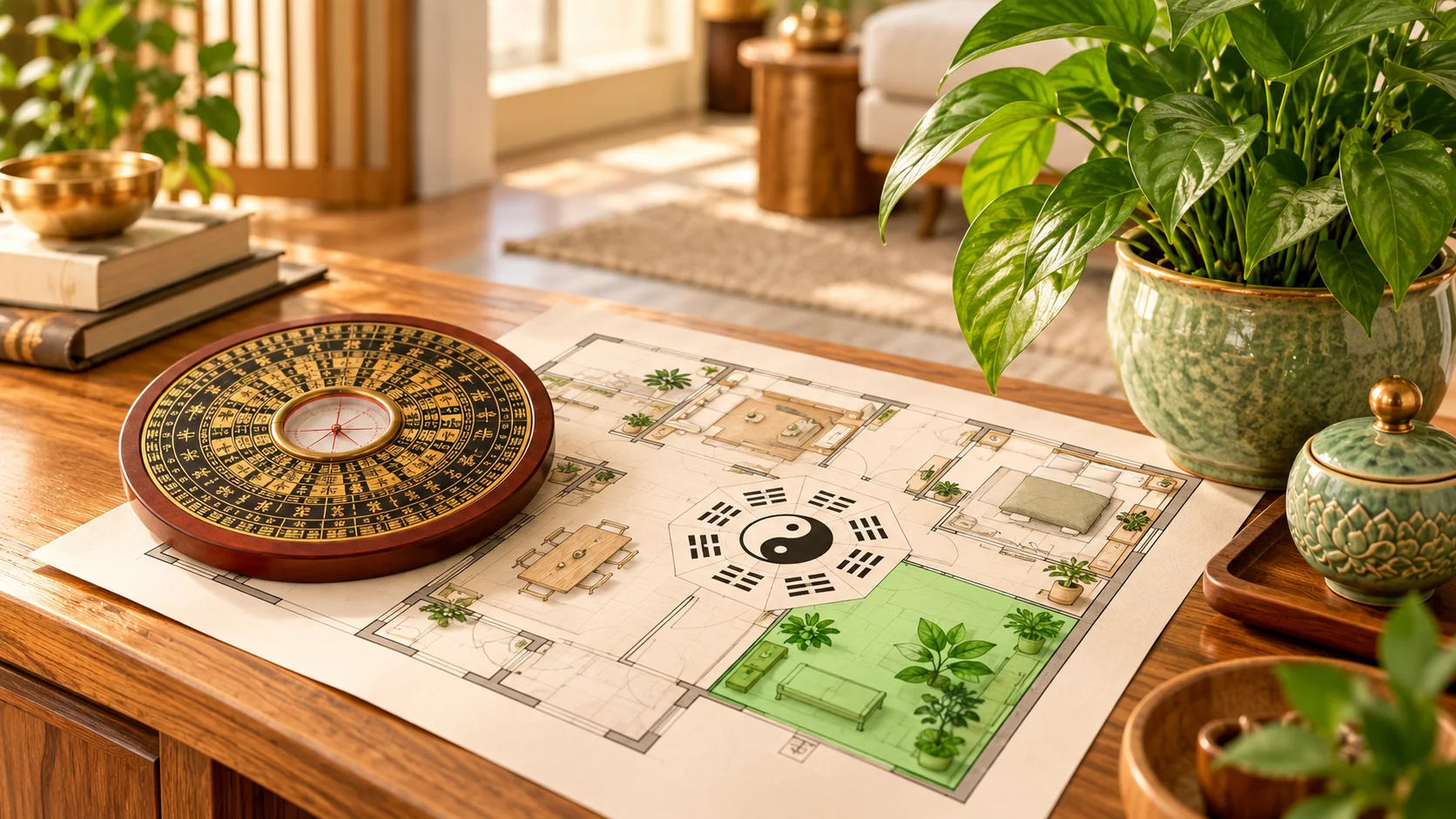
Feng Shui has a long-standing association with the idea that certain directions relate to prosperity, opportunity and the way people organise their living spaces. One of the most widely discussed examples is the southeast wealth area. But where does this association come from, and does every Feng Shui tradition interpret it in the same way?
The key distinction is that the southeast–wealth connection belongs to particular systems of Feng Shui interpretation, not to a universal rule that every school applies identically. Understanding the tradition behind the association makes it easier to explore it respectfully without treating decorative objects, colours or compass directions as guarantees of financial success.
Table of Contents
Where the Southeast Wealth Association Comes From
The association between southeast and wealth is best understood through the symbolic frameworks used in Feng Shui rather than as a claim about physical cause and effect. Feng Shui encompasses several traditions concerned with the relationship between people, buildings, orientation and the surrounding environment. These traditions do not always use the same method to interpret a space.
In popular Feng Shui guidance, the southeast is often identified with wealth and prosperity through the Bagua, a framework used to organise areas of life and their symbolic associations. In the commonly used Western or BTB Bagua approach, the wealth and abundance area is traditionally associated with the far-left section of a floor plan when viewed from the entrance. This is a Bagua-based interpretation, not necessarily the same as locating the compass southeast in a building.
The distinction matters because the word southeast can refer to an actual compass direction, while a Bagua area can be positioned according to a particular mapping method. These two approaches may produce different locations in the same home.
The broader cultural context also matters. Traditional Chinese cosmological systems use concepts such as yin and yang, the five phases or elements, and directional relationships to interpret the environment. Modern popular advice often simplifies these complex frameworks into accessible ideas about prosperity corners, plants and decorative objects.
That simplification can be useful as a starting point, but it should not be mistaken for proof that a direction creates wealth. The more accurate question is which Feng Shui framework is being used and what the southeast represents within that framework.
How Different Feng Shui Schools Interpret Directions
There is no single placement rule that can be applied confidently across every Feng Shui school. The approach used to interpret a home changes how directions, rooms and symbolic areas are understood.
Compass-based approaches use actual orientation and directional information as part of their analysis. In these systems, a compass reading can help establish the building’s orientation or a relevant directional sector. The southeast is therefore a physical direction, not simply a position on a page.
Form-based approaches give considerable attention to the surrounding landscape, the building’s form, the relationship between spaces and how people move through the environment. From this perspective, a home’s layout and practical conditions matter alongside any directional symbolism.
Western or BTB Feng Shui commonly uses a Bagua map aligned with the entrance rather than relying exclusively on the home’s compass directions. Its wealth area is often placed in the far-left zone of the mapped space. This is why a popular article about a southeast wealth corner may not describe the same method as a guide using a compass.
Other systems, including Eight Mansions and Flying Star Feng Shui, use their own calculations and interpretive rules. Their recommendations should not automatically be reduced to a single southeast prosperity formula.
When reading Feng Shui advice, look for the named school or method. If a guide does not identify its approach, treat its placement recommendation as general contemporary guidance rather than a rule shared by all traditions.
How to Identify the Southeast Sector at Home
If you want to explore the compass-direction interpretation, start by establishing the actual southeast direction rather than guessing from a photograph, a floor-plan illustration or the position of the front door.
- Establish the orientation. Use a reliable compass or an appropriate compass tool to identify southeast. Check the reading carefully, particularly near metal objects or electronic equipment that could interfere with a compass.
- Relate the direction to the floor plan. Mark the southeast sector on a simple plan of your home. The precise boundaries depend on the method being followed, so avoid assuming that one small corner automatically represents the whole sector.
- Identify the Feng Shui approach. Decide whether you are exploring a compass-based system or a Bagua method aligned with the entrance. Do not combine their placement rules without understanding the difference.
- Work with the existing layout. A rented flat, shared home or compact apartment may not allow changes to walls, entrances or room functions. There is no need to undertake structural work simply to match a symbolic diagram.
For example, the compass southeast might fall partly across a living room and partly across a hallway. That is not a reason to redesign the home immediately. You can first understand the mapping method and then decide whether any simple, practical adjustment is appropriate.
Similarly, an attractive floor plan with a highlighted southeast area is an explanatory illustration, not a substitute for measuring the orientation of your actual home.
How to Apply the Tradition Without Overcomplicating Your Home
Once you understand which interpretation you are following, the practical goal is to explore its symbolism while keeping your home comfortable, functional and within your budget.
Keep the space orderly and usable. If you choose to give attention to a traditional prosperity area, begin with ordinary home organisation. Remove unnecessary clutter, keep walkways clear and arrange furniture so the space remains easy to use. These are practical interior-design choices in their own right, regardless of whether you follow Feng Shui.
Treat colours and plants as optional styling choices. Green plants, natural wood, muted green tones and warm neutrals can create a visually cohesive interior. Some contemporary Feng Shui guidance associates particular colours or living plants with growth and prosperity, but those meanings vary by framework. Choose plants and décor that suit the available light, maintenance requirements and your personal taste.
Use symbolic objects thoughtfully. Traditional or popular Feng Shui décor may include coins, figurines, bowls or other prosperity-related symbols. If you enjoy these objects, consider their appearance, size, craftsmanship and placement. A small ceramic vessel on a console can be an attractive decorative choice without being presented as a financial remedy.
Avoid expensive or disruptive changes. You do not need to purchase a special object, repaint an entire room or renovate a property to engage with a cultural tradition. Never let a prosperity-placement recommendation override safe access, ventilation, electrical safety or the practical needs of people living in the home.
For readers exploring related placement traditions, How to Place a Feng Shui Money Frog for Wealth discusses another popular prosperity symbol, while Feng Shui Water Features: A Beautiful, Practical Guide explores a different element of Feng Shui-inspired home design.
The important distinction is between appreciating a tradition and expecting it to deliver a guaranteed outcome. Financial wellbeing depends on real-world circumstances and decisions; symbolic décor should not replace practical financial planning.
The southeast–wealth association is therefore best approached as a cultural idea whose meaning depends on the Feng Shui system being followed. Start by identifying the method, confirm the relevant direction when needed, and make only practical, affordable changes that suit your home.
Related Blogs
- Front Door Feng Shui: Traditional Importance and Modern Design
- Feng Shui Apartment Entrance Ideas for Shared Corridors
Frequently Asked Questions
1. What does southeast mean in Feng Shui for wealth?
In some Feng Shui interpretations, southeast is traditionally associated with wealth and prosperity. The meaning depends on the method being used, however. Compass-based approaches and Western Bagua mapping do not necessarily identify the same area as the wealth sector.
2. Is the southeast wealth corner the same in every Feng Shui school?
No. Western or BTB Bagua guidance commonly places the wealth area in the far-left zone when a floor plan is mapped from the entrance. Compass-based, Eight Mansions and Flying Star approaches use different frameworks and should not be treated as interchangeable.
3. How can I find southeast in my home?
Use a compass to establish the actual southeast direction and relate it to your floor plan. Check for possible compass interference and follow the measurement method appropriate to your chosen Feng Shui school. Do not infer compass direction from a photograph or decorative floor-plan graphic.
4. Which plants are traditionally used in a Feng Shui wealth area?
Some contemporary Feng Shui guidance recommends healthy green plants as symbols of growth and vitality. Specific plant choices and placement advice vary. Consider light, available space and ongoing care first, and do not assume a plant will produce financial gains.
5. Do Feng Shui wealth symbols guarantee prosperity?
No reliable evidence establishes that a compass direction or decorative symbol guarantees wealth. Such objects may hold traditional or personal meaning, but they cannot replace budgeting, saving, informed financial decisions or other practical steps towards financial wellbeing.