
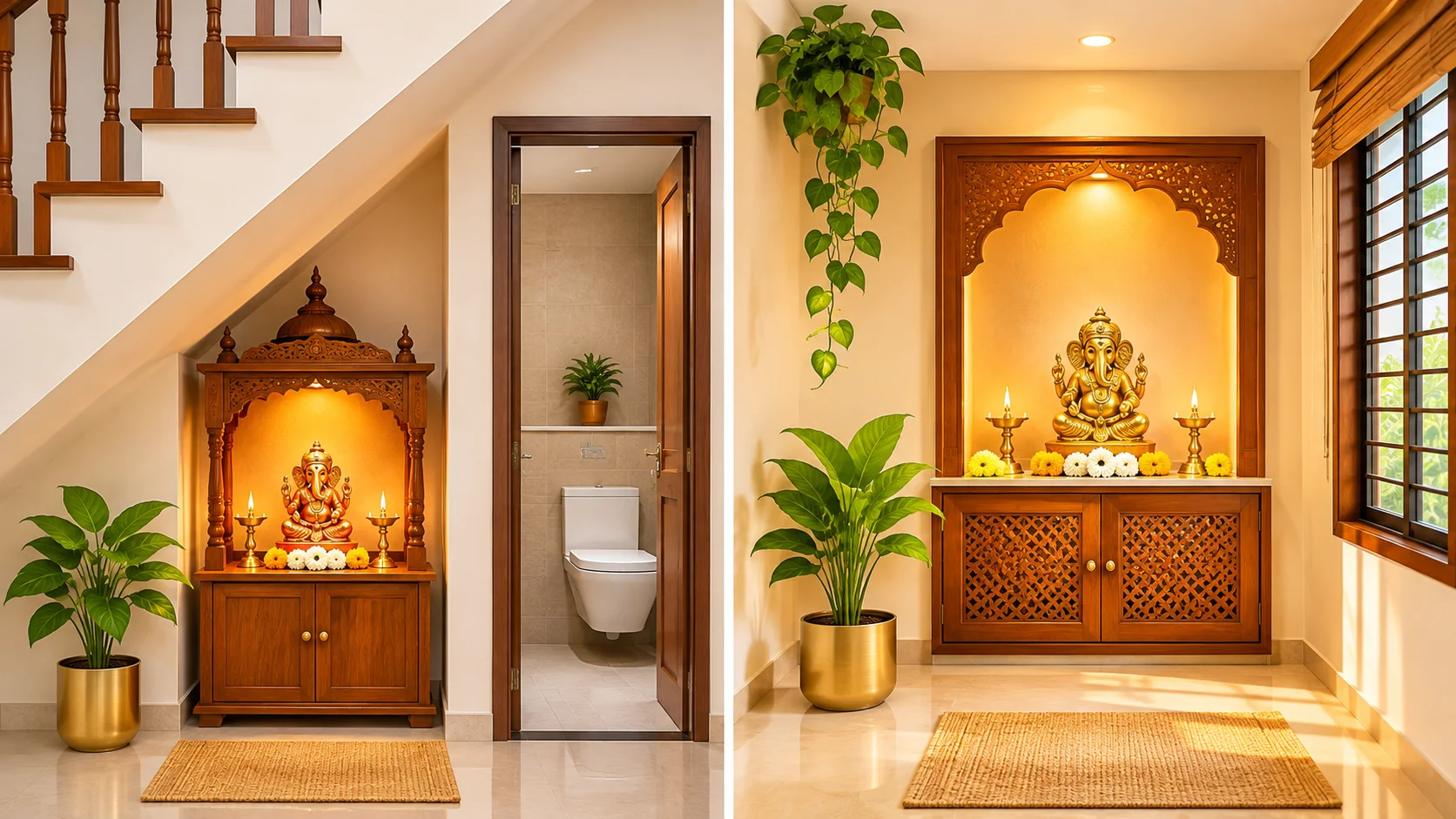
A pooja room or prayer corner is intended to be a calm, respectful space for prayer, meditation or quiet reflection. In traditional Vastu, however, placement matters. A mandir positioned next to a toilet or beneath a staircase is commonly considered unsuitable for a sacred space.
If your home already has this layout, there is no need to panic or make an expensive structural change. A more practical approach is to create a clean, dedicated prayer area elsewhere where possible. Traditional Vastu commonly treats the North-East (NE) and East as preferred directions for a prayer space, while the everyday goal should remain simple: create a quiet, uncluttered and respectful place for your ritual.
Important: Vastu is a traditional architectural and cultural system, and interpretations can vary by region and practitioner. The guidance below should be understood as traditional practice rather than a guarantee of peace, prosperity, health or any other outcome.
Table of Contents
Why a Pooja Room Near a Toilet or Under Stairs Is Traditionally Avoided
Traditional Vastu guidance generally treats a prayer area differently from ordinary home décor because it is intended for a specific spiritual purpose. A location beside a toilet may feel inappropriate to some households because of privacy, hygiene and the contrast between the functions of the two spaces.
A mandir beneath a staircase can create another practical problem: the area may feel low, enclosed or cramped. Depending on the design, it can also become a convenient place for household storage, which may gradually turn the prayer area into a mixed-use corner rather than a dedicated space.
The useful decision rule is therefore not simply to memorise a prohibition. Ask whether the chosen location allows the prayer area to remain clean, accessible, uncluttered and separate from unrelated household storage.
Where to Place a Mandir According to Traditional Vastu
The North-East, often called the Ishanya corner, is frequently referenced in traditional Vastu discussions of prayer spaces. Nimon Group’s existing prayer-corner guidance also identifies the North-East as a traditional starting point when establishing a dedicated area for worship.
If the North-East is practical in your home, you may consider it first. If not, the East can also be considered according to the traditional guidance supplied for this topic. Use a compass or a reliable digital compass to confirm the actual direction rather than assuming direction from the layout of a room.
The goal is to choose a calm location that suits your home’s real structure. Avoid forcing a mandir into a passageway, blocking a door or creating an unsafe arrangement simply to follow a general placement rule.
For related guidance, see Nimon Group’s article on Prayer Corner Vastu Made Simple for a Beautiful Sacred Space.
What to Do When You Cannot Change the Home’s Layout
Not every home has a separate pooja room, and reconstruction is rarely the first practical answer. If your existing prayer area is under stairs or too close to a toilet, consider whether you can create a small movable mandir on a raised platform in a calmer part of the home.
A compact setup can work well when it has a clear purpose. Rather than adding many decorative objects, keep the arrangement focused on the items your household genuinely uses for prayer.
A practical approach is to:
- Choose a calm part of a room where daily activity is less disruptive.
- Consider the North-East or East if the home’s layout allows it.
- Use a stable, raised platform suitable for the mandir.
- Keep the area separate from general storage.
- Confirm that the placement does not block walkways, doors or ventilation.
Traditional guidance for this topic also suggests orienting the mandir so that worshippers may follow their own customary practice, including facing East or West where appropriate. Customs can vary, so it is reasonable to follow the traditions of your household.
You may also find useful context in Nimon Group’s guide to North East Vastu Remedies for Electronic Tech Clutter.
How to Keep the Prayer Space Calm and Practical
Direction is only one part of creating a useful prayer corner. Even a traditionally preferred location can become distracting when it is crowded with boxes, cables, unused objects or everyday storage.
Start with the simplest improvements. Keep the surface clean, remove unrelated items and make sure the space is comfortable to access. A dedicated prayer corner usually benefits from visual simplicity because the purpose of the area is clearer when the surroundings are not competing for attention.
Lighting can also affect how welcoming the space feels. Use lighting that is appropriate for the room and safe for the fixtures you have installed. If lamps, candles or diyas are part of your household’s practice, follow normal fire-safety precautions and never leave an open flame unattended.
The same principle applies to a small apartment: a modest but well-organised prayer space is usually more practical than trying to create a large mandir in an unsuitable location.
A Final Placement Check Before Setting Up Your Mandir
Before finalising the arrangement, check these five points:
1. Is the direction correct?
Confirm the North-East or East with a compass rather than guessing.
2. Is the space genuinely dedicated to prayer?
Avoid mixing the mandir with random household storage.
3. Is the location calm and respectful?
Consider whether constant traffic, noise or nearby household functions make the area uncomfortable.
4. Is the arrangement safe?
Keep exits and walkways clear, secure heavy objects properly and take care with electrical cords and open flames.
5. Does the setup work for your household?
Traditional guidance should be adapted thoughtfully to the home you actually live in. Major structural changes should be considered carefully and, where necessary, assessed by qualified professionals.
Conclusion
If a pooja room is near a toilet or beneath stairs, traditional Vastu commonly suggests choosing a more suitable location where practical rather than treating the situation as something to fear. A calm, clean and dedicated space—preferably considered in relation to the North-East or East according to tradition—can be a more useful approach.
The simplest next step is to check your home’s actual directions and identify the most peaceful practical location for a dedicated prayer area.
Related Blogs
- Prayer Corner Vastu Made Simple for a Beautiful Sacred Space
- North East Vastu Remedies for Electronic Tech Clutter
- Simple Dining Layout Fixes for Harmonious Living
Frequently Asked Questions
1. Is it bad to keep a mandir under the stairs?
Traditional Vastu commonly advises against placing a prayer area beneath a staircase. From a practical perspective, the space may also feel cramped or become mixed with storage. If possible, consider creating a dedicated prayer corner in a calmer location.
2. Can a pooja room be next to a toilet?
Traditional guidance generally considers this an unsuitable arrangement for a sacred space. Where the layout cannot be changed, focus on creating a separate, clean and respectful prayer area elsewhere in the home if practical.
3. Which direction is traditionally preferred for a pooja room?
The North-East is frequently associated with prayer spaces in traditional Vastu, and East is also commonly considered for this purpose. Interpretations can vary, so confirm your home’s actual directions and follow your household’s traditions where relevant.
4. What if my home has no separate pooja room?
A separate room is not always necessary. A small, dedicated mandir or prayer corner can be created in a suitable calm location, provided it remains clean, accessible and separate from unrelated storage.
5. Does changing the mandir’s location guarantee peace and positivity?
No placement can guarantee a particular life outcome. In traditional belief, a thoughtfully arranged prayer space may hold spiritual and cultural significance, while the practical benefit is having a tidy, calm and dedicated place for prayer or meditation.