
This article may contain affiliate links. We may earn a commission at no extra cost to you.
Winter dressing often forces a frustrating trade-off between looking sharp and staying warm. Heavy coats worn over thin shirts leave you shivering on windy platforms, while piling on bulky sweaters under tight outerwear restricts movement and creates a boxy silhouette. Nordic winter layers solve this problem by treating cold-weather dressing as a deliberate system of weight, texture, and controlled colour.
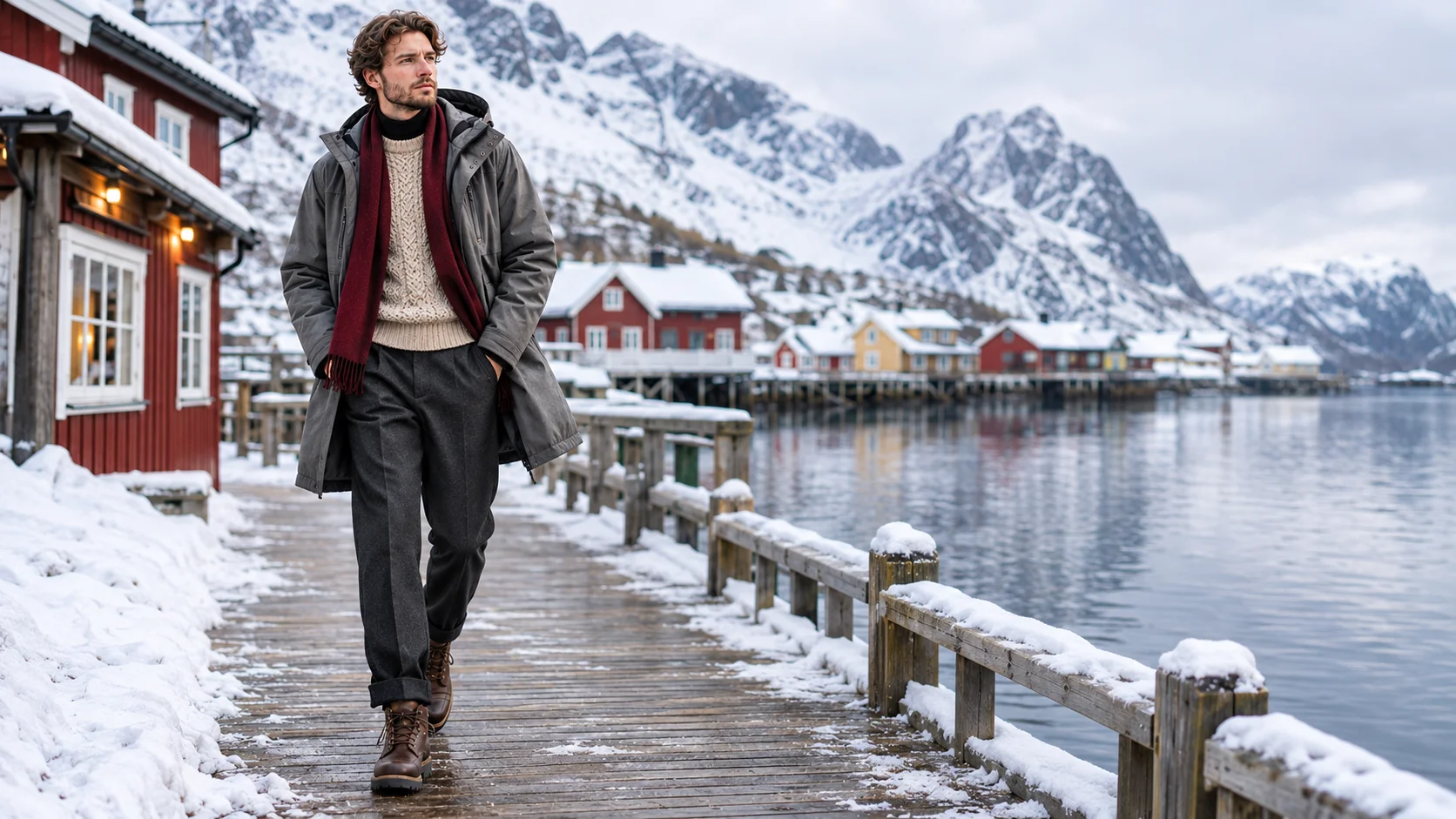
The trick to building effective Nordic winter layers is stacking three distinct weights—a fine ribbed turtleneck base, a chunky cable-knit mid-layer, and a weather-resistant technical parka—grounded in charcoal, oatmeal, and deep burgundy. Combining contrasting fabric textures with tailored dark trousers or dark denim keeps the profile streamlined while adapting easily to shifting indoor and outdoor temperatures.
Table of Contents
How the Three-Tier Nordic Layering System Works
Rather than relying on one heavy coat to do all the work, Nordic winter dressing distributes insulation across three purposeful tiers. Each tier has a clear structural job, trapping warmth efficiently without adding bulk around the shoulders or waist.
The base tier starts with a fine-knit black turtleneck sitting close to the neck and torso. Because a fine rib lies flat against the skin, it seals in heat at the collar while sliding smoothly beneath heavier knitwear without bunching at the sleeves. Over that sits the mid-layer: a chunky oatmeal cable-knit crewneck sweater. The raised cable stitch introduces visual depth and traps warm air, while the higher crew neckline lets a neat band of the black turtleneck peek through at the throat.
Topping the stack is a matte charcoal technical parka with a structured hood, storm placket, and generous flap pockets.Choosing an outer shell with clean, straight tailoring rather than heavy quilting gives the outfit architectural discipline.If you are building a broader cold-weather rotation, our guide to a European winter capsule wardrobe for men shows how core outerwear anchors multiple outfits across the week.
Balancing Texture and Weight Without Bulk
When multiple layers share the same smooth finish, an outfit quickly looks flat or overly formal. Nordic winter layers stay visually interesting by pairing four distinct surface textures in one frame: smooth technical weave, chunky cable knit, fine ribbed jersey, and brushed wool or raw denim.
Contrast keeps heavy winter fabrics from looking cumbersome. The matte, structured surface of a charcoal parka sharpens the soft, three-dimensional cables of an oatmeal sweater. Below the waist, dark charcoal pleated wool trousers or crisp dark indigo denim with contrast stitching anchor the upper-body volume with clean vertical lines. When pairing wool, knitwear, and structured outerwear, surface variation matters just as much as colour, a principle explored further in our guide on fall texture styling for men.
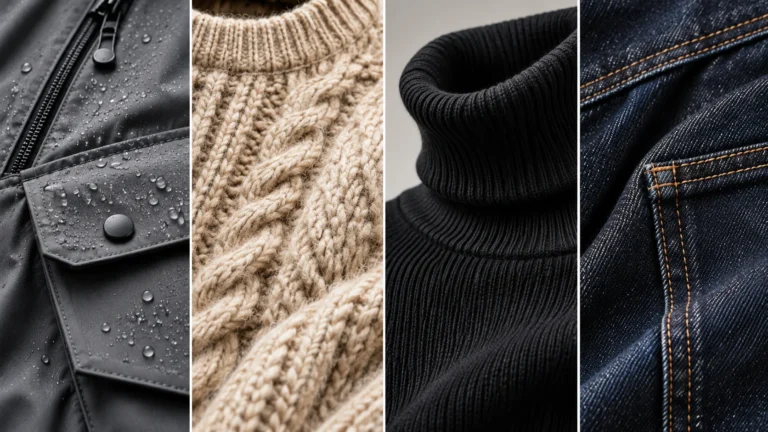
Check sleeve and hem proportions so no single layer fights another. Ensure your base turtleneck cuffs sit neatly beneath the ribbed cuffs of your cable-knit sweater, and choose a parka with enough armhole ease to accommodate a textured knit without pulling across the upper back.
The Grey, Oatmeal, and Burgundy Colour Formula
A restrained palette stops a multi-layered outfit from looking busy. Anchoring your wardrobe in cool charcoal grey,warm oatmeal, and dark indigo creates a calm, neutral foundation where every piece pairs effortlessly with the next.
Oatmeal acts as the bridge between cool and warm tones. Placed directly beneath a dark grey parka and over a black turtleneck, the warm cream knit brightens the face and prevents an all-dark winter outfit from feeling heavy. Dark brown lace-up leather boots with a sturdy lug sole ground the lower half, echoing the warm undertones of the knitwear while handling wet pavements.
To keep the palette from feeling clinical, introduce a single rich accent through your cold-weather accessories. A deep burgundy ribbed beanie and fringed scarf add controlled warmth near the neckline without disrupting the neutral base.Drape the scarf vertically inside the open lapels of the parka rather than tying a thick knot, preserving clean lines and avoiding collar bulk.
Adapting Nordic Layers for City Commutes and Weekend Walks
A modular layering system adjusts quickly when you move between freezing streets, heated trains, and casual indoor spaces. Instead of dressing for one static temperature, you can add or shed pieces while keeping an intentional outfit at every stage.
For daily city commutes or smart-casual office days, pair the charcoal parka and oatmeal cable knit with pleated dark grey wool trousers and polished brown lace-up boots. Once indoors, removing the parka leaves a composed sweater-and-trouser combination that looks sharp at a desk or over lunch—much like the transitions outlined in our guide to men’s office to dinner outfits.
For weekend travel or outdoor walks in crisp weather, swap the pleated wool trousers for straight-leg dark denim and add the burgundy beanie and scarf. The sturdy cotton twill of dark jeans handles wind and damp pavements while pairing naturally with lug-sole boots. According to the Woolmark Company, airing natural wool knitwear between wears and washing gently in cool water preserves fibre elasticity and loft across seasons.
Cuffs, Collars, and Layering Pitfalls to Avoid
Even well-chosen winter pieces lose their polish when small styling details clash at the neckline, waist, or ankle.Checking three common friction points keeps the silhouette sharp before you step outside.
Avoid pairing a bulky shawl-collar cardigan under a hooded parka, as competing collars bunch awkwardly behind the neck; stick to a flat-lying turtleneck under a clean crewneck instead. Keep trouser breaks clean over chunky boots by choosing a straight-leg cut or a single neat cuff so fabric does not pool around the laces. Finally, leave the parka unzipped indoors or during brisk walks so the layered black turtleneck, oatmeal knit, and vertical burgundy scarf create a streamlined central column.
Mastering Nordic winter layers comes down to letting each garment play a clear role: fine knitwear for warmth at the skin, chunky cable texture for insulation and depth, and a structured technical shell for weather protection. Start by pairing one textured neutral knit with a clean dark outer layer, and build your cold-weather rotation from there.
Related Blogs
- How to Style a Ski Sweater for City Winter: 5 Easy Looks
- 5 Men’s Puffer Jacket Outfits for Winter 2026
- Winter 2026 Capsule Wardrobe for Men in the USA: 12 Pieces, 30 Outfits
Frequently Asked Questions
How do I wear Nordic winter layers without looking bulky?
Combine garments of graduated thickness rather than stacking multiple heavy pieces. Pair a thin ribbed turtleneck base with one textured cable-knit sweater and a straight-cut technical parka. Tailored or straight-leg trousers balance upper-body volume and preserve a clean vertical silhouette.
What colours work best for a Scandinavian winter wardrobe?
Cool charcoal grey, black, and dark indigo form a versatile base, while warm oatmeal and cream soften contrast near your face. Adding one deep accent shade—such as burgundy or forest green—through a beanie and scarf brings warmth without complicating combinations.
Can I wear dark jeans instead of wool trousers with a technical parka?
Yes, straight-leg dark indigo jeans are an ideal casual alternative to pleated wool trousers. The sturdy denim weave complements a technical parka’s matte finish and pairs naturally with brown lug-sole leather boots for weekend errands or winter travel.
How should I style a scarf with a layered turtleneck and crewneck?
Drape a fringed scarf vertically down your torso inside an open parka rather than wrapping it tightly around your neck.This vertical line keeps the layered turtleneck and cable-knit collar visible while preventing bulk around the throat.
What boots suit Nordic winter layering outfits?
Sturdy dark brown leather lace-up boots with a lugged rubber sole work best. They provide reliable traction in cold,wet weather while their rich brown tone bridges charcoal trousers, dark denim, and warm oatmeal knitwear effortlessly.