
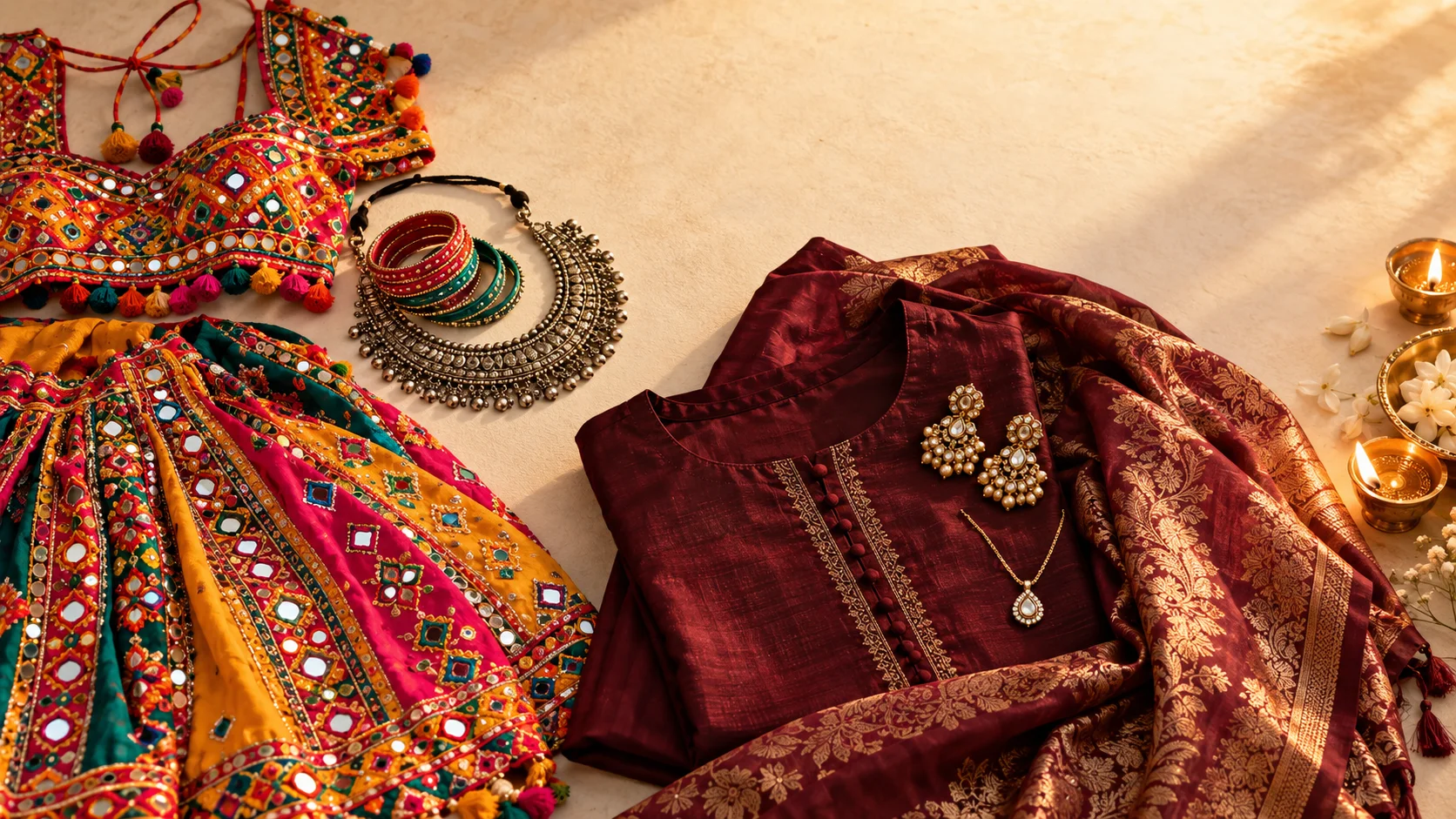
Navratri leaves you with a wardrobe full of mirror work, a dupatta that has survived nine nights of dancing and Diwali only a few weeks away. It is tempting to assume the whole festive set now needs replacing. It rarely does.
Keep the base garments and change the three things that show most when you are standing still or sitting beside the diyas: the layer you drape or wear over the outfit, the metal tone of your jewellery and the depth of your colour. A Navratri to Diwali wardrobe is a shift from outfits built for movement to outfits built for stillness, and a handful of swaps carries that shift.
Table of Contents
Table of Contents
Why Your Navratri to Diwali Wardrobe Needs a Mood Change, Not a New Set
Navratri dressing is judged in motion. A skirt that swirls, mirror work that flashes under the garba lights and a blouse cut so your arms can move freely all answer the same question: can you dance in this for hours? Lighter cottons and corset-style blouses earn their place for exactly that reason.
Diwali asks something different. The evenings are spent at the puja, welcoming guests, sitting at a long dinner table and posing for photographs in warm lamplight, so the outfit is seen at rest and up close. That is why richer fabrics such as silk, velvet and brocade, more structured silhouettes and deeper colours tend to take over. Texture and finish now do the work that movement did a fortnight earlier.
Diwali falls on Sunday 8 November this year, although puja timings change from city to city. Checking the Diwali 2026 date and Lakshmi Puja timings for your own city tells you which evenings need a dressier look and which can stay relaxed.
The common mistake is to wear the Navratri outfit unchanged and simply add more: more jewellery, more embellishment, more sparkle. That raises the volume without changing the mood. The fix is to change the quality of what you add, not the quantity.
Which Navratri Pieces Stay in Your Diwali Wardrobe
Sort your Navratri outfits by structure rather than by how much you enjoyed wearing them. Pieces that are already tailored or draped, such as kurta sets, sarees and plain or lightly worked lehenga skirts, carry over easily because the silhouette is settled and only the finishing layers need to change. The busiest mirror-work chaniya cholis are the ones to rest, because their whole character is movement.
Mirror work is not banned from Diwali. It simply works best as the only busy element, paired with something plain and deep-toned, rather than competing with a heavily worked dupatta and a full jewellery set.
The rule that keeps this manageable is to change two layers, not five. Choose one swap from the dupatta, jacket or blouse, and one from jewellery, then leave everything else alone. When every element changes at once, the outfit loses its coherence and you end up shopping to rescue it; two deliberate changes shift the mood while the base garment stays familiar.
If you want a method for sorting a wardrobe by the role each piece plays, our guide to festive outfit planning without buying a new look walks through it step by step.
Borrow Silk, Velvet and Brocade Without Buying a Full Outfit
Richness reads first in what frames your face and shoulders and what hangs from your body: the dupatta, the jacket and the blouse. That makes them the cheapest places to introduce a heavier fabric. A plain Navratri kurta set or lehenga skirt can look entirely different with a silk or brocade-style dupatta, or a velvet jacket worn over it.
The reason this works is structure. Heavier layers hold a deliberate fold instead of fluttering, which suits a person who is standing at a puja or sitting for dinner, whereas a light dupatta is designed to move with a dancer. Pin it or drape it so the folds sit where you want them to stay.
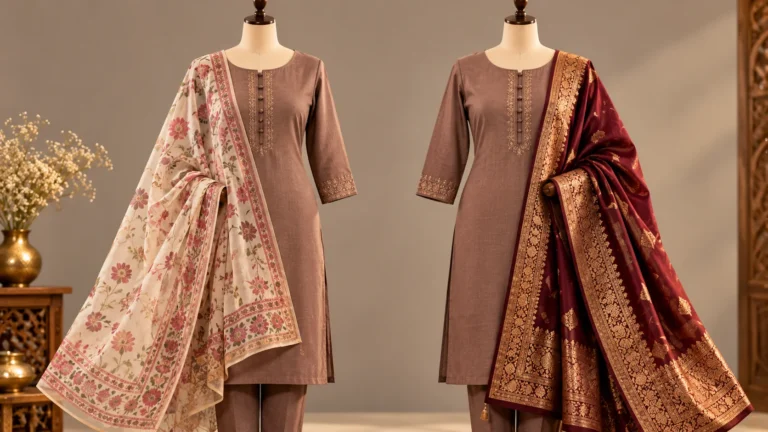
The blouse is the other quiet lever. If a corset-style blouse made sense for dancing, a plainer blouse in a deeper shade, with fuller sleeves or a higher neckline, tends to read as more formal without adding any decoration at all.
For a worked example of letting one festive kurta set lead through its colour and detailing while everything else supports it, see our festive kurta set styling guide.
Heavier fabrics can feel warm in a crowded, lamp-lit house, and weight varies from piece to piece. Try the dupatta or jacket on for a few minutes before the day and keep a lighter backup if it pulls on your shoulders.
Swap Oxidised and Glass Pieces for Gold-Toned, Polki or Diamond-Accented Jewellery
Oxidised sets and glass bangles suit the nine nights: they are light, bold and happy beside mirror work and cotton. Against silk and velvet, a warmer metal tone sits closer to the fabric’s own sheen, and it catches lamplight and fairy lights in a way darker pieces do not.
So carry forward what is neutral in shape, and swap the oxidised and glass pieces for gold-toned, Polki-style or diamond-accented ones. Festive jewellery coverage this season leans towards refined, comfort-led pieces rather than the heaviest set in your collection, which makes sense for an evening that involves hours of sitting, hugging relatives and holding a plate.
A useful limit is one focal piece. If the outfit already has a heavy dupatta, let a single pair of earrings or one necklace lead. If you are buying genuine Polki, diamond or gold jewellery rather than imitation styles, ask the seller for certification and care guidance, as quality varies widely between pieces.
If you assembled a Navratri jewellery edit, our Navratri jewellery guide sets out the five pieces it recommends. The hero earrings and the delicate layered necklace from that list tend to carry forward best, while glass or lac bangles are the pieces to rest until next year.
Deepen the Colour in Steps Instead of Starting Again
Navratri palettes lean towards bright primary shades. Diwali palettes tend to deepen into jewel tones such as emerald, wine and deep gold, which look richer in warm light and sit more comfortably beside silk and velvet.
You do not need to replace a bright garment to get there. Keep the vivid kurta or skirt and change what surrounds it: a wine or emerald dupatta, a deep gold border or a dark jacket makes the brighter base read as part of a richer palette. The rule is one bright shade at most, with the supporting pieces in deeper tones, because two competing brights flatten each other under warm bulbs.
Picture a hot pink Navratri lehenga skirt. Worn with a plain deep-green dupatta and gold-toned earrings, it becomes an evening outfit; worn with another bright dupatta and glass bangles, it is still Navratri.
Check the Look in Warm Light Before the Night
Dress the full look a day early and test it the way it will actually be seen. Stand under a warm bulb rather than daylight, because some colours that look vivid outdoors go flat or muddy indoors. Sit down for a few minutes, since a dupatta that sits perfectly while you stand can slip or bunch when you are seated.
Then take one photograph from a short distance. If a single element draws the eye away from the rest, such as an oversized earring against a heavily worked dupatta, remove or swap that one piece and look again. Finally, walk around for ten minutes: if any layer, pin or clasp is uncomfortable now, it will be unbearable by the third hour.
The rule behind every Navratri to Diwali wardrobe swap is the same: keep what is tailored, change what frames you, and let one deep colour and one warm metal lead. Start with two swaps this weekend, test them in warm light, and add a third only if the look still feels flat.
Related Blogs
- Multicoloured Kanjeevaram saree styling
- Green American diamond jewellery set styling guide
- How to style a black embroidered lehenga with a pink dupatta
Frequently Asked Questions
How do I plan a Navratri to Diwali wardrobe without buying new outfits?
Keep your base garments and change two layers: a heavier dupatta or jacket, and gold-toned jewellery in place of oxidised or glass pieces. Sort outfits by structure, rest the busiest mirror-work pieces, and deepen the colour with supporting pieces rather than replacing the garment itself.
Can I wear a mirror-work outfit for Diwali?
Yes, if it is the only busy element. Pair it with a plain, deep-toned dupatta and one gold-toned jewellery piece so the mirror work leads. Avoid layering it with heavy embellishment or a full set, which makes the look compete with itself.
Which jewellery suits Diwali after Navratri?
Gold-toned, Polki-style or diamond-accented pieces suit the richer fabrics of Diwali. Let one piece lead, such as earrings or a necklace, and rest glass bangles. When buying genuine stones or gold, ask the seller for certification and care guidance.
Which colours work for Diwali after Navratri’s brights?
Jewel tones such as emerald, wine and deep gold tend to look richer in warm light. You can keep one bright garment as the base, then surround it with deeper dupattas, jackets or borders so the overall palette reads darker and more formal.
What should I wear to the Lakshmi Puja?
Traditions vary by region and family, so follow your household’s custom first. Where there is no set rule, a deep-toned kurta set or saree with a heavier dupatta and gold-toned jewellery is a comfortable choice for sitting and standing through the ceremony.