
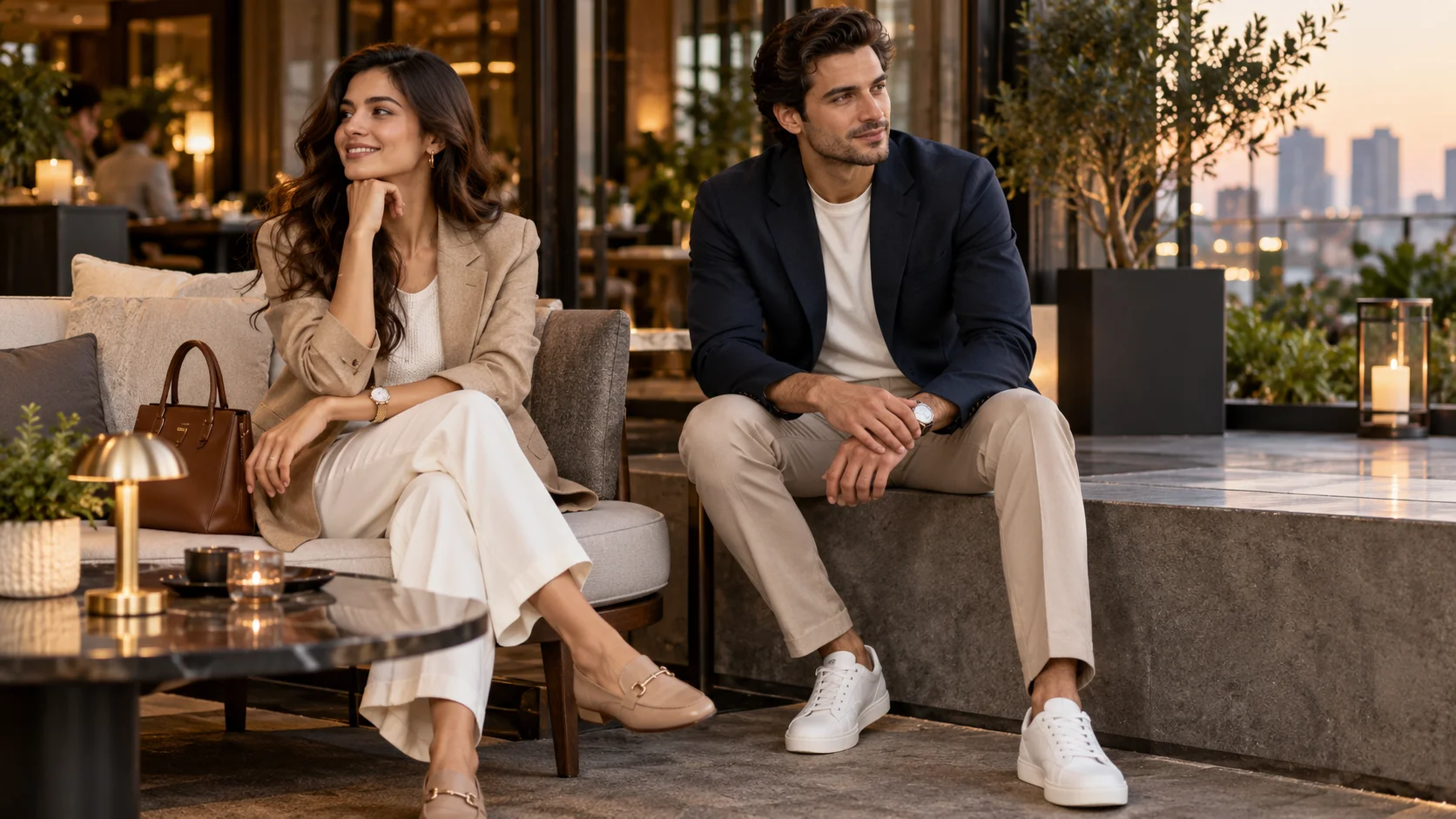
When an invitation says smart casual, the hardest part is often not getting dressed — it is working out what “smart” and “casual” mean in that particular setting. Smart casual sits between relaxed everyday clothing and formal dressing, and the right balance depends heavily on the occasion. ℹ️
A useful starting point is to build your smart casual outfit formulas around one polished element, one relaxed element and clean, intentional finishing touches. That gives you structure without making the outfit look overdressed.
Table of Contents
What Smart Casual Actually Means
There is no single universal smart casual uniform.
Cambridge Dictionary describes smart casual as clothing that is neat and stylish without being too formal, while MIT’s career guidance similarly places it between everyday casual and more formal dressing. ℹ️
That is why the context matters.
A smart casual outfit for a restaurant may allow dark denim and minimal trainers. A workplace event may call for tailored trousers and a blazer. A dinner or networking occasion may sit somewhere between the two.
The safest approach is therefore not to memorise one rigid outfit. Instead, create a flexible formula that can be adjusted according to the venue, time and invitation.
The Smart Casual Outfit Formula
Think of your outfit as three layers of decision-making.
Start with one polished anchor
Choose one piece that immediately gives the outfit structure.
Good options include:
- An unstructured blazer
- Tailored trousers
- A refined knit polo
- A crisp shirt
- A polished midi skirt
- A simple tailored dress
- A structured jacket
An unstructured blazer is particularly useful because it can bridge the gap between tailoring and relaxed clothing. Current men’s style guidance also highlights relaxed tailoring, knitwear, overshirts, chinos and clean trainers as useful ways of interpreting smart casual dressing. ℹ
Add one relaxed element
This is where the outfit becomes approachable rather than formal.
Try:
- Dark, clean denim
- A premium plain T-shirt
- Fine-gauge knitwear
- A relaxed shirt
- Straight or gently wide trousers
- Clean minimalist trainers
- A relaxed skirt or dress
The important point is balance. If your trousers are sharply tailored and your jacket is formal, a relaxed knit or simple top can soften the result.
If your base is casual, a blazer, polished footwear or structured bag can provide the opposite adjustment.
Finish deliberately
Shoes and accessories often determine where an outfit lands on the smart-casual spectrum.
Loafers, sleek flats, polished boots and minimalist trainers can all work, but the choice should reflect the occasion. John Lewis’ current 2026 guide similarly stresses context, with minimal trainers suited to some less formal settings and loafers or boots providing a more polished direction.
Keep accessories purposeful rather than adding several competing statement pieces.
Outfit Formulas for Unclear Dress Codes
When the dress code gives you little information, these combinations provide useful starting points rather than strict rules.
Formula 1 — Tailored Trousers + Relaxed Top
Pair tailored trousers with a fine knit, premium T-shirt, relaxed shirt or knitted polo.
This is one of the easiest ways to create a polished silhouette without looking as though you are heading to a formal business meeting.
For a neutral base, try navy, charcoal, beige, stone or cream. Add a belt and refined footwear to make the outfit feel intentional.
Formula 2 — Blazer + Dark Denim
A blazer can instantly give jeans a more polished direction.
Choose clean, non-distressed denim with a simple top underneath. A white or pale shirt keeps the combination classic, while a fine knit gives it a softer feel.
For footwear, consider loafers, sleek flats, Chelsea boots or minimalist leather trainers depending on the setting.
The key is contrast: the blazer provides structure while the denim prevents the outfit from becoming overly formal.
Formula 3 — Tonal Dressing
Wearing closely related shades is another simple way to make relaxed clothing look considered.
Try combinations such as:
- Cream with ivory
- Beige with stone
- Navy with lighter blue
- Charcoal with grey
- Brown with camel
Recent 2026 smart-casual coverage has highlighted tonal and monochrome dressing alongside elevated basics and relaxed tailoring. ℹ️
The result does not need to be completely monochromatic. Similar shades with subtle texture differences can create enough visual interest without relying on bold prints.
Formula 4 — Refined Knitwear + Structured Bottom
A premium-looking knit can be the bridge between casual and polished.
For a masculine wardrobe, consider a knitted polo or fine-gauge crew neck with chinos or tailored trousers.
For a feminine wardrobe, a sleeveless knit, fine cardigan or elegant jumper can work with tailored trousers, a midi skirt or a clean-lined dress.
The formula works particularly well when the fabric and fit look intentional.
Formula 5 — Simple Dress + Polished Accessories
Smart casual does not have to mean separates.
A clean midi or shirt dress can become smart casual with the right footwear, belt, bag and jewellery.
Choose understated accessories when the dress already has a strong silhouette or pattern. If the dress is simple, a structured bag or distinctive but restrained accessory can provide interest.
Formula 6 — Smart Base + Relaxed Layer
Start with tailored trousers or a simple dress and add a relaxed overshirt, cardigan or softly structured jacket.
Layering gives you another advantage: you can adapt the outfit when the setting changes.
A cardigan can soften a workwear-inspired look, while a structured jacket can make a relaxed base feel more polished.
What Feels Current in Smart Casual Style
Smart casual style in 2026 is increasingly being interpreted through elevated basics rather than complicated outfit combinations. Recent fashion coverage points towards relaxed tailoring, versatile separates, premium knitwear, clean silhouettes and tonal dressing. ℹ️ ℹ️
That does not mean every smart casual outfit needs to look minimalist.
The current fashion conversation also includes more personality through accessories and carefully chosen statement details. Vogue’s September 2026 New York Fashion Week coverage, for example, highlighted statement brooches, rich purple shades and scarf styling among notable street-style directions. ℹ️
For an unclear dress code, however, the practical takeaway is to introduce personality through one controlled detail rather than turning the whole outfit into a trend showcase.
A brooch, sculptural earring, textured belt, interesting shoe or coloured knit can be enough.
Small Details That Change the Whole Look
Sometimes the difference between “too casual” and “smart casual” is surprisingly small.
Check the footwear first
If an outfit feels too relaxed, changing the shoes can be one of the quickest adjustments.
Minimal trainers create a different impression from athletic running shoes. Loafers or polished boots can shift the same trousers towards a dressier setting.
Pay attention to fit
Smart casual does not mean tight clothing.
Relaxed silhouettes can still look polished when the proportions are intentional. Current fashion coverage continues to show relaxed tailoring and fluid shapes alongside cleaner, refined styling. ℹ️
The goal is not to make every piece fitted. It is to make the overall silhouette look deliberate.
Keep the colour story simple
A restrained colour palette makes mixing pieces easier.
Start with two or three compatible neutrals, then add one accent if you want more personality.
For example:
Navy + cream + brown
or
Stone + white + burgundy
or
Charcoal + grey + silver
This makes the outfit easier to adjust if you discover that the event is slightly smarter or more relaxed than expected.
Use accessories as the final adjustment
Accessories can help you move the outfit in either direction.
A structured leather bag, refined belt or polished watch can make a relaxed outfit feel smarter. Conversely, understated jewellery, a softer bag or minimalist trainers can prevent tailoring from becoming overly formal.
How to Decide What to Wear
If the invitation is vague, ask yourself four questions before getting dressed:
Where is it?
A restaurant, office, gallery, hotel, garden or private home can all suggest different levels of polish.
When is it?
Daytime usually allows more relaxed combinations, while evening occasions can call for sharper footwear, richer fabrics or stronger accessories.
Who will be there?
A workplace networking event and a casual dinner may both say “smart casual”, but the social expectations can be different.
What is the safest adjustment?
If you are genuinely uncertain, begin with a polished base and use one relaxed element to soften it. That gives you room to dress the outfit down without starting from something that feels obviously underdressed.
Most importantly, remember that smart casual is a balance rather than a single formula. The same blazer, trousers, dress or shoes can look completely different depending on what surrounds them.
The easiest wardrobe is therefore one built around versatile pieces that can move between relaxed and polished settings.
Final Thoughts
The most useful smart casual outfit formulas are flexible enough to respond to the occasion.
Start with one structured or polished element, add something relaxed, then use footwear and accessories to fine-tune the overall impression. Tailored trousers with knitwear, dark denim with a blazer, tonal separates and simple dresses with polished accessories can all provide a strong starting point.
And when the dress code remains unclear, focus less on following a rigid rule and more on creating an outfit that looks intentional, comfortable and appropriate for the setting.
Related Blogs
- Men’s Navy Blazer Styling Ideas
- Business Casual Fall Wardrobe Guide
- Men’s Casual T-Shirt Styling Guide
Frequently Asked Questions
1. What are smart casual outfit formulas?
Smart casual outfit formulas combine a polished element such as tailoring or refined knitwear with a relaxed element such as dark denim, a simple T-shirt or minimalist trainers. The final balance should suit the venue, time and occasion.
2. Can jeans be smart casual?
Yes. Clean, well-fitting dark or structured denim can work in some smart casual settings, particularly when paired with a blazer, refined knitwear, polished footwear or another tailored element.
3. Are trainers suitable for smart casual?
Minimal, clean trainers can suit some smart casual occasions, but athletic or heavily technical footwear may look too casual. Always consider the venue and how formal the invitation is.
4. What colours work well for smart casual outfits?
Neutral combinations such as navy, cream, beige, grey, charcoal, brown and white are easy starting points. A single accent colour can add personality without making the outfit feel overly busy.
5. How can I dress smarter without looking overdressed?
Add one structured element rather than formalising everything. A blazer, tailored trousers, polished loafers, refined knitwear or a structured accessory can raise the overall look while keeping the rest relaxed.