
This article may contain affiliate links. We may earn a commission at no extra cost to you.
A good business casual wardrobe should make weekday dressing simpler, not give you seven completely unrelated outfits to manage. For autumn, that often means building around a restrained palette and a handful of pieces that can move comfortably between more polished and more relaxed combinations.
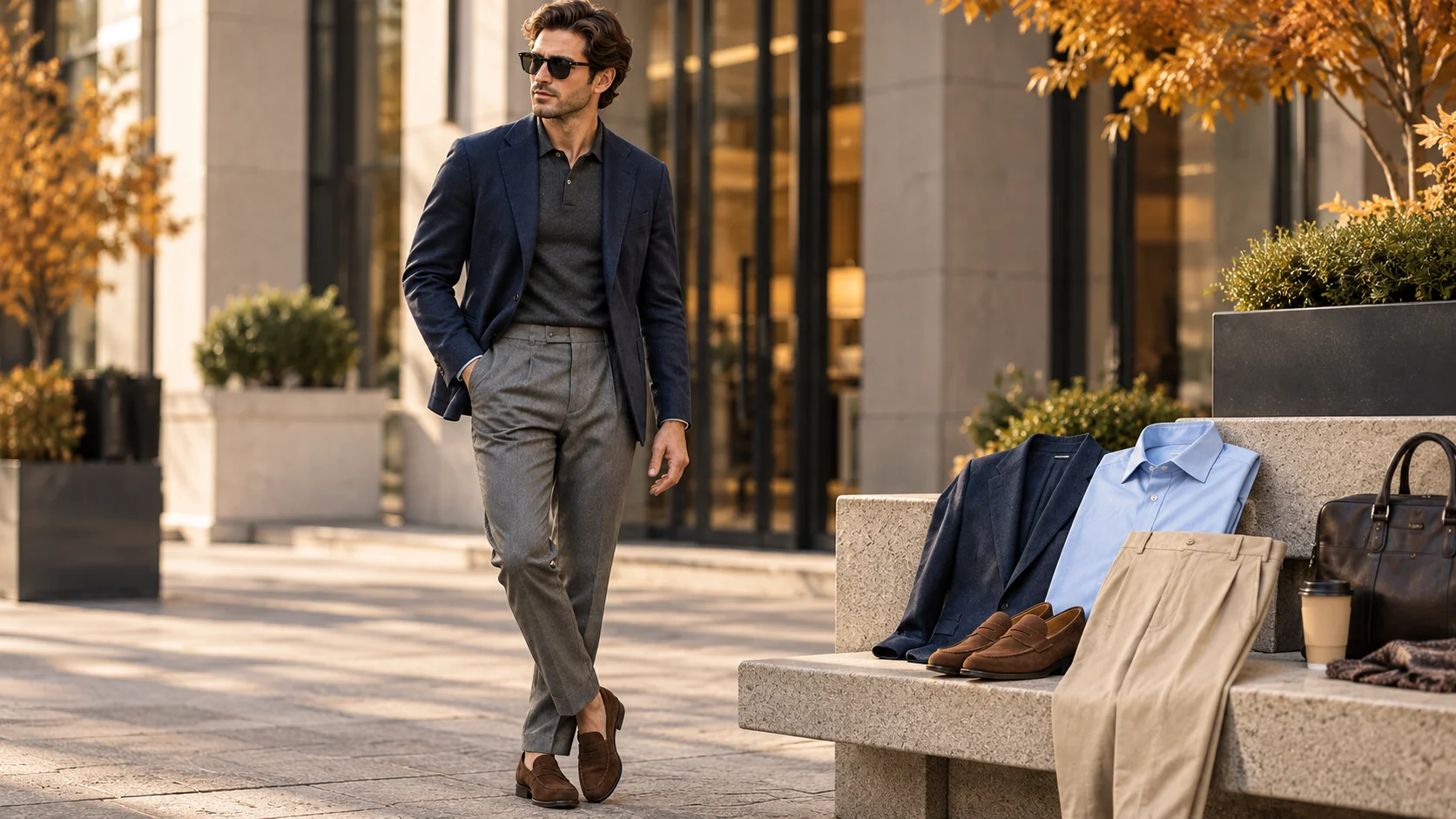
A navy blazer, charcoal polo, light blue shirt, grey pleated trousers, beige chinos, brown penny loafers and a simple belt illustrate the idea particularly well. Navy, charcoal, grey, beige, pale blue and brown sit together naturally, giving you enough contrast to keep outfits interesting without making every morning a colour-matching exercise.
The result is a business casual fall wardrobe that can take you from a conventional office combination to a more relaxed after-work look simply by changing a layer, shirt or pair of trousers.
Table of Contents
Why This Business Casual Fall Wardrobe Works
The strength of this wardrobe is not any single piece. It is the relationship between them.
Navy and grey form a classic foundation. Light blue adds freshness, while beige brings warmth and prevents the rotation from becoming too dark. Charcoal creates a softer alternative to black, and brown footwear complements the warmer side of the palette.
That makes mixing the pieces considerably easier.
The blazer can sit over either the light blue shirt or charcoal polo. Grey trousers work with both tops, while beige chinos provide a more relaxed alternative. The loafers help keep the overall appearance polished even when the blazer is left behind.
Rather than thinking in terms of seven fixed outfits, think of this as a small mix-and-match wardrobe system.
The colour palette does much of the work
One reason capsule-style dressing is useful for business casual wardrobes is that fewer competing colours mean more possible combinations.
Here, the palette has three broad roles:
- Foundation: navy, charcoal and grey
- Contrast: light blue and beige
- Finishing accent: brown footwear
You do not need every piece to match perfectly. In fact, slight tonal contrast usually makes business casual dressing look more considered.
The aim is coordination rather than uniformity.
Build Around Seven Versatile Pieces
1. Navy blazer
A navy blazer provides the clearest route from relaxed to polished.
Wear it with grey trousers when you want the outfit to feel more office-oriented, or introduce beige chinos when the setting allows something less formal.
Because navy works with both the charcoal and pale blue pieces in this wardrobe, it can become the recurring layer without making every outfit look identical.
2. Charcoal polo
The dark polo changes the character of the blazer immediately.
Compared with a conventional collared shirt, the combination feels more relaxed while retaining the clean lines that suit business casual dressing. It is particularly useful for days when a full shirt-and-blazer combination feels more formal than necessary.
3. Light blue shirt
A light blue shirt gives the wardrobe its classic office element.
Against navy and grey, the colour creates enough contrast to look crisp without becoming visually loud. With beige trousers, the same shirt moves towards a lighter and more relaxed combination.
4. Grey pleated trousers
Grey trousers bridge the gap between the navy blazer, charcoal top and lighter blue shirt.
The visible pleated styling also introduces some shape and visual interest, which is useful when the outfit relies on a limited colour palette.
5. Beige chinos
This is where the rotation becomes noticeably more flexible.
Beige trousers soften navy and charcoal while also working naturally with light blue. They can therefore shift an outfit away from traditional office dressing without taking it into weekend-only territory.
6. Brown penny loafers
Brown loafers provide a smart finishing point for these combinations.
Their warm colour complements beige particularly well while providing useful contrast against navy and grey. The loafer silhouette also sits naturally between dressier shoes and casual footwear.
7. A simple belt
Keep the belt visually restrained.
Its job within this kind of wardrobe is to finish the outfit rather than compete with it. When coordinating belts and shoes, aim for a harmonious overall effect rather than obsessing over an exact shade match.
How to Create a 7-Day Outfit Rotation
The interesting part begins once you stop treating these seven pieces as seven individual purchases and start looking at the combinations between them.
Here is one practical rotation to illustrate the principle:
Day 1 — Classic office:
Navy blazer + light blue shirt + grey trousers + brown loafers.
Day 2 — Relaxed business casual:
Charcoal polo + beige chinos + brown loafers.
Day 3 — Light and polished:
Light blue shirt + beige chinos + brown loafers.
Day 4 — Tonal weekday look:
Navy blazer + charcoal polo + grey trousers + brown loafers.
Day 5 — Simple office combination:
Light blue shirt + grey trousers + brown loafers.
Day 6 — Dark top, tailored bottom:
Charcoal polo + grey trousers + brown loafers.
Day 7 — Lighter blazer combination:
Navy blazer + light blue shirt + beige chinos + brown loafers.
These are not rules. They are a demonstration of how a limited wardrobe can produce different levels of formality without introducing an entirely new set of clothes every day.
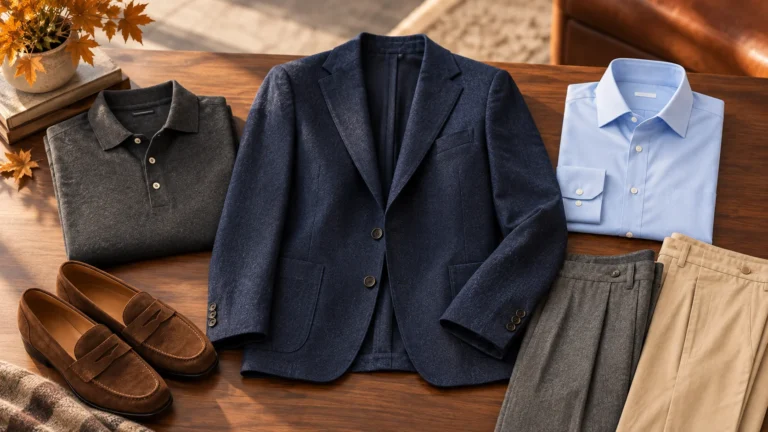
More importantly, you can alter the sequence according to your actual week. Save the blazer-and-shirt combinations for meetings, presentations or smarter environments, then use the polo or blazer-free combinations on less formal days.
That is much more useful than following a rigid Monday-to-Sunday formula.
The Office-to-Evening Formula
A business casual wardrobe becomes particularly valuable when your day does not finish at the office door.
You may have dinner, an informal meeting or another social commitment afterwards. Instead of planning a second outfit, build the daytime look so that one small adjustment changes its mood.
Start polished
For a more formal beginning, try:
Navy blazer + light blue shirt + grey trousers + brown loafers.
The combination has clear contrast and familiar business proportions.
Relax the top half
For a less formal setting, replacing the light blue shirt with the charcoal polo changes the tone without requiring an entirely different outfit.
The navy-and-charcoal combination is darker and more understated, while grey trousers maintain the smarter foundation.
Use beige to soften the look
Switching grey trousers for beige chinos has another effect.
The outfit immediately feels lighter and less corporate, particularly when paired with the blue shirt. The palette remains coordinated, but the impression changes.
This is why a well-planned wardrobe is less about owning a large number of items and more about understanding what each change does.
Small Styling Details That Matter
When the palette is deliberately restrained, details become more noticeable.
Keep the trouser break tidy
Whether you prefer pleated trousers or chinos, pay attention to how the hem meets your footwear. A clean trouser line helps loafers remain visible and keeps the proportions looking intentional.
Let one piece lead
If you are wearing the navy blazer, allow it to be the dominant dark layer rather than adding several competing statement elements.
If you skip the blazer, the contrast between the shirt or polo and trousers becomes more important.
Use contrast deliberately
Dark-on-dark combinations such as navy and charcoal can work particularly well when the trousers provide separation.
Similarly, the light blue shirt benefits from darker navy or grey around it.
Avoid over-accessorising
A restrained business casual wardrobe rarely needs numerous visible accessories competing for attention. Keep additions purposeful and appropriate to your workplace.
Think beyond one outfit
Before adding another piece to this kind of wardrobe, ask a simple question:
Will it work with at least two or three things I already wear?
That question can be more useful than deciding whether an item looks good on its own.
How to Make the Rotation Your Own
The seven-piece idea is a starting framework rather than a shopping checklist.
Your workplace, climate and personal preferences should determine the final version.
If your office is more formal, you might rely more heavily on collared shirts and tailored trousers. If the dress code is relaxed, polos and chinos may do more of the work.
Likewise, the exact colours can change while the underlying logic remains intact.
You could build around dark brown rather than navy, or use stone trousers instead of beige. What matters is maintaining enough colour compatibility that the pieces continue to communicate with one another.
Before buying anything new, look through your existing wardrobe. You may already own several pieces that can perform these roles. Identifying the gaps first can help you avoid buying another attractive item that works with almost nothing else.
A useful fall rotation should ultimately reduce decisions.
When the blazer works with both tops, both trousers work with those tops, and the footwear suits the overall palette, getting dressed becomes less about inventing an outfit and more about choosing the level of formality you need that day.
That is the real advantage of an effortless business casual fall wardrobe: fewer disconnected choices, more useful combinations, and enough variation to keep weekday dressing interesting.
FAQs
What should be included in a business casual fall wardrobe?
Start with versatile pieces that coordinate easily, such as a navy blazer, collared shirt, polo, grey trousers, beige chinos and loafers. Choose a cohesive colour palette so the individual pieces can create multiple combinations.
Can you wear a polo with a blazer for business casual?
Yes, in workplaces where the dress code allows it. A clean, understated polo beneath a blazer can create a more relaxed alternative to a traditional shirt while retaining a polished silhouette.
Are beige chinos appropriate for business casual?
They can be. Beige chinos pair naturally with navy, charcoal and light blue, making them useful for less formal business casual settings. Always consider your individual workplace dress code.
Do brown loafers work with grey trousers?
Brown loafers can complement grey trousers particularly well when other colours in the outfit, such as navy or light blue, create a cohesive palette.
How many outfits can you make from a small work wardrobe?
There is no fixed number because combinations depend on the individual pieces and dress code. A carefully coordinated capsule can create multiple looks by changing the top, trousers and layering piece rather than requiring a completely different outfit each day.