
This article may contain affiliate links. We may earn a commission at no extra cost to you.
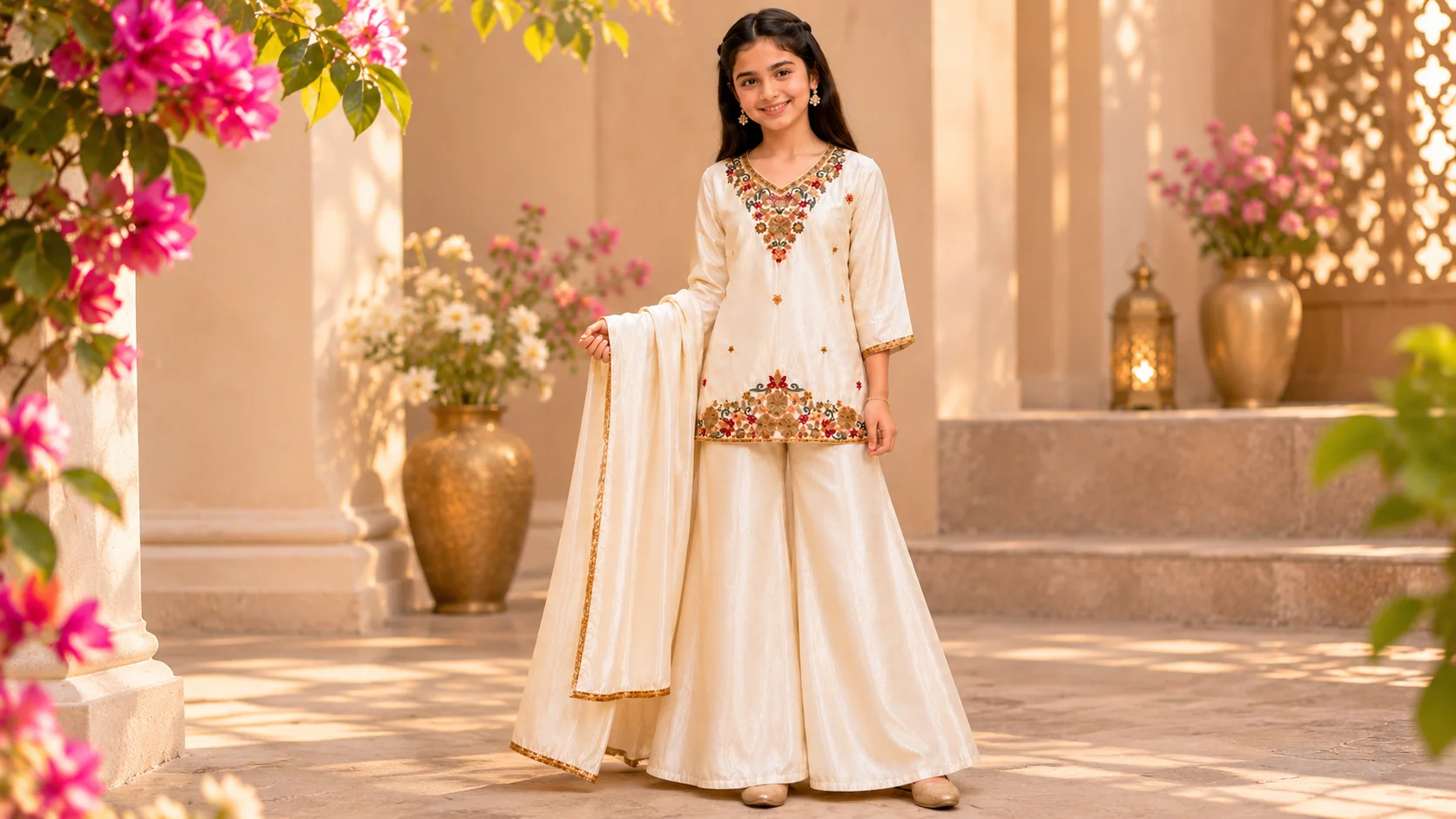
An ivory embroidered kurti set for girls can look complete before you add a single accessory. The challenge is knowing when to stop. With an ivory kurti, colourful embroidery, wide sharara trousers and a matching dupatta, the visual interest is already concentrated in a few carefully placed details.
The most balanced approach is to let the embroidery lead, keep the neckline clear, and use the dupatta and accessories to support rather than compete with the outfit. That gives parents a simple way to create a considered occasion look without over-styling it.
Table of Contents
Table of Contents
Read the Embroidered Kurti Set Before Styling
The KALINI embroidered kurti set is a coordinated three-piece look, listed as a girls’ ethnic-motif regular thread-work kurti with sharara and dupatta. The kurti has a V-shaped neckline, floral threadwork across the upper front, smaller motifs through the body and a more decorative border at the hem. The sharara creates a wide lower silhouette, while the dupatta repeats the light colour and decorative edging.
Notice where the detail sits. The neckline draws the eye towards the face, while the embroidered hem gives the lower half of the outfit its own focal point. Between them, the plain ivory areas create visual breathing space. This is why adding several strong accessories can make the look feel busier than intended.
Let the outfit lead, then choose additions around its neckline, hem and dupatta. Our guide to girls ethnic outfit styling explores the same principle with a different outfit.
Shop the StyleKeep the Embroidered Kurti Set’s Neckline and Hem in Focus
The embroidered neckline is the first detail most people notice, so it does not need a large necklace competing with it. Small earrings or a simple hair accessory can be enough. For a family celebration, choose one finishing detail that picks up a colour already visible in the embroidery.
The hem deserves the same consideration. Avoid adding another heavily embellished layer over its decorated border. Let the sharara remain visually simple beneath the kurti. If adding a bracelet or bangle, keep it restrained so the embroidered front remains the focus.
A useful rule for children’s occasion wear is one main decorative story at a time. Here, the embroidery is that story. For a different example of how a coordinated kurta set can be styled without overloading it, see girls festive kurta set styling.
Drape the Dupatta Without Hiding the Kurti
How the dupatta is arranged changes what people see first. A simple drape over one shoulder can leave the neckline visible and let the border fall as a neat frame. If it is carried over the forearm for photographs, keep the front of the kurti clear.
For a more traditional presentation, it can sit across both shoulders, but avoid covering the neckline motif or bunching it over the hem. The aim is to keep the outfit’s design visible.
The wide sharara already creates volume below the kurti, so simple footwear can help balance the silhouette. Plain flats or traditional slip-ons in a neutral shade are possible options; choose for the child’s size, the event setting and secure footing rather than appearance alone.
Choose the Occasion and Finish the Look Thoughtfully
An ivory embroidered kurti-sharara set can suit festive gatherings, family celebrations and cultural occasions where children’s ethnic wear is appropriate. For a daytime gathering, keep accessories minimal. For a more dressed-up celebration, a small coordinated hair detail or modest earrings may be enough.
Before the event, check the size information and compare garment measurements with the child’s current measurements where provided; age labels alone may not settle the choice. Check that the sharara length does not interfere with walking and that the dupatta is neatly secured. A long loose drape may be impractical during active play.
If you are looking for ways to make a kurta set work beyond a single celebration, girls kurta set styling for everyday wear offers a useful contrast in how simpler finishing choices can shift the mood.
The best finishing choice is the one that leaves the child able to move naturally while keeping the outfit’s embroidery visible. A quick check in a full-length mirror can catch a hidden neckline, a twisted dupatta border or a hem that needs adjusting.
When an embroidered kurti set for girls already has a decorated neckline and hem, restraint is the useful styling rule. Keep accessories selective, arrange the dupatta so the main details remain visible, and check the outfit’s practical fit before leaving.
Related Blogs
- Beautiful Kids Ethnic Wear Styling Made Effortless — more ideas for balancing ivory-and-gold children’s ethnic wear.
- Beautiful Floral Girls Ethnic Wear With Effortless Festive Style — a colour-led approach to styling a floral festive outfit.
- Beautiful Girls Angrakha Kurta Set With Smart Styling Ideas — an alternative silhouette with a different approach to children’s ethnic styling.
Frequently Asked Questions
How do I style an ivory embroidered kurti set for girls?
Let the embroidery remain the main feature. Keep the neckline free from a large necklace, choose one or two restrained accessories, and drape the dupatta so it frames rather than covers the kurti. Simple footwear helps maintain visual balance.
Can a child wear a sharara set to a family celebration?
A sharara set can be suitable for a family celebration when the event’s dress code and setting make ethnic wear appropriate. Check the garment length and ensure the child can walk, sit and move without the trousers or dupatta getting in the way.
Should I add a necklace to an embroidered kurti?
Not necessarily. If the kurti already has noticeable embroidery around the neckline, a necklace may compete with that detail. Small earrings or a simple hair accessory can provide a finishing touch without crowding the upper front.
How should the dupatta be draped on a child?
Choose a neat, manageable drape that does not cover the main embroidery or trail where it could catch underfoot. Secure it appropriately for the occasion, and reconsider a loose drape when the child will be moving or playing actively.
What should I check before buying a girls kurti and sharara set online?
Read the product description and size chart, then compare the listed garment measurements with the child’s current measurements where available. Check what pieces are included, review the care instructions and confirm the return terms before ordering.