
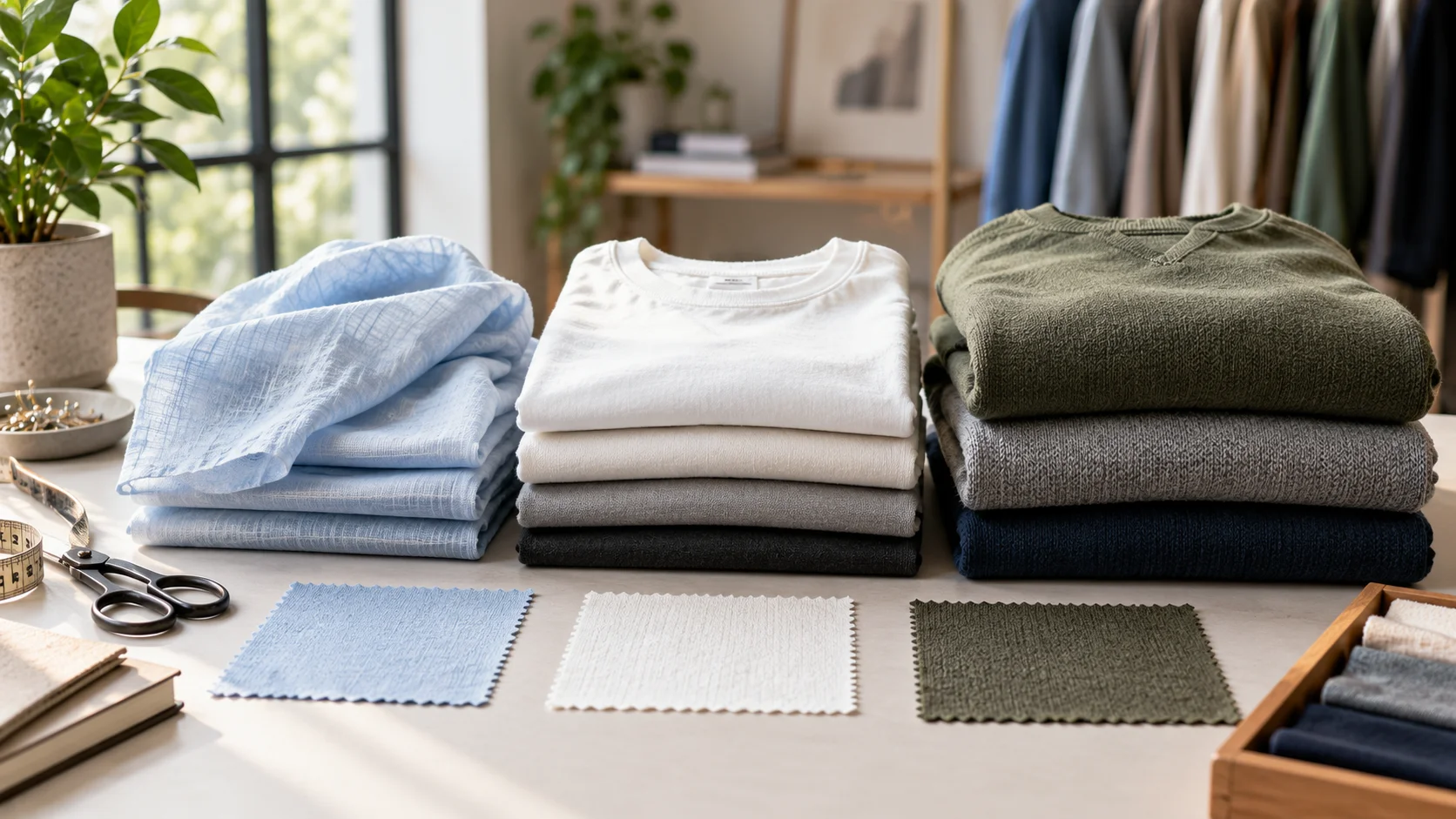
When you shop for clothes online, fabric composition, fit and colour usually get most of the attention. Yet another specification can tell you something surprisingly useful about a garment before you buy it: GSM.
GSM means grams per square metre. In textiles, it measures how much one square metre of a fabric weighs. Textile Exchange uses GSM in this sense when documenting fabric weight.
That makes GSM useful for understanding whether a fabric is relatively light, medium or heavy. But it is not a standalone quality score. A higher number does not automatically mean better clothing, and a lower number does not automatically mean cheaper or poorer fabric.
The useful question is not “What is the highest GSM?” It is “What fabric weight makes sense for the garment I actually want to wear?”
Table of Contents
What Does GSM Mean in Clothing?
GSM stands for grams per square metre, usually written as g/m². It describes the mass of a square metre of fabric rather than the total weight of the finished garment.
For example, if two fabrics of exactly the same area weigh different amounts, the fabric with the higher GSM is heavier per square metre.
This distinction matters because the finished weight of a shirt, sweatshirt or pair of trousers also depends on how much fabric is used, garment size, construction and components. GSM is therefore primarily a fabric specification, not simply another way of stating how heavy the whole garment feels.
Textile Exchange documentation explicitly identifies fabric GSM as weight in g/m² and treats it separately from other construction information such as yarn count and ends or picks per inch.
A simple way to think about GSM
Imagine equal-sized pieces of two fabrics.
If the first square metre weighs 150 grams, it is 150 GSM. If the second weighs 300 grams, it is 300 GSM.
The second fabric has twice the mass per unit area.
What that means for an actual garment, however, needs more context.
Why Fabric GSM Matters When Buying Clothes
Knowing the GSM can make an online product description more informative because fabric weight can help you judge whether a garment broadly fits the role you have in mind.
You might be looking for a lightweight T-shirt for warm days, a more substantial everyday tee, a layering piece or a heavier sweatshirt. GSM gives you another piece of information for distinguishing between options that can look remarkably similar on a screen.
It is particularly useful when:
- comparing similar garments from the same or different brands;
- choosing clothing for different seasons;
- deciding whether you want a lighter or more substantial fabric;
- comparing two products with similar fibre compositions;
- evaluating whether a garment’s stated fabric weight suits its intended use.
The important word is context.
GSM should be considered alongside fibre content, fabric construction, intended use and the manufacturer’s other specifications—not treated as a shortcut for judging the entire garment.
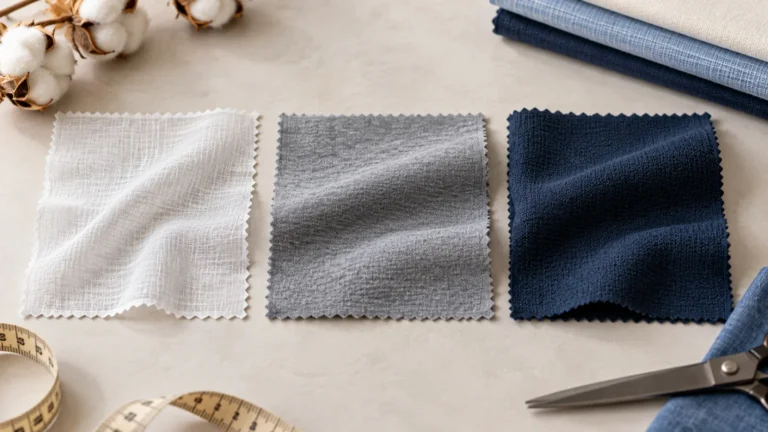
Light, Medium and Heavy GSM Explained
There is no universal clothing rule saying that every fabric below one exact number is “light” and every fabric above another is “heavy”. Different fabric constructions and garment categories can behave differently.
As a broad illustration, one textile manufacturer classifies 20–100 GSM as light, 101–249 GSM as medium and 250+ GSM as heavy across its fabric applications. Those ranges are useful for understanding the concept, but they should not be treated as a universal clothing standard.
Lightweight fabrics
Lower-GSM fabrics use less mass per square metre.
In clothing, a lighter fabric may be desirable when you want a less substantial garment or when the design is intended for lightweight dressing. But GSM alone cannot tell you exactly how cool, soft, opaque or durable that garment will be.
Those characteristics also depend on factors such as fibre, yarn and construction.
Mid-weight fabrics
A middle-range GSM can make sense for many everyday garments where neither extreme lightness nor substantial weight is the primary goal.
This is also where context becomes particularly important. Two fabrics with similar GSM figures can still look and behave differently because their fibre content and construction differ.
Heavier fabrics
Higher GSM means more fabric mass per unit area. It can therefore help identify more substantial fabric options.
But avoid turning that observation into assumptions about comfort or quality. A heavier fabric is not automatically warmer, softer, stronger or more premium simply because its GSM number is higher.
GSM tells you weight per area. Other specifications tell you other parts of the story.
Why Higher GSM Does Not Automatically Mean Better
This is perhaps the most important lesson when learning what GSM means in clothing.
Suppose you are comparing a lightweight summer shirt with a substantial sweatshirt. Choosing the garment with the higher GSM because “higher must be better” would make little sense: the two products are designed for different purposes.
The same principle applies within a clothing category.
Fabric weight needs to work with:
Fibre composition. Cotton, linen, polyester and blends can have different characteristics even at comparable fabric weights.
Fabric construction. The way fibres and yarns become fabric affects how the finished textile behaves. Textile Exchange documentation, for example, records GSM alongside construction information rather than treating fabric weight as a complete specification by itself.
Intended use. The ideal fabric for a light layer may be quite different from the fabric you would deliberately choose for a structured or substantial garment.
Season and climate. Fabric weight can be one useful consideration when building a wardrobe for particular conditions, but fibre, weave or knit, layering and garment design matter too.
Personal preference. Some people simply prefer a lighter-feeling T-shirt; others like something more substantial. Neither preference is inherently superior.
So instead of asking, “Is 250 GSM better than 180 GSM?”, ask:
“Which fabric weight better suits what I want this garment to do?”
That small change makes GSM considerably more useful.
How to Use GSM When Shopping Online
Once you understand the number, GSM becomes practical rather than technical.
1. Start with the garment type
Decide what you are actually buying.
A T-shirt, overshirt, sweatshirt and pair of trousers serve different purposes. Comparing their GSM figures without considering the garment type tells you very little.
2. Decide how substantial you want the fabric to be
Are you deliberately looking for something lightweight, or do you prefer a more substantial fabric?
This gives the GSM number a purpose.
3. Check the fibre composition
Do not stop at GSM.
Look at the stated fibre percentages and other available fabric details. A fabric’s mass per square metre cannot identify its fibre composition for you.
4. Look for construction information
If a retailer or manufacturer provides information about weave, knit or fabric construction, use it.
GSM and construction answer different questions, which is why technical textile documentation can specify both.
5. Compare like with like
GSM becomes particularly useful when you are comparing genuinely similar garments.
Two basic T-shirts intended for a similar purpose? Useful comparison.
A summer shirt and a winter sweatshirt? The GSM difference is obvious but not particularly helpful as a quality comparison.
6. Do not invent information that is missing
If a product page does not state GSM, you usually cannot reliably calculate it from a photograph or from the finished garment’s listed shipping weight.
Instead, use the specifications that are actually provided or check whether the manufacturer publishes the fabric weight.
The Smarter Way to Compare Two Garments
When two products look similar, try a simple comparison sequence:
Purpose → fibre composition → fabric construction → GSM → fit → care requirements
GSM sits in the middle rather than at the top.
For example, imagine two plain T-shirts. One has a lower GSM and the other a higher GSM. If you specifically want a lighter garment, the lower figure may be more aligned with your preference. If you want a more substantial fabric, the higher figure may be more relevant.
But you would still want to consider their fibre composition, construction, fit and care information before making a decision.
That is why GSM is best viewed as a decision-support specification rather than a quality rating.
One Number, Much Better Context
GSM can look like obscure textile jargon until you know what it represents. In reality, it is straightforward: grams per square metre tells you the weight of fabric per unit area.
Its real value comes from using that number intelligently.
Instead of chasing the highest GSM, consider the garment’s purpose, fibre composition, construction, season and your own preference for lighter or more substantial clothing. That approach makes fabric specifications much more useful when you cannot touch the garment before buying it.
Once you start reading product details this way, GSM stops being a mysterious number and becomes another practical tool for making a more informed clothing choice.
FAQs
What does GSM mean in clothing?
GSM in clothing means grams per square metre, a measurement of fabric weight per unit area. A higher GSM indicates more fabric mass per square metre, but it does not by itself establish overall garment quality.
Is a higher GSM always better for clothing?
No. Higher GSM means a heavier fabric per square metre, not automatically better quality. The appropriate weight depends on the garment, its intended use, fabric construction and your preferences.
Does high GSM mean a garment will be warmer?
Not necessarily. GSM provides information about fabric weight. Warmth can also be affected by fibre type, construction, garment design, layering and other factors, so GSM should not be used as a standalone warmth rating.
Can two fabrics with the same GSM feel different?
Yes. GSM measures weight per area rather than every property of the textile. Fibre content, yarn characteristics, weave or knit, finishing and construction can make fabrics with similar GSM figures behave differently.
Should I check GSM when buying clothes online?
It can be useful when the manufacturer provides it, especially when comparing similar garments. Combine GSM with fibre composition, construction, fit, intended use and care information rather than making your decision from the GSM number alone.