
This article may contain affiliate links. We may earn a commission at no extra cost to you.
A beautiful saree rarely needs an overload of accessories to make an impression. Sometimes, the most memorable look comes from allowing its colour, border and drape to lead — then adding just enough detail to give the outfit a contemporary point of view.
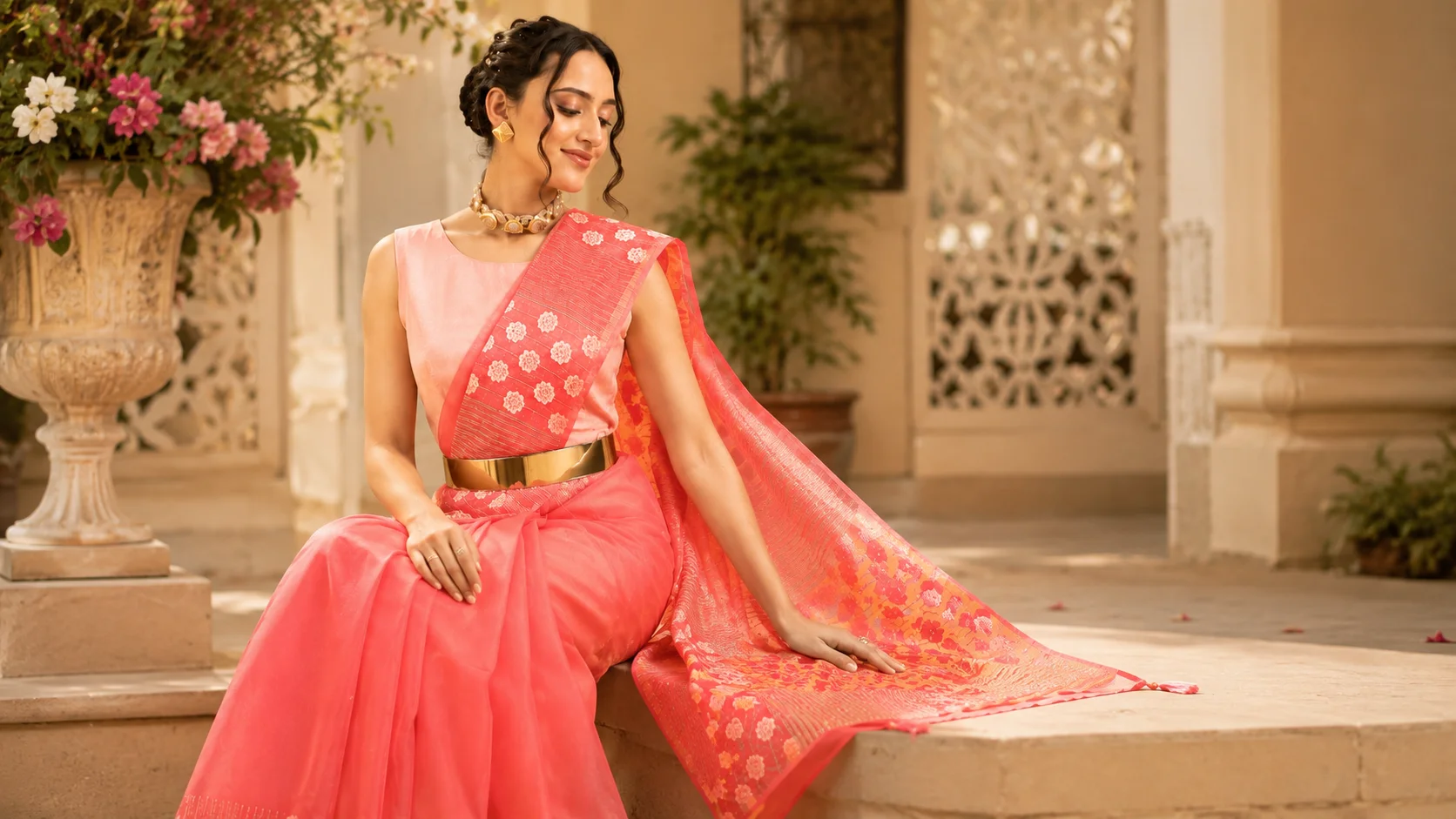
This coral-pink saree is a good example. Its warm colour palette, floral detailing and contrasting patterned border already provide plenty of visual interest. The styling lesson is simple: when a saree has distinctive details of its own, build the rest of the outfit around them rather than competing with them.
Table of Contents
Why This Coral-Pink Saree Catches the Eye
The first thing that stands out is the interplay of colour and detail.
The main body uses a warm coral-pink tone, while the border introduces floral motifs, fine linear detailing and stronger colour accents. Rather than appearing completely uniform from top to bottom, the saree creates different points of interest as the eye moves across the drape.
That distinction matters when styling it.
With a very minimal saree, accessories often have to provide the visual personality. Here, much of that work is already being done by the saree itself. This gives you the freedom to keep the blouse and supporting accessories relatively controlled.
The sleeveless blouse in a closely related pink tone is one way to approach it. Keeping the blouse within the same colour family prevents another competing block of colour from interrupting the saree.
If this combination fits the kind of occasion look you are building, you can review the original product listing for further product information and available options.
View Product DetailsLet the Saree Border Lead the Styling
One of the easiest mistakes with patterned ethnic wear is trying to match every visible colour.
You do not need to.
Instead, identify the element you want to emphasise. With this saree, the decorative border can become the anchor for the whole outfit.
A tonal blouse allows that border to remain prominent. You could take a similar approach with footwear and a small clutch, choosing pieces that sit quietly alongside the saree rather than introducing another elaborate pattern.
There is also a useful placement trick here: pay attention to how the pallu falls across the upper body. When the border contains one of the saree’s strongest decorative elements, arranging the drape so that this section remains visible can make the overall look feel much more intentional.
This does not require an elaborate styling technique. It is simply about deciding which part of the saree deserves attention before adding anything else.
The Belt Changes the Whole Silhouette
A metallic waist belt introduces an interesting contemporary element to a traditional drape.
Visually, it creates a defined break around the waist and gives the flowing saree a more structured appearance. It can therefore be an effective styling direction when you want traditional clothing to feel slightly more fashion-led without fundamentally changing the saree itself.
The key is restraint.
If you choose a noticeable belt, consider allowing it to be the primary statement accessory around the waist. Adding several equally bold elements nearby can quickly make the middle of the outfit feel crowded.
A belt can also affect how the drape is perceived. Instead of the fabric appearing entirely fluid from shoulder to floor, the defined waist creates two visual zones: the decorated upper drape and the longer pleated section below.
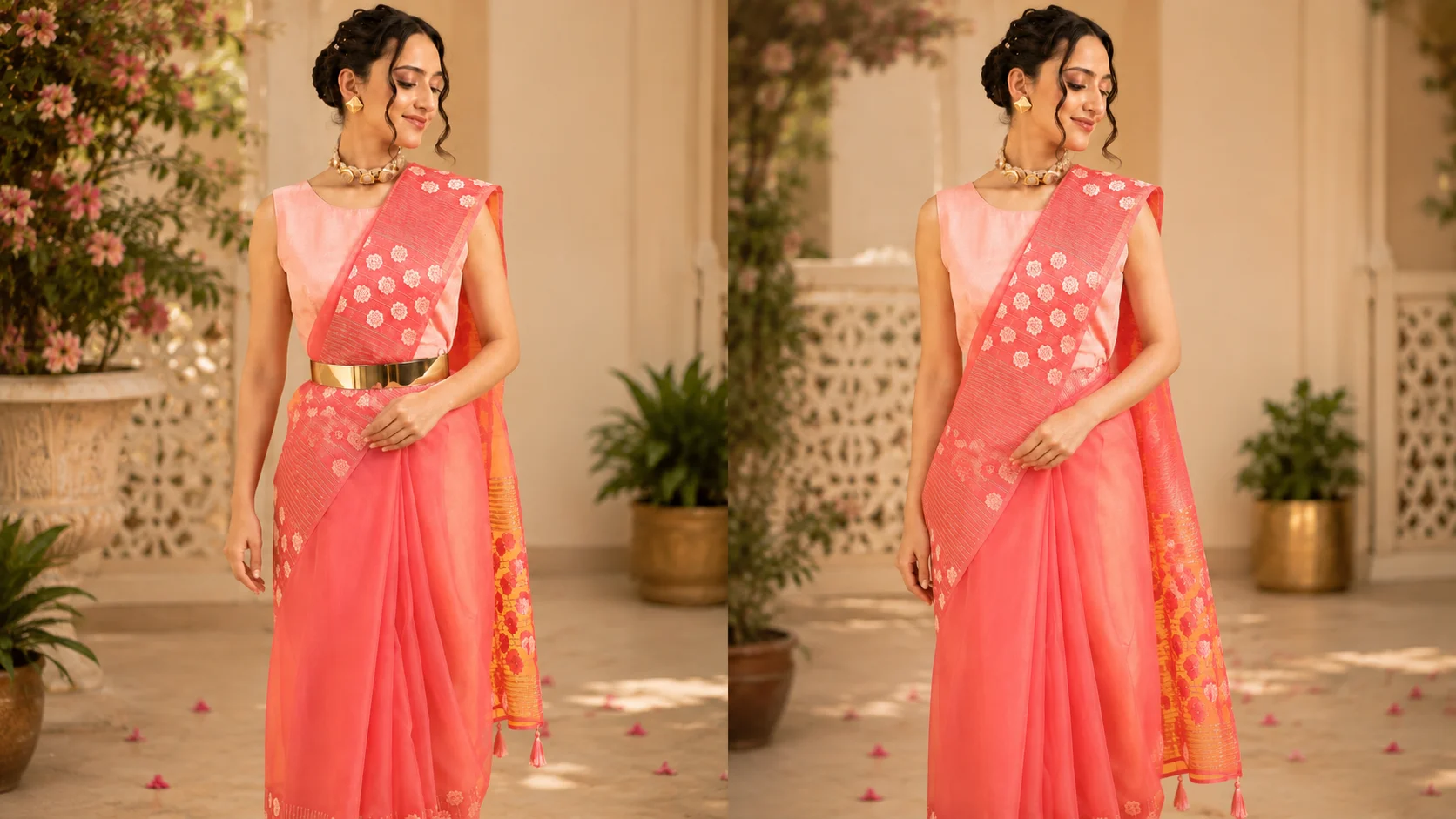
For a softer interpretation, the same saree could be worn without a belt. That would shift attention away from the waist and back towards the uninterrupted fall of the drape.
Neither approach is inherently better. The choice depends on whether you want the styling to feel more traditional and fluid or more structured and contemporary.
Jewellery That Complements Rather Than Competes
Once the saree and belt are doing significant visual work, jewellery needs a little more consideration.
A necklace positioned close to the neckline can work particularly well with a sleeveless blouse because it fills some of the visual space around the neck without interfering with the saree border.
The broader lesson is more useful than trying to reproduce one exact jewellery combination:
Choose one jewellery zone to emphasise.
For example, you might make the necklace the focus and keep the earrings relatively restrained. Alternatively, statement earrings could take the lead while the neckline remains simpler.
You can also take colour cues from the metallic waist detail. Repeating a similar warm metallic tone through earrings or another small accessory can help different elements of the outfit feel connected.
That does not mean every piece has to match perfectly. In fact, overly precise matching can sometimes make an outfit feel more assembled than styled.
A few coordinated details are usually enough.
Where This Saree Styling Direction Works
The combination naturally leans towards occasions where dressing up feels appropriate.
Think festive gatherings, family celebrations, cultural occasions, daytime functions or wedding-related events where a colourful saree suits the setting. The final level of formality can then be adjusted through accessories.
For a lighter daytime direction, you could simplify the jewellery and let the floral detailing carry the look.
For a more dressed-up occasion, a defined waist, coordinated jewellery and polished footwear can create a stronger visual statement.
The coral-pink palette is also useful because it offers several possible supporting colour directions. Warm metallic tones create one route, while softer neutrals can keep the overall styling calmer. Picking one supporting palette — rather than introducing many unrelated colours — generally produces a more coherent result.
How to Recreate the Look Without Overdoing It
You do not need the exact same accessories to borrow the strongest ideas from this styling direction.
Start with the saree.
Arrange the drape so that its distinctive border or motif remains visible. Then choose a blouse that supports the saree instead of fighting for attention.
Next, decide whether you want a defined waist. If yes, introduce one belt that visually works with the rest of the accessories. If no, allow the drape to remain fluid and use jewellery as the main finishing detail instead.
Then edit.
Before leaving the mirror, ask yourself whether the saree still feels like the hero of the outfit. If the answer is no, remove one competing element.
That small editing step can make a considerable difference.
A statement necklace, large earrings, belt, embellished clutch and highly decorative footwear might all work individually, but wearing every statement at once is not necessary. Select the details that strengthen the saree and allow the remaining pieces to play supporting roles.
A simple styling formula
Try thinking of the outfit in four layers:
Saree: the visual foundation
Blouse: the supporting colour and silhouette
One focal accessory: perhaps the belt or jewellery
Finishing details: restrained footwear, bag and remaining jewellery
This formula is flexible enough to adapt to other Indian wear as well. It also makes getting dressed easier because every accessory has a purpose.
If the coral-pink colour, floral detailing and decorative border suit the outfit direction you have in mind, check the product page before making your final decision.
Explore This SareeA saree does not become memorable simply because more accessories are added to it. Strong styling comes from recognising what is already interesting about the garment and building around that.
Here, the combination of coral-pink colour, decorative floral elements, a prominent border and a defined waist provides plenty of personality. Keep those elements in focus, edit the supporting accessories carefully, and the result can feel polished without becoming visually busy.
FAQs
How can I style an elegant saree without making it look over-accessorised?
For elegant saree styling, start with the saree’s strongest visible feature and let it lead. If the border or pattern is already decorative, choose one focal accessory and keep the remaining jewellery, bag and footwear comparatively restrained.
Does a belt work with a saree?
Yes, a belt can create a more defined and contemporary-looking silhouette. Choose one that visually complements the saree and accessories, and avoid overcrowding the waist with several competing statement elements.
What jewellery works with a saree that already has a decorative border?
Try emphasising one jewellery area. A noticeable necklace with simpler earrings, or statement earrings with a quieter neckline, can prevent the jewellery from competing with the saree.
Should the blouse match the saree exactly?
Not necessarily. A blouse in the same or a closely related colour family can create a cohesive look, while a contrasting blouse can create more separation. The right choice depends on how much visual contrast you want.
What occasions suit a colourful floral-detailed saree?
Depending on the garment and dress code, this styling direction can inspire outfits for festive gatherings, family celebrations, cultural occasions and wedding-related events. Adjust the jewellery and accessories to suit the formality of the occasion.