
This article may contain affiliate links. We may earn a commission at no extra cost to you.
Some pieces do not need complicated styling to make an impression. A vivid colour-block top can do most of the visual work itself, especially when its silhouette is relaxed and the colour story is already strong.
The easiest way to style a colour block top for women is to let it remain the focal point. Pair its saturated shades with a quieter bottom, keep accessories selective rather than competitive, and repeat one of the top’s colours only when you want a more coordinated finish.
That sounds simple, but there is plenty of room to change the mood. The same statement piece can feel relaxed, artistic, polished or occasion-ready depending on what surrounds it.
Table of Contents
Why This Colour-Block Top Already Does the Heavy Lifting
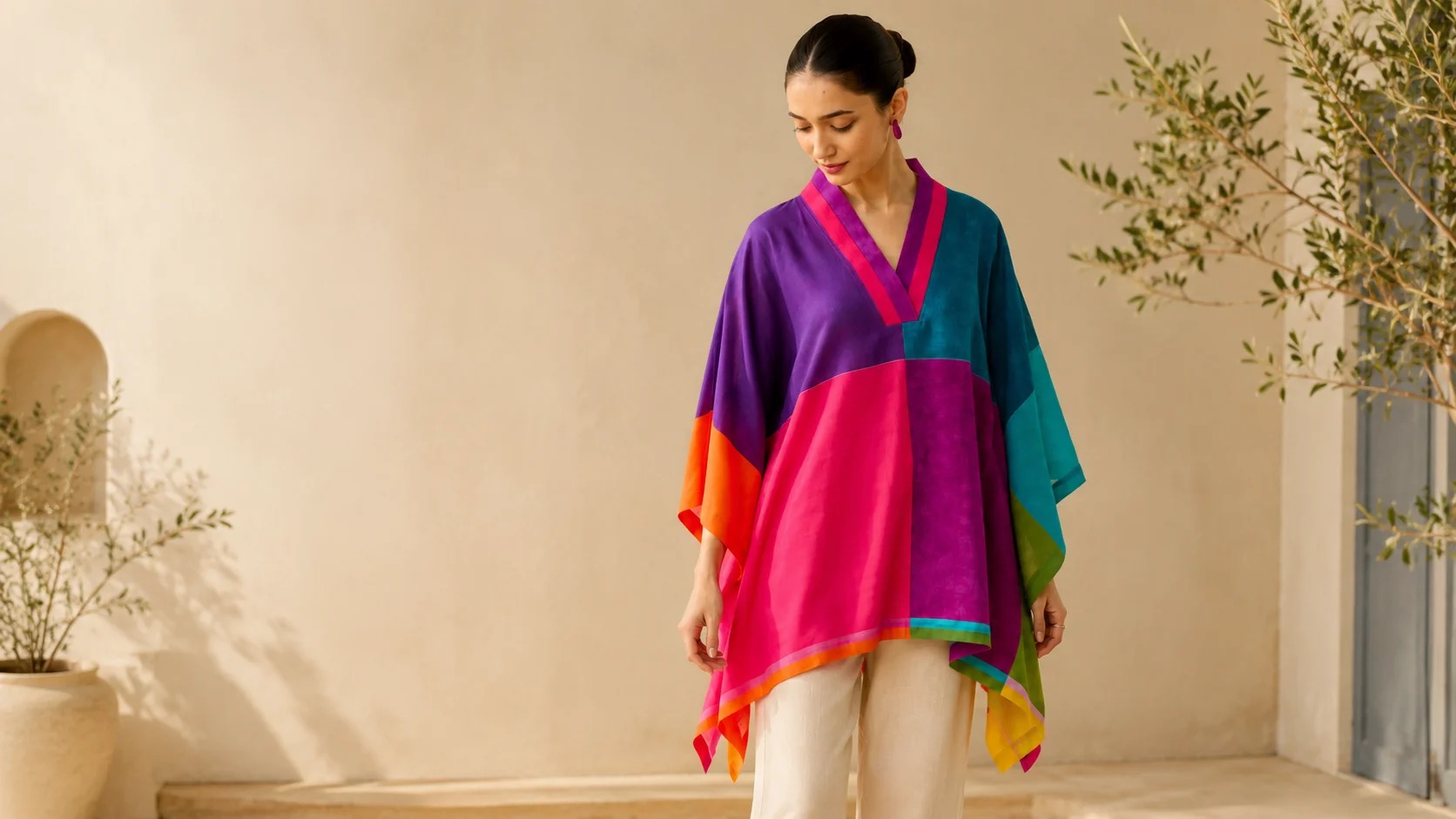
The appeal here is immediately visual: large areas of purple, vivid pink, teal and magenta are balanced by smaller flashes of orange, green, yellow and turquoise. The V-shaped neckline and loose, asymmetric drape give those colours plenty of uninterrupted space.
That combination makes the top a natural statement piece. You do not need a heavily patterned trouser, an elaborate necklace and several colourful accessories to prove the point again.
In fact, restraint elsewhere can make the colour blocking look even more intentional.
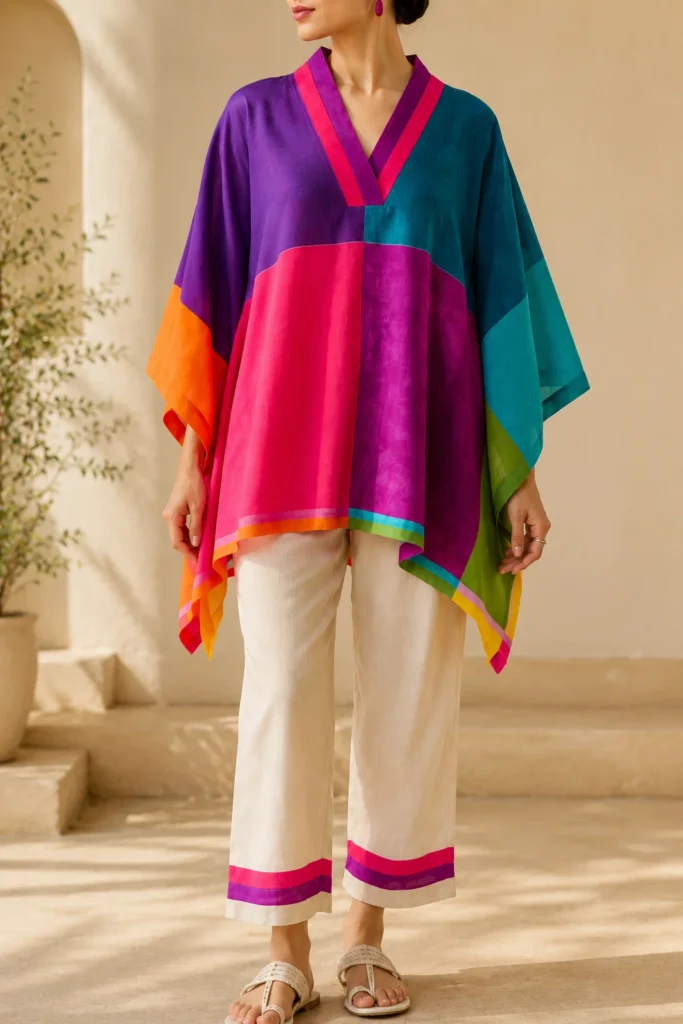
The cream trousers shown with the top demonstrate the principle particularly well. Their neutral tone gives the brighter shades room to stand out, while the coloured bands near the hems create a small visual connection without turning the lower half into a competing focal point.
If your wardrobe normally leans neutral, a piece like this can also be an approachable way to introduce stronger colour: one expressive garment, surrounded by familiar basics.
Explore This StyleStart With a Calm Bottom
When one garment contains several strong colours, the bottom is usually the easiest place to create balance.
Cream, ivory, ecru, beige and other quiet neutrals can work particularly well because they soften the transition from a highly saturated top without making the outfit feel dull. White can create a crisper contrast, while black can produce a sharper, more graphic effect.
The silhouette matters too.
Because the top has a generous shape, a clean straight-leg or gently wide trouser keeps the overall outfit visually controlled. You do not necessarily need a tight bottom to “balance” an oversized top. What matters more is avoiding unnecessary detail that fights with the garment.
Think clean lines rather than rigid rules.
For a casual direction, simple trousers and understated sandals are enough. For a slightly smarter interpretation, you could explore a more structured neutral trouser and refined footwear while keeping the colourful top unchanged.
A useful colour rule
Instead of asking, What matches every colour in this top?, ask:
What can stay quiet enough to make these colours look their best?
That small change in thinking makes colourful pieces much easier to style.
Let One Colour Lead the Accessories
Accessories are where a colourful outfit can either become beautifully cohesive or unnecessarily busy.
Rather than trying to repeat purple, pink, teal, orange and green simultaneously, choose one accent colour from the garment and let it make a small return elsewhere.
For example, earrings in a pink or magenta family can visually echo the neckline and main colour panels. Alternatively, you could leave the jewellery neutral and introduce a restrained teal, purple or orange accent through a bag or another small accessory.
The important word is small.
You are creating a visual echo, not building a second colour-block composition around the first.
Metallic or neutral accessories are another useful route when you want the top to command virtually all the attention. A simple bag, uncomplicated footwear and restrained jewellery can give a highly colourful garment a more grown-up editorial feel.
Three Styling Directions Worth Trying
A strong statement top becomes much more useful when you stop thinking of it as having only one “correct” outfit.
1. Relaxed and easy
Keep the formula close to its simplest form:
statement top + neutral trousers + understated sandals
This works because nothing distracts from the garment’s colour and drape. Add only a small piece of jewellery if the outfit needs a finishing touch.
It is an uncomplicated direction for daytime dressing, casual gatherings or occasions where you want personality without looking over-styled.
2. Polished with contrast
Move towards a cleaner, sharper base.
Try a streamlined neutral or dark trouser, simple footwear and a structured-looking accessory. Instead of adding several bright accents, allow just one colour from the top to reappear.
The top still provides the expressive element, but the surrounding pieces make the overall styling feel more deliberate.
3. Colour-aware without becoming colour-heavy
If you enjoy brighter wardrobes, choose one supporting shade that relates to the top rather than introducing a completely unrelated palette.
For example, a subtle teal, pink or purple accessory can build continuity. Keep the remaining elements quiet so that the outfit still has a clear visual hierarchy.
This is often more effective than attempting to match every coloured panel.
When More Colour Actually Works
Neutral styling is the easiest route, but it is not the only one.
A colourful garment can sit alongside additional colour when there is a clear relationship between the shades. The safest approach is usually to pull a colour that already appears in the main piece rather than introduce several new competing hues.
Another option is tonal styling. A deeper or softer variation of one visible shade can feel connected without looking overly matched.
What tends to create difficulty is not colour itself but too many simultaneous focal points.
A bright top, patterned trousers, statement earrings, a contrasting bag and highly decorative shoes may all be attractive individually, yet together they can leave the eye with nowhere to settle.
Before adding another bold element, ask what it contributes. If the outfit already feels complete, stopping is often the stronger styling decision.
See The Product DetailsMake the Look Feel Like Your Own
Colour-block fashion does not require a colour-theory rulebook. The most wearable outfits usually begin with a simple hierarchy: decide what should attract attention first, then let everything else support it.
With a top this expressive, that hierarchy is already clear.
If you prefer minimalist dressing, surround it with cream, beige, white, black or another restrained neutral. If your style is more playful, pick one of its vivid colours and repeat it selectively. If you want a smarter result, focus less on adding decoration and more on clean shapes and purposeful accessories.
Most importantly, resist the urge to finish the outfit simply because there is still room to add something.
A statement piece becomes memorable when it has space to be seen.
FAQs
How do you style a colour block top for women?
Start with a neutral bottom such as cream, beige, white or black and let the colourful top remain the focal point. Then add restrained footwear and either neutral accessories or one accent that repeats a shade already present in the top.
What trousers work with a multicoloured statement top?
Plain trousers with clean lines are an easy choice. Neutral shades reduce visual competition, while straight or gently wide silhouettes can complement a loose statement top without adding unnecessary detail.
Should accessories match a colourful top?
They do not have to match exactly. Try repeating just one colour from the garment through earrings, a bag or another small accent, or choose neutral accessories and let the top carry the colour story.
Can I wear more than one bright colour in the same outfit?
Yes. A useful approach is to repeat a shade already present in the main garment or use a tonal variation of it. Keeping the remaining elements quieter helps prevent the outfit from feeling visually crowded.
How can I make a bold top look more polished?
Reduce competing details. Pair it with a clean neutral base, selective jewellery and simple footwear. A more structured trouser or accessory can also shift the outfit towards a polished direction without hiding its colourful character.