
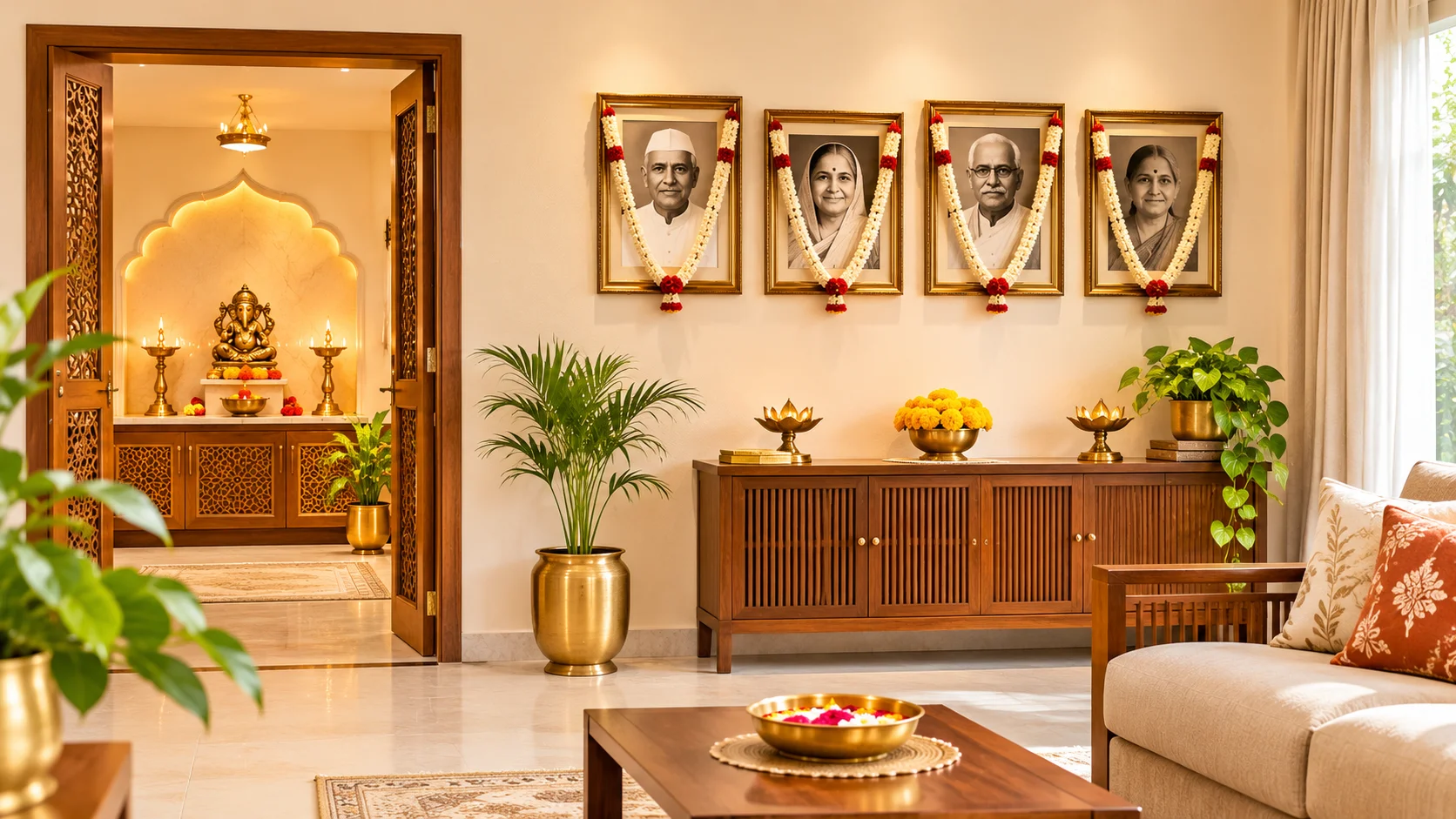
Many families display photographs of their departed loved ones as a way of remembering their lives and honouring their contribution to the family. However, when it comes to Vastu, the placement of these photographs deserves some thought, particularly when a home has a dedicated pooja room.
Traditional Vastu guidance generally recommends keeping ancestors’ photographs separate from pictures or idols of deities. Instead, a respectful place on the south wall of a living space is commonly suggested. This approach keeps the worship area focused while providing a dignified place for family memories.
Table of Contents
Why Vastu Separates Ancestors’ Photos from the Pooja Room
A pooja room is traditionally considered a dedicated space for prayer, meditation and worship. It is usually arranged around deities, religious symbols and objects associated with daily spiritual practices.
Ancestors hold a different place in family traditions. Their photographs represent remembrance, gratitude, family heritage and respect for previous generations. Although honouring ancestors is meaningful in many Indian households, traditional Vastu guidance distinguishes remembrance from the worship of deities.
For this reason, many Vastu practitioners recommend displaying ancestral portraits separately rather than placing them alongside religious idols or photographs.
The intention is not to show less respect to departed family members. It is to give both spaces their own purpose.
If your existing pooja room contains ancestors’ photographs, there is no need to panic or make expensive changes. A simple relocation to a suitable wall elsewhere in the home can help create a more organised arrangement.
Where to Place Ancestors’ Photos Instead
The south wall of a living space is traditionally recommended for ancestors’ photographs in the guidance used for this topic. Some Vastu practitioners also suggest the south-west direction.
The south is symbolically associated with ancestors in several Vastu traditions. However, recommendations can vary between practitioners and regional customs, so the south and south-west should not automatically be treated as identical rules.
Consider these practical placement suggestions:
- Living room: Choose a calm, respectful section of the living room where the photographs can be displayed without competing with the main decorative arrangement.
- South wall: If following the traditional recommendation, identify the actual south-facing wall using a compass rather than estimating its direction from the room layout.
- Respectful height: Position the photographs at a comfortable viewing height, allowing family members to remember their loved ones without placing the frames in an awkward or neglected position.
- Dedicated display: If several generations are represented, arrange their photographs neatly together instead of scattering them across different rooms.
A simple arrangement with suitable frames and enough surrounding space can look dignified without making the room feel like a memorial gallery.
Placements to Avoid When Displaying Ancestors’ Photos
Apart from choosing a suitable location, it is equally useful to understand which placements traditional Vastu guidance commonly discourages.
Alongside deities in the pooja room: Keep ancestral portraits separate from religious idols and deity photographs. This preserves the distinct purpose of the worship area.
Above bedroom beds: Many Vastu practitioners advise against placing ancestral photographs directly above the bed or on the headboard wall. A separate living-space display is generally a more suitable alternative.
Above doors: Avoid hanging photographs directly above doorways. Apart from the traditional recommendation, this can also be an awkward arrangement for viewing and maintaining the frames.
In neglected or cluttered corners: Avoid placing family photographs where they are easily forgotten, surrounded by miscellaneous objects or difficult to maintain.
If your home has limited wall space, do not undertake unnecessary reconstruction just to follow a placement recommendation. Choose the most respectful and practical available location, taking your family’s traditions into account.
How to Create a Respectful Ancestors’ Photo Display
A thoughtful display does not require an elaborate interior makeover. A few simple decisions can make the arrangement feel appropriate and visually balanced.
Start by selecting a clean, uncluttered wall. If you are following the south-wall recommendation, confirm the direction first. The direction of a wall cannot be reliably identified from a photograph of the room.
Next, consider the number and arrangement of frames. Similar frame finishes can create a coordinated appearance, while consistent spacing prevents the wall from looking crowded. For multiple generations, a balanced arrangement is usually easier to maintain than an assortment of photographs placed randomly.
Keep the photographs clean and in good condition. Avoid positioning frames where moisture, direct heat or accidental knocks could damage them. Make sure wall-mounted frames are properly secured.
You can also keep the surrounding décor understated. A small decorative element may complement the display, but excessive decoration is unnecessary. The photographs should remain the main focus of this dedicated area.
If you are also planning the layout of your worship space, our guide to Prayer Corner Vastu Made Simple for a Beautiful Sacred Space offers further ideas for organising a home prayer corner.
The aim is to create a setting that respects family memories while keeping the pooja room organised and focused on worship.
Conclusion
Vastu traditionally recommends keeping ancestors’ photographs separate from deities, with the south wall of a living space commonly suggested as an alternative. Treat the direction as traditional guidance rather than a guaranteed outcome, and confirm it with a compass before arranging the photographs. A respectful, uncluttered display is a practical place to start.
Further Reading
For a contemporary discussion of how Vastu practitioners approach ancestral-photo placement, see The Most Auspicious Places to Hang Family Photos as per Vastu – Architectural Digest India. Its guidance also discusses the south-west direction, illustrating why recommendations can differ between practitioners.
Frequently Asked Questions
1. Can ancestors’ photos be kept in the pooja room as per Vastu?
Many Vastu traditions recommend keeping ancestors’ photographs separate from deity images and idols. The pooja room is traditionally reserved for worship, while ancestral portraits are better displayed in a separate, respectful area of the home.
2. Which direction is considered suitable for ancestors’ photographs?
The south direction is traditionally recommended, while some Vastu practitioners also suggest the south-west. These recommendations can vary between traditions. Use a compass to identify the actual direction instead of relying on the apparent position of a wall.
3. Can ancestors’ photos be placed in the living room?
Yes. A clean and respectful section of the living room is a commonly suggested alternative to the pooja room. If following Vastu guidance, consider the south wall and arrange the photographs neatly at a comfortable viewing height.
4. Is it appropriate to keep ancestors’ photographs in a bedroom?
Many Vastu practitioners advise against displaying ancestral photographs directly above the bed or on the headboard wall. A separate living-space display is generally preferred. Consider your household’s traditions and choose an arrangement that feels respectful.
5. What should I do if my home has no south-facing wall available?
Avoid unnecessary structural changes. Choose a clean, dignified and practical alternative location that respects your family’s customs. If strict directional compliance matters to your household, consult a knowledgeable Vastu practitioner about the available layout.