
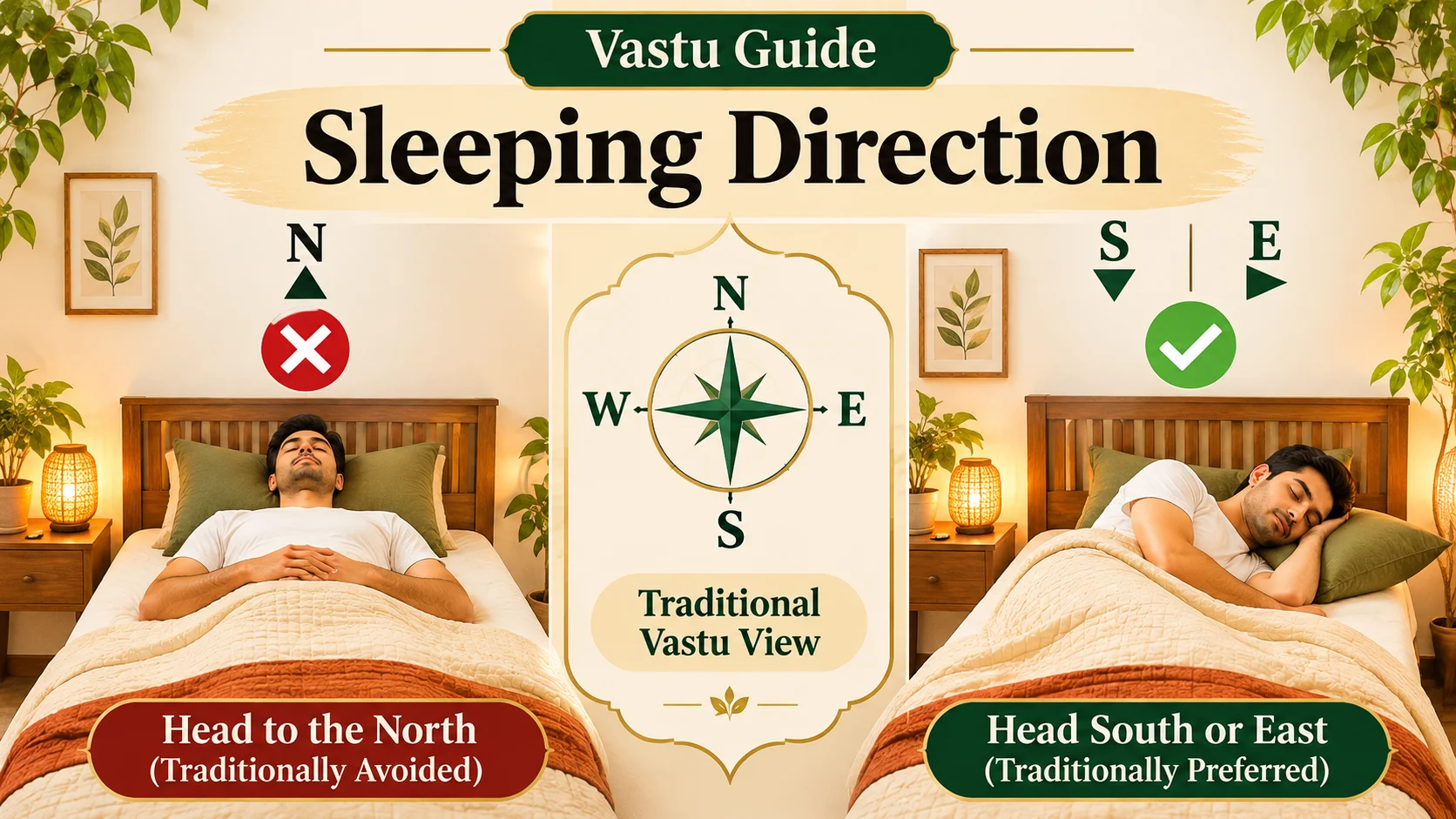
Sleeping direction is one of the most commonly discussed bedroom topics in Vastu. According to traditional Vastu guidance, sleeping with your head towards the North is generally avoided, while South or East is traditionally preferred.
The practical first step is simple: check the actual direction of your bed with a reliable compass or compass app. If your head currently points North and following Vastu is important to you, consider repositioning the bed so your head points South or East. If neither arrangement is practical, some Vastu traditions also consider West as an alternative.
It is important to keep the distinction clear: these are traditional Vastu beliefs and practices, not a guaranteed medical method for improving sleep or health.
Table of Contents
What Vastu Traditionally Says About Sleeping With Your Head North
In traditional Vastu practice, the direction of the body during sleep is considered part of the overall relationship between a person and their living space. A common recommendation is to avoid placing the head towards the North while sleeping.
Traditional explanations sometimes connect this advice with the Earth’s magnetic field and the body’s orientation. However, this explanation should not be treated as established medical proof. Vastu guidance can vary between regions, texts and practitioners, so it is better understood as a traditional framework for arranging a home rather than a guaranteed cause-and-effect system.
The useful decision for a homeowner is therefore straightforward: if you choose to follow Vastu principles in the bedroom, head direction is one placement detail to consider alongside the rest of the room’s layout.
A broader review of Maharishi Vastu Architecture also discusses the role of directional orientation and sleeping direction, while making clear that this is an area of ongoing research and interpretation rather than a simple universal medical rule.
Why South and East Are Traditionally Preferred Sleeping Directions
Traditional Vastu guidance commonly gives priority to sleeping with the head towards the South or East.
Head towards South
South is often the first traditional preference in many modern Vastu recommendations for sleeping arrangements. The bed should be positioned so that your head rests at the South end and your feet point generally towards the North.
For an existing bedroom, this can sometimes be achieved simply by rotating the bed rather than making any structural changes. That makes it a practical adjustment for homeowners and renters alike.
Head towards East
East is another commonly preferred direction in traditional Vastu practice. If the bedroom layout works better with the headboard against an eastern wall, this can provide an alternative arrangement without forcing the room into an awkward furniture layout.
The important point is not to create a new practical problem simply to follow one directional rule. Your bed should still allow safe movement, comfortable access and sensible use of the bedroom.
How to Check Your Bed Direction and Make a Practical Change
A frequent mistake is guessing the bedroom’s direction from the position of a window, sunrise or the shape of the property. Vastu guidance should not be based on a visual assumption.
Instead, use a reliable compass to identify the actual cardinal directions.
Start with these steps:
- Stand near the centre of the bedroom and identify North, South, East and West.
- Check which direction your head points when you are lying on the bed.
- If your head points North and you want to follow traditional Vastu guidance, first see whether rotating the bed towards South or East is practical.
- Check that the new position does not block doors, windows, walkways or essential storage.
- Avoid expensive structural changes unless they are genuinely necessary for the wider function of the room.
The bed direction is only one part of creating a comfortable bedroom. A clear, practical layout can matter more to everyday usability than forcing furniture into an inconvenient position.
If your bedroom also has heavy built-in storage above the bed, you may want to explore Vastu remedies for heavy built-in over-bed cabinets at Nimon Group.
What to Do When You Cannot Move the Bed
Many bedrooms have fixed wardrobes, windows, electrical points or limited floor space. In these situations, moving the bed may not be realistic.
Traditional Vastu practice does not need to become an excuse for making a functional room uncomfortable. If South or East is impossible, the Topic ID 16 guidance identifies West as an alternative.
Before changing anything, consider the practical trade-offs:
- Can both sides of the bed still be accessed safely?
- Does the new position block a door or reduce circulation space?
- Does the headboard remain stable against a suitable wall?
- Will the new layout interfere with storage or electrical access?
For a rented home, a simple furniture adjustment is usually more realistic than reconstruction. There is no need to create fear or make unnecessary structural changes over a single Vastu consideration.
If you are reviewing other directional placements in the home, Nimon Group also has a guide on North Wall Vastu remedies for balanced room energy.
A practical bedroom rule
Use traditional Vastu as a guide, then apply common sense to the actual room. A direction that works on paper but creates blocked movement, an unstable bed or an impractical bedroom is not automatically a better everyday solution.
The Traditional Vastu Approach in Perspective
The most balanced way to approach sleeping direction is to separate tradition from certainty.
Traditional Vastu commonly advises avoiding sleep with the head towards the North and instead choosing South or East when the bedroom layout allows it. Many people follow these practices because they value the cultural and traditional principles behind them.
However, you should not treat bed direction as a guaranteed cure for insomnia, poor health or other medical concerns. Sleep problems can have many causes, and persistent health or sleep concerns should be discussed with an appropriately qualified healthcare professional.
The simplest next step is to check your current sleeping direction with a compass and decide whether a practical, non-disruptive bed adjustment would better match the Vastu tradition you choose to follow.
Related Blogs
- Vastu remedies for heavy built-in over-bed cabinets
- North Wall Vastu remedies for balanced room energy
Further Reading
For readers interested in research discussing directional orientation within Maharishi Vastu Architecture: Managing the Built Environment for Health Promotion and Disease Prevention With Maharishi Vastu Architecture
Frequently Asked Questions
1. What is the best Vastu sleeping direction?
According to common traditional Vastu guidance, South and East are generally preferred directions for the head while sleeping. South is often treated as the primary preference, while East is another common option. Practices can vary between Vastu traditions and practitioners.
2. Is sleeping with your head towards the North scientifically proven to be harmful?
No clear medical conclusion should be made from Vastu tradition alone. The recommendation to avoid the North direction is primarily presented as traditional guidance. It should not replace medical advice or be treated as a guaranteed explanation for poor sleep or health problems.
3. How can I check which direction my head points while sleeping?
Use a reliable compass or compass app to identify the cardinal directions in your bedroom. Check the direction of the wall behind your headboard rather than estimating from the room’s appearance, windows or the position of the sun.
4. What if my bed cannot face South or East?
If moving the bed is impractical, avoid forcing a layout that blocks doors or creates unsafe movement. The Topic ID 16 guidance identifies West as an alternative when South or East cannot be achieved.
5. Do I need to reconstruct my bedroom to follow Vastu?
Not necessarily. For this issue, a simple change in furniture placement may be enough if the room allows it. Major structural changes should not be made casually and should be considered separately with appropriate professional advice.