
This article may contain affiliate links. We may earn a commission at no extra cost to you.
Festive dressing is about more than choosing a beautiful outfit. The way you balance colour, prints, jewellery, footwear and draping can make traditional Indian wear feel coordinated without looking overdone.
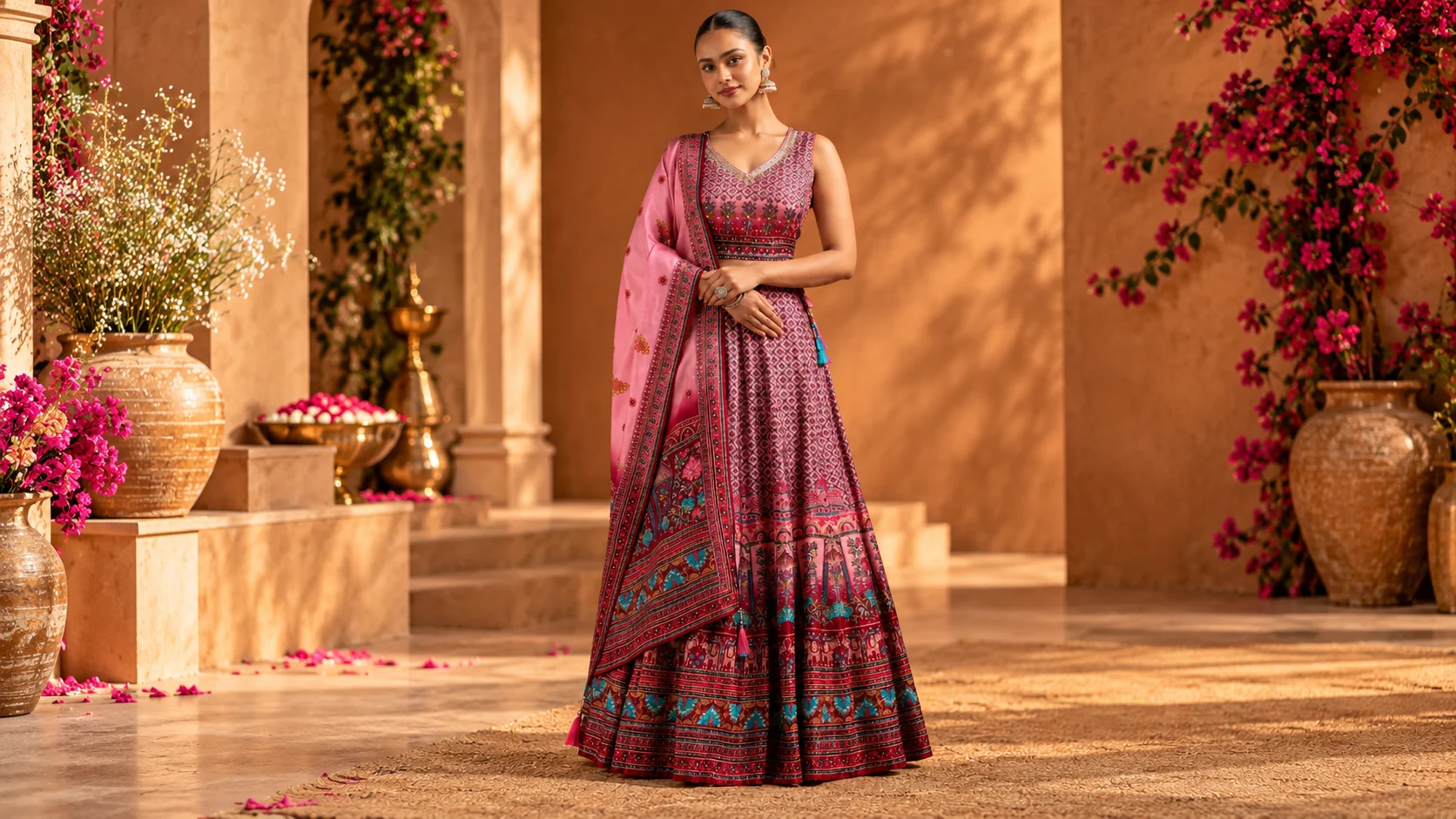
For an elegant festive Indian outfit, start with one main visual feature and let the remaining elements support it. A pink printed Anarkali with a richly patterned dupatta creates a different silhouette from a flared lehenga choli, but both can be styled using the same principle: balance detail with simplicity.
Whether you are preparing for a wedding, Diwali celebration, Navratri gathering or family function, these styling ideas will help you create a polished ethnic look and make thoughtful choices when selecting an outfit.
Table of Contents
Find the focal point of your festive outfit
The easiest way to build an elegant ethnic look is to identify the detail that deserves the most attention. It might be an intricate print, an embroidered blouse, a decorative skirt border or a contrasting dupatta.
A pink Anarkali with geometric and floral patterns, burgundy borders and turquoise accents already has several visual details. Rather than introducing more competing colours, choose accessories that repeat one of the existing tones. This makes the outfit feel intentional while allowing its original design to remain prominent.
A lehenga choli needs a slightly different approach because the skirt, blouse and dupatta work together as separate components. The blouse neckline, skirt pattern and dupatta border should be considered as one composition. If the skirt carries extensive embellishment, a simpler blouse design or restrained accessories can provide balance.
A useful styling rule: choose one leading feature, one supporting feature and keep the remaining elements relatively understated. For example, let a printed skirt lead, use the dupatta as the supporting colour accent and choose jewellery that complements rather than competes with both.
This approach also helps when shopping for festive wear. Instead of choosing an outfit solely because it looks striking on its own, consider whether its components will work with accessories you already own.
Balance prints, embroidery and jewellery
Traditional outfits often combine several decorative elements, but that does not mean every accessory needs to make an equally strong statement. The most effective combinations give the eye a clear place to settle.
For a printed Anarkali, traditional jhumka earrings and a statement ring can provide enough jewellery interest without requiring a heavy necklace. If the neckline already has elaborate detailing, keeping the neck area relatively clear can preserve the design. A simple bracelet or a small pair of complementary earrings may be more suitable for a less ornate outfit.
With a lehenga choli, begin by checking the blouse neckline and the amount of decoration around the upper body. A V-neck blouse may suit a pendant or necklace that follows its shape, while prominent earrings can become the main feature when the neckline is already detailed. These are styling options rather than fixed rules; personal preference and the formality of the event matter too.
The same principle applies to colour. Silver-toned jewellery can complement cooler accents such as turquoise, while gold-toned pieces can echo warm decorative details. You do not need to match every accessory to the outfit exactly.
For further inspiration, explore Vogue India’s guide to dressing for the festive season, which discusses contrasting combinations and occasion-led styling.
Shop the LookStyle the dupatta, silhouette and footwear
A dupatta can change the overall impression of an outfit without requiring a new garment. Its placement determines which parts of the blouse, waist and skirt remain visible, so choose a drape that supports the outfit’s shape.
For a printed Anarkali, a shoulder drape that displays the decorative border can make the dupatta an integral part of the look. For a lehenga, a one-shoulder drape can highlight the blouse, while a diagonal drape can create a more traditional appearance. Secure the fabric appropriately so it stays in place during the event.
Footwear should work with the skirt length and the setting. Embellished juttis can complement a traditional daytime celebration, while dressier heels may suit an evening reception. Check the footwear with the complete outfit before the event, particularly if the skirt has a wide, flared hem. The aim is to maintain a clean silhouette without allowing the hem to interfere with walking.
Hair and makeup can also help balance the overall look. A neat bun or sleek hairstyle can draw attention to statement earrings, while softer styling may suit a lighter, more relaxed outfit. There is no need to make every element elaborate; one or two carefully chosen finishing touches are often enough.
Adapt your ethnic outfit to the occasion
The same styling approach can work across several events, but the level of formality should guide your final choices.
- Daytime family celebration: Choose a balanced combination of print, a neatly draped dupatta and modest jewellery. Juttis or other dressy flats can complete the outfit.
- Wedding guest look: Consider more prominent earrings, a coordinated ring or a more structured dupatta drape. Keep the jewellery balanced with the blouse and skirt detailing.
- Diwali gathering: Let rich colours and decorative borders provide the festive impact. A complementary accessory or a touch of metallic detail can finish the look without adding unnecessary visual clutter.
- Navratri celebration: Prioritise a secure dupatta drape and footwear suited to the planned activities. If you expect to dance or move frequently, check that the skirt and accessories stay manageable.
- Evening reception: A more defined hairstyle, dressier footwear and one stronger jewellery feature can make the same ethnic outfit feel more formal.
This is a multicoloured embroidered lehenga choli set with sequinned detailing, a V-neck sleeveless semi-stitched blouse, a flared printed lehenga and a printed dupatta with a tasselled border. The fabrics include poly silk for the lehenga and blouse, silk for the dupatta, and Shantoon for the lehenga lining; the stated care method is dry cleaning.
Because the blouse and lehenga are semi-stitched, check the product’s current construction details and sizing information before making a decision. Do not assume that a semi-stitched garment will fit without tailoring.
Shop the LookThe key is to choose an outfit that suits the event and then coordinate its details around the strongest feature, rather than adding accessories simply to make the look more elaborate.
Frequently Asked Questions
1. How do you style a pink Anarkali outfit for a festive occasion?
Start with the outfit’s dominant pink and burgundy tones, then choose a dupatta drape that displays its decorative border. Add traditional earrings or a statement ring, and keep other accessories restrained if the print is already detailed. Choose footwear that works with the skirt length and venue.
2. What jewellery goes well with a printed Anarkali suit?
Jhumka earrings, a statement ring or a simple bracelet can complement a printed Anarkali. If the neckline has heavy decoration, avoid adding a necklace that competes with it. Choose jewellery according to the outfit’s colours, neckline and occasion rather than matching every detail exactly.
3. What is the difference between an Anarkali and a lehenga choli?
An Anarkali typically features a long, flared tunic worn with a lower garment, while a lehenga choli generally combines a separate flared skirt, blouse and dupatta. Their silhouettes and styling options differ, so consider the garment structure when choosing jewellery, draping and footwear.
4. How should you drape a dupatta with a lehenga?
A one-shoulder drape can highlight the blouse and allow the skirt to remain prominent. A diagonal drape can create a more traditional look, while a waist-secured drape may suit occasions where greater freedom of movement is useful. Choose a style that displays the border and remains secure.
5. What should you check before buying a semi-stitched lehenga?
Check the blouse and skirt construction, available size or measurement information, fabric details, lining information and care instructions. Confirm whether tailoring is required and whether the finished proportions will suit your preferred footwear. Read the current product listing carefully before purchasing.