
This article may contain affiliate links. We may earn a commission at no extra cost to you.
Your front door is the transition between the outside world and the rooms inside, so it has an important role in how an entrance feels and functions. In traditional Feng Shui, entrances form part of a wider Chinese geomancy tradition concerned with the relationship between buildings, surroundings and human activity. Modern scholarship treats Feng Shui as a historical and cultural framework, not a scientifically validated way to predict personal outcomes. 🌐 🌐
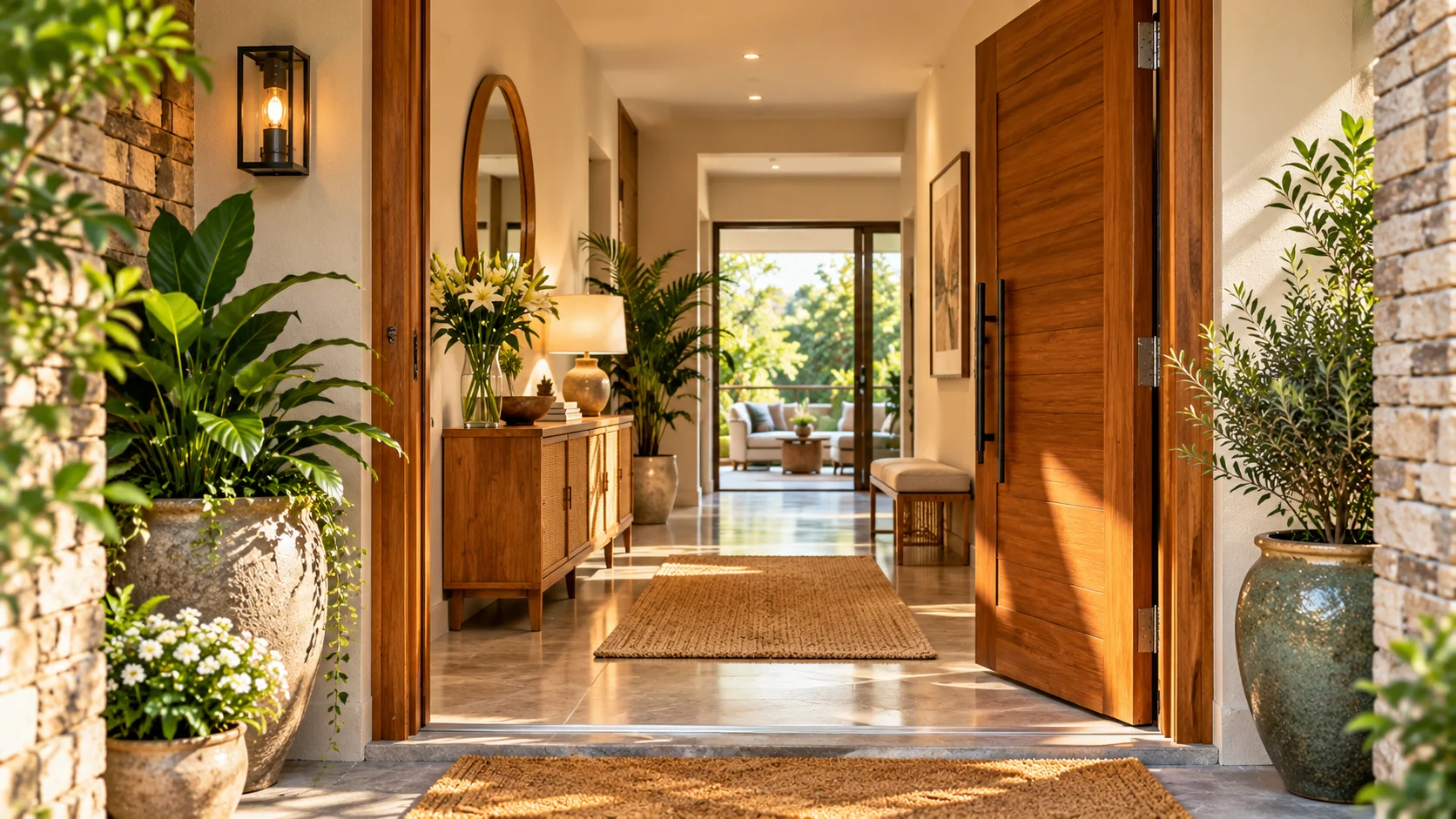
The practical takeaway is simple: you can explore front door Feng Shui without turning your entrance into a themed display. A clear path, useful lighting, sensible storage and a calm focal point can create a welcoming foyer while keeping traditional symbolism in its proper cultural context.
Table of Contents
What the Front Door Represents in Traditional Feng Shui
Traditional Feng Shui developed within Chinese geomancy and has been applied to the relationship between buildings, landscape and human activity. Academic research describes different approaches, including Form School and Compass School traditions, rather than one universal rulebook. Some approaches focus on physical surroundings and spatial form, while compass-based methods interpret orientation and other symbolic relationships.
That distinction matters when reading modern front door Feng Shui advice. A recommendation may belong to a particular school or later practitioner tradition, so it should not automatically be presented as an ancient rule that applies to every home.
For homeowners, the best starting point is therefore the entrance itself. Is the route easy to use? Can visitors immediately understand where to enter? Does the door open safely without striking furniture or blocking a walkway? These practical questions work across cultures and should come before symbolic adjustments.
Build a Clear and Comfortable Entrance First
A modern Feng Shui-inspired entrance often benefits from fewer, better-considered elements. Keep the threshold clear, remove unnecessary obstacles and give shoes, bags and parcels a sensible storage point. This improves everyday organisation while also creating the uncluttered visual flow associated with many contemporary Feng Shui interpretations.
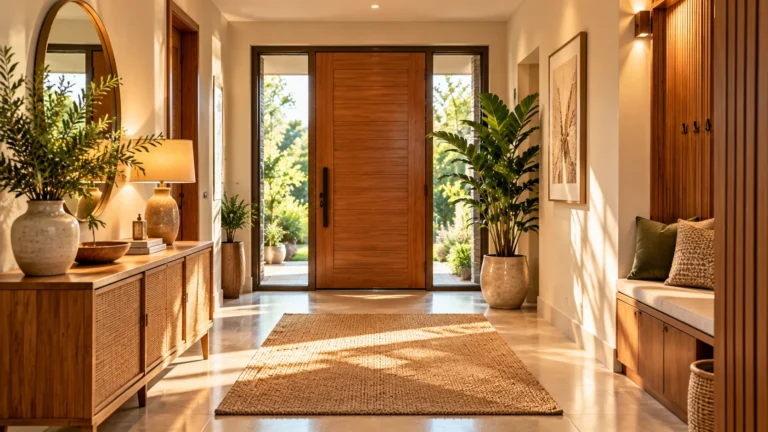
Think about movement before decoration. A narrow entrance can feel crowded when a console, mirror, planter and storage basket all compete for the same floor area. Choose one main focal point and protect the walking route. In a larger foyer, slim closed storage can provide useful organisation without making the doorway feel like a storage zone.
If you enjoy traditional Feng Shui practices, keep the interpretation measured. Rather than saying that a particular arrangement will bring wealth, health or luck, describe it as a traditional approach to harmony, order or auspicious space.
Use Lighting, Materials and Greenery With Restraint
Lighting can make an entrance feel more inviting without requiring a supernatural explanation. A suitable wall light, pendant or warm lamp can define the threshold and improve visibility in the evening. Select fittings for appropriate illumination and safe installation rather than choosing lighting solely for a symbolic association.
Natural materials such as timber, stone, woven fibres and ceramics can introduce warmth and texture. You do not need to combine every traditional colour or elemental association. Repeating one or two materials usually looks more considered than filling the foyer with symbolic objects.
Greenery can soften a hard architectural entrance, provided the plant suits the available light and does not obstruct movement. Prioritise genuine care requirements such as light, watering and stability; cultural symbolism can remain an optional layer.
Adapt Traditional Ideas to a Modern Home
The most useful way to approach front door Feng Shui today is as a design conversation rather than a promise. Start with what cannot easily change — the doorway, floor plan, building structure and safety requirements. Then adjust what can change: lighting, storage, colour balance, movable furniture and decorative details.
This is particularly useful in rented homes or flats. You do not need expensive structural changes simply to explore traditional ideas. Removing unused furniture, improving lighting, moving a planter away from a walkway or creating dedicated storage can make a meaningful practical difference.
Compass-based advice deserves similar care. If a practitioner recommends a direction-specific placement, confirm the direction with a reliable compass and ask which school or method is being used. Recent architectural research shows that Feng Shui contains different approaches and that their design criteria can vary. 🌐 🌐
For a related placement topic, read Feng Shui Wind Chimes Placement: Transform Your Energy. You can also explore Feng Shui Water Features: Beautiful, Practical Guide.
A welcoming front door does not need to prove that Feng Shui works. It needs to work as an entrance. When traditional ideas are treated respectfully as cultural frameworks and modern design handles comfort, safety, lighting and organisation, the result can feel thoughtful without becoming overly symbolic.
Related Blogs
Further Reading
- S. A. Smith, “Geomancers and Yin-Yang Masters”, Cambridge University Press, 2026.
- Yuyang Wang, Andrew Crompton and Asterios Agkathidis, “A parametric approach to investigate the influence of Fengshui on traditional Chinese courtyard dwelling design”, npj Heritage Science, 2026.
Frequently Asked Questions
What is front door Feng Shui?
Front door Feng Shui refers to traditional ideas concerning the entrance, its surroundings and the organisation of movement and space. Different schools use different methods, so these ideas are best understood as cultural and traditional frameworks rather than scientifically validated predictions.
Does Feng Shui require a specific front door direction?
Not universally. Direction-specific recommendations can depend on the Feng Shui school or method being used. If a practitioner gives you a compass-based instruction, confirm the actual direction with a compass and ask which method supports the recommendation.
Should a Feng Shui entrance be minimalist?
An uncluttered entrance is a practical design choice and is compatible with many modern Feng Shui interpretations. Minimalism itself is not a universal Feng Shui requirement. The useful test is whether the entrance remains easy to navigate, organised and visually balanced.
Can I use Feng Shui ideas in a rented home?
Yes. You can explore non-structural ideas such as decluttering, movable storage, lighting, plants and décor without making permanent changes. Building safety, landlord requirements and the practical limits of the property should always take priority.
What should I prioritise in a Feng Shui-inspired entrance?
Start with safety, clear movement, useful lighting, practical storage and comfortable visual balance. Once those basics work, you can add traditional Feng Shui-inspired symbolism if it has personal or cultural meaning for you.