
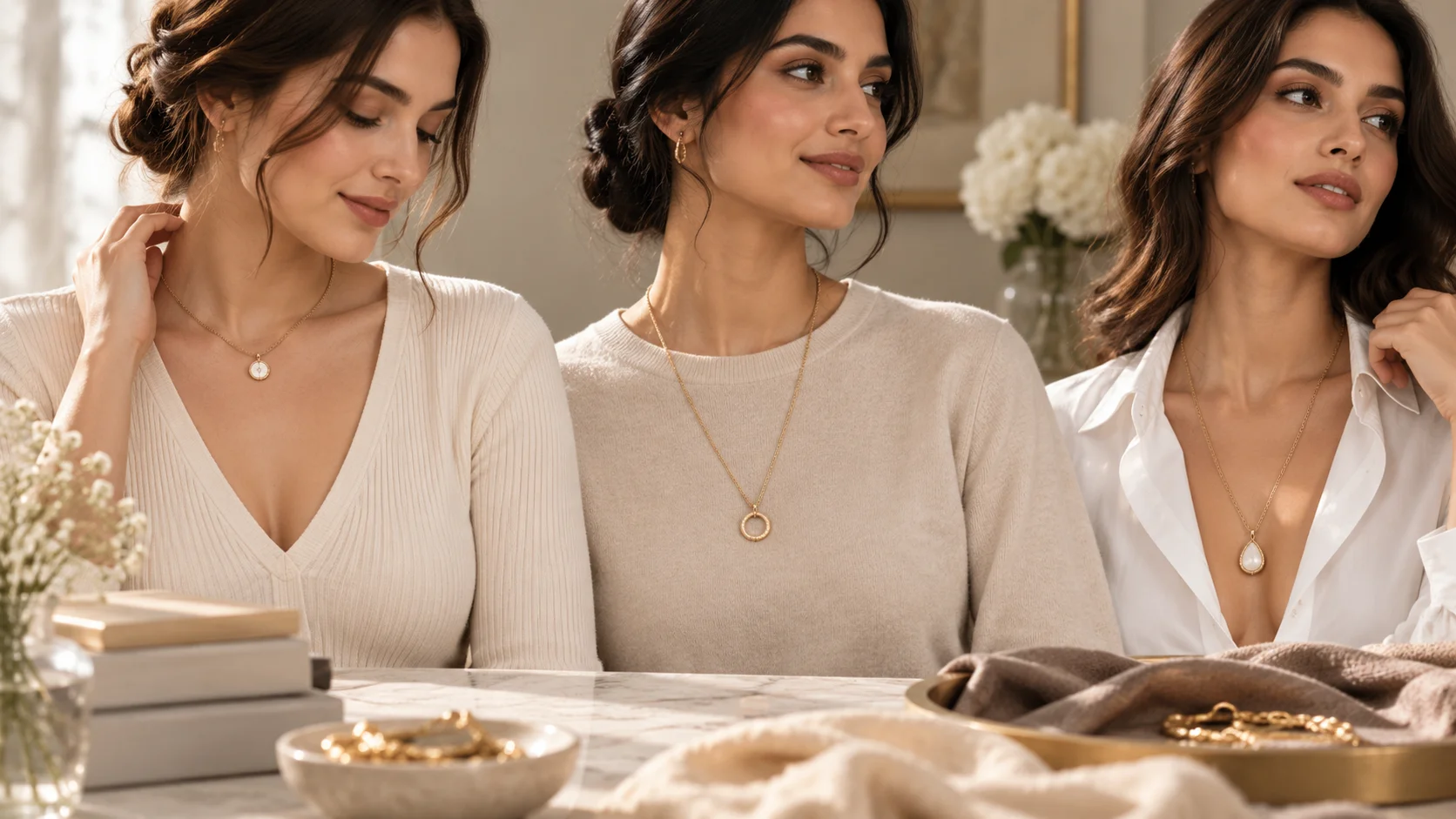
The right necklace length can change the way an entire outfit feels, but there is no single length that works perfectly with every neckline. The easiest approach is to look at the shape and visual space created by the neckline, then choose a necklace that either follows that line or creates deliberate contrast.
Whether you are styling a V-neck dress, a classic crew neck, a square neckline or an open shirt, a little attention to proportion can make your jewellery look far more intentional.
Table of Contents
Why Necklace Length Changes the Look
A necklace does not sit in isolation. Your neckline creates a visual frame around it.
A short chain may look beautifully balanced against bare skin but become crowded when placed directly over a high crew neck. Conversely, a longer pendant may add a useful vertical line to a covered neckline but overwhelm a very open, delicate neckline.
This is why necklace styling is less about memorising a rigid “correct” length and more about understanding where the necklace sits in relation to the neckline.
A useful starting point is the familiar length system:
- Choker: approximately 14–16 inches
- Princess: approximately 17–19 inches
- Matinee: approximately 20–24 inches
- Opera: approximately 28–36 inches
- Rope: 36 inches or longer
These are useful reference categories rather than absolute rules. Chain thickness, pendant size, body proportions and the actual cut of a garment can all change how a necklace appears.
The most important visual check is simple: avoid letting the necklace accidentally disappear into the neckline edge. Either make the separation clearly intentional or allow the necklace to sit comfortably within the open space.
How to Match Necklace Length to Different Necklines
V-Neck
A V-neck already creates a strong downward direction, so a pendant that echoes that movement is often an easy starting point.
A shorter or medium-length necklace can sit inside the V, particularly when the pendant follows the neckline rather than cutting across it. A pendant with an elongated, teardrop or pointed shape can reinforce the vertical movement.
For a deeper V-neck, a slightly longer necklace may work better because it keeps the pendant from looking stranded too high on the chest.
Styling idea: Keep the necklace relatively clean if the V-neck garment already has embroidery, texture or embellishment.
Crew Neck and Round Neck
Crew necks sit relatively high, leaving less open skin around the collarbone.
One option is a short necklace that clearly sits above the neckline. Another is to move the necklace noticeably lower so that it creates a separate visual layer over the garment.
A medium-to-long pendant can be particularly useful with a simple crew-neck top because it introduces vertical movement without requiring a complicated outfit.
The key mistake to avoid: choosing a necklace that lands directly on the fabric edge and repeatedly disappears into it.
Scoop Neck
A scoop neckline creates a rounded area of visible space, making it natural to consider necklaces that complement that curve.
A princess-length necklace or a compact pendant can work well when it sits comfortably inside the opening. A slightly longer pendant can also work when the outfit is minimal and the jewellery is intended to become the focal point.
The deeper and wider the scoop, the more room you have to experiment with pendant scale and length.
Square Neckline
Square necklines introduce stronger geometry than rounded necklines.
A shorter necklace can sit within the open area without fighting the straight edges. Alternatively, a contrasting pendant shape can soften the structured feel.
This is a good place to think about negative space. If the neckline is already visually strong, leaving some breathing room between the garment and necklace can create a cleaner result.
Boat Neck
A boat neckline spreads horizontally across the shoulders, so necklace placement needs a little more thought.
A short, understated necklace can work when you want to keep the look refined. A longer necklace can create vertical contrast against the broad horizontal neckline.
For an especially wide boat neck, the necklace does not necessarily need to follow the garment exactly. Deliberate contrast can be more interesting than trying to make every line match.
Turtleneck and High Neck
High necklines cover much of the upper chest, so very short necklaces can become visually crowded or simply disappear.
Longer necklaces worn over the fabric create clearer separation. A pendant can introduce a vertical focal point, while a longer chain can provide movement against an otherwise continuous block of fabric.
This is also a useful setting for a statement piece. Current 2026 jewellery coverage points towards substantial individual pieces as one important direction, alongside continued interest in layering. ℹ️ ℹ️
Strapless and Off-Shoulder Necklines
These necklines provide a large amount of exposed space around the neck and collarbone.
A shorter necklace can frame that space neatly, while a choker or collar-style piece can create a deliberate focal point. A slightly longer pendant can work when the outfit is simple and you want to draw the eye towards the centre.
Because the neckline itself is already dramatic, jewellery does not always need to be oversized.
Open Collars and Button-Down Shirts
An open shirt naturally creates a V-like shape, which gives a necklace a defined space to occupy.
A medium-length pendant can sit inside the opening, while a shorter chain can create a more understated effect near the collarbone.
For workwear, a restrained chain or pendant can keep the look polished. For a relaxed outfit, layering two noticeably different lengths can add texture without requiring additional statement accessories.
The 2026 Jewellery Trend Twist
Necklace styling in 2026 does not point towards one single aesthetic.
British Vogue’s 2026 jewellery trend coverage highlights a move towards fewer but more substantial statement pieces, while Marie Claire UK’s SS26 coverage shows that layered necklaces and other stacked jewellery remain highly visible on the runway. ℹ️ ℹ️
The practical lesson is useful: choose the visual relationship first, then decide whether one necklace or several pieces deliver it better.
If you are wearing a bold pendant, there may be little need for multiple competing chains. If the necklace is delicate, varying lengths and textures can create more dimension.
Layering can also work through contrast rather than perfect matching. Different chain thicknesses, pendant shapes and lengths can prevent a stack from looking too uniform.
How to Make Necklace Proportions Look Intentional
Before adding another piece, check three things.
First, look at the neckline shape.
Is it curved, pointed, straight, wide or high? Your necklace can echo that shape or deliberately contrast with it.
Second, check where the necklace ends.
If the pendant lands exactly on the neckline edge, try moving it shorter or longer. Clear separation often looks more deliberate than accidental overlap.
Third, consider the rest of the outfit.
A heavily embellished blouse may need less jewellery than a plain knit or simple dress. Likewise, large earrings can change how much visual weight your necklace should carry.
This approach is more useful than buying a different necklace for every individual top.
Common Necklace-Length Mistakes to Avoid
One of the most common problems is choosing a necklace solely because its length looks good on its own. The same chain can behave very differently against a different neckline.
Other mistakes include:
- Letting a pendant disappear beneath the neckline
- Choosing a very large necklace for an already busy neckline
- Matching every line too literally
- Layering several pieces with almost identical lengths
- Ignoring pendant scale
- Forgetting how earrings affect the overall balance
- Assuming a standard necklace length will look identical on everyone
The last point matters. Necklace length is measured in inches or centimetres, but the visual result also depends on where that measurement sits on your individual proportions.
A Simple Rule Before You Choose
Instead of asking, “Which necklace is right for this neckline?”, ask three smaller questions:
Where is the open visual space?
Should the necklace echo the neckline or contrast with it?
Does the necklace finish clearly above, within or below the neckline rather than accidentally sitting on its edge?
Those questions give you more flexibility than a fixed chart.
A necklace length guide should therefore be treated as a starting point, not a strict dress code.
For broader jewellery styling inspiration, you can also explore Beautiful Statement Earrings With Effortless Styling Power and Statement Necklace Styling Made Effortless With Smart Balance.
For a wider view of current jewellery direction, British Vogue’s 2026 jewellery trends coverage is a useful editorial reference.
Related Blogs
Statement Necklace Styling Made Effortless With Smart Balance
Choosing Earrings for High and Low Necklines Made Effortless
FAQs
What is the best necklace length for different necklines?
There is no universal best length. V-necks often work well with pendants that follow the downward line, while high necks can benefit from longer necklaces that create separation over the fabric. Personal proportions and pendant size also matter.
Should necklace length match the neckline exactly?
Not necessarily. Echoing the neckline can create harmony, but deliberate contrast can be equally effective. The more important consideration is whether the necklace sits in a clear visual space rather than accidentally colliding with the neckline edge.
What necklace length works with a V-neck?
A shorter or medium-length necklace with a pendant that sits inside the V is a useful starting point. The deeper the V, the more room there is to experiment with a longer pendant, provided the proportions remain balanced.
Can I wear layered necklaces with different necklines?
Yes. Layering can work particularly well when the necklaces have clearly different lengths, textures or pendant sizes. With a busy neckline, however, a simpler necklace arrangement may create a cleaner result.
How do I choose necklace length if I am unsure?
Start with the neckline rather than the necklace. Identify the available visual space, test where the pendant ends, then check the balance against your earrings and clothing detail. Moving the chain slightly shorter or longer can change the overall effect.