
This article may contain affiliate links. We may earn a commission at no extra cost to you.
Packing light becomes surprisingly difficult when small accessories begin multiplying. Belts, jewellery, sunglasses, scarves, hair accessories, chargers and other everyday extras may look insignificant on their own, but together they can create clutter and occupy useful luggage space.
Learning how to pack accessories efficiently is less about squeezing everything into the smallest possible pouch and more about choosing what deserves space, grouping similar items and using otherwise wasted areas of your bag. A simple accessory-editing system can make your luggage easier to organise without sacrificing the pieces you genuinely expect to use.
Table of Contents
Start With an Accessory Edit
The easiest way to save space is to avoid packing unnecessary items in the first place.
Before opening your suitcase, put the outfits you expect to wear in one place. Then place your possible accessories alongside them.
Ask a simple question: does each accessory work with something I am actually taking?
A neutral belt that works with several outfits may earn its space more easily than three belts chosen for individual looks. The same principle can apply to scarves, jewellery, hair accessories and bags.
Instead of packing for every hypothetical situation, build a small accessory capsule around the clothes already selected.
A useful approach is to prioritise:
- pieces that work with several outfits;
- accessories that serve a practical purpose;
- lightweight items that can change an outfit without adding much bulk;
- one or two more distinctive pieces when the itinerary genuinely calls for them.
This makes the suitcase smaller at the planning stage rather than relying entirely on compression later.
How to Pack Accessories by Shape and Function
Not every accessory should be packed in the same way.
Belts
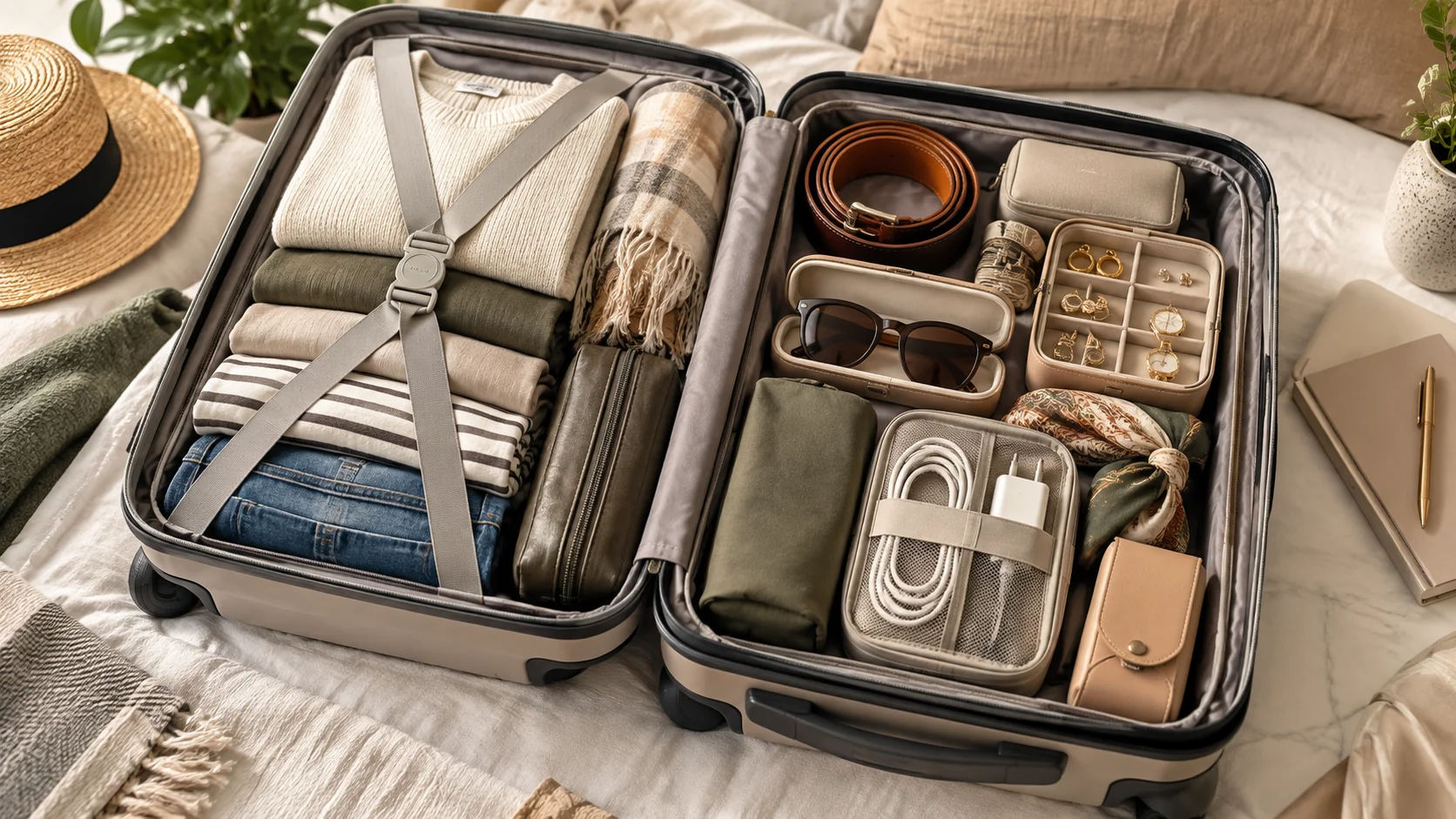
Rather than laying a belt diagonally across the suitcase, gently coil it according to its natural flexibility. It can often sit inside the perimeter of a packing cube or another protected gap.
Avoid forcing a stiff or structured belt into a very tight coil simply to save space. The aim is efficient packing, not changing its shape.
Scarves
Soft scarves are among the easiest accessories to fit into unused spaces.
Fold or loosely roll them and use them to fill gaps between packing cubes, clothing or other soft items. A lightweight scarf can also provide a soft layer around another non-fragile accessory.
Sunglasses
Sunglasses are different because saving a few centimetres is rarely worth risking bent frames or scratched lenses.
Use a protective case appropriate for the pair and place it where heavier items will not press directly against it.
Small jewellery
Keep small pieces separated rather than dropping them into a general accessories pouch.
Chains can tangle, earrings can become separated and harder pieces can rub against more delicate surfaces. A compact organiser with individual sections—or appropriately sized separate pouches—can make these tiny items much easier to manage.
For valuable jewellery, travel security matters as much as efficient packing. The US Transportation Security Administration advises travellers to keep valuable jewellery with them rather than putting it in checked baggage. TSA’s current guidance is available here: TSA What Can I Bring.
Chargers and small electronics
A compact cable pouch can stop charging leads and small electronic accessories from spreading throughout the bag.
Do not assume every battery-powered travel accessory can simply be placed wherever there is space. For air travel, the FAA says spare lithium batteries and power banks must remain in carry-on baggage, and individual airlines may impose additional restrictions. See FAA Airline Passengers and Batteries.
Use the Empty Spaces Already in Your Bag
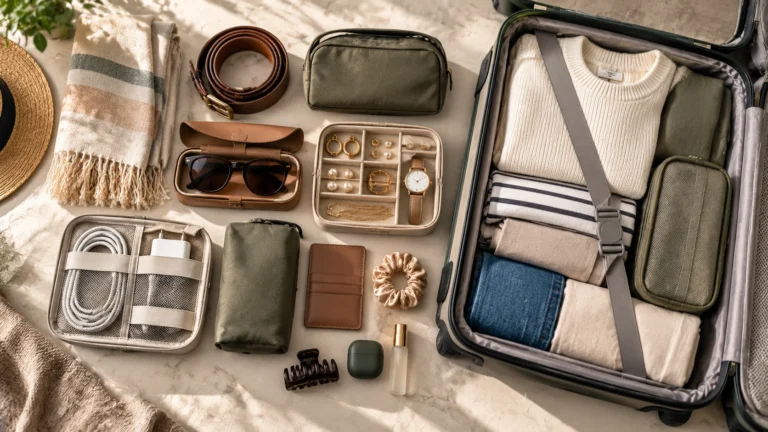
One of the smartest ways to pack accessories without consuming extra room is to look for spaces your main clothing items do not use efficiently.
The edges around packing cubes, shallow gaps between folded garments and small protected pockets can all become useful accessory zones.
Even footwear may contain usable internal space for suitable soft, non-valuable items. For hygiene, place anything going inside shoes in its own clean pouch or wrapping rather than allowing it to make direct contact.
The important distinction is between using empty space and overstuffing.
If a suitcase only closes after significant pressure, the packing system probably needs another edit. The US Department of Transportation specifically advises against overpacking checked bags because excess pressure can make closures more likely to spring open. US DOT baggage guidance is available here: Plane Talk Baggage Tips.
Keep Small Accessories Together
Small objects become frustrating when they are distributed across five different pockets.
Instead, create a few clear accessory zones.
For example, one compact organiser might contain fashion accessories, another might hold charging cables and technology essentials, while travel documents stay in a dedicated accessible location.
The goal is not to own an organiser for every object. Too many organisers can themselves become unnecessary bulk.
Choose the smallest system that keeps genuinely different types of items separated and easy to retrieve.
A good test is simple: could you find a specific small item without unpacking the entire suitcase?
If the answer is yes, the system is probably doing its job.
Protect Delicate and Valuable Accessories
Space efficiency should never come at the expense of sensible protection.
Hard, sharp or structured accessories should not be pressed directly against delicate pieces. Sunglasses need protection from pressure, jewellery benefits from separation, and structured accessories need enough room to retain their intended form.
Valuable or irreplaceable items deserve additional consideration. The US Department of Transportation recommends carrying valuables such as jewellery with you rather than placing them in checked baggage. 📖
For flights, it is also worth checking both your airline’s baggage policy and the relevant aviation rules before departure. FAA guidance notes that airline carry-on rules can be more restrictive than general regulations. FAA Carry-On Baggage Tips.
That is particularly relevant when an “accessories” pouch contains more than fashion pieces—for example a power bank, rechargeable device or other battery-powered travel item.
Make Your Packing System Easy to Reverse
Efficient packing is not only about departure.
A tightly engineered suitcase can save space on the way out but become inconvenient if you cannot recreate the system when leaving your destination.
Keep the method simple enough to repeat.
Use consistent zones, return small accessories to the same pouch after use and avoid creating a complicated arrangement that depends on remembering exactly where every tiny object was squeezed.
This also makes unpacking easier. Instead of searching the room for earrings, cables, belts and hair accessories, you can work through a small number of defined groups.
Before closing your suitcase for the return journey, do one final accessory check: bedside surfaces, bathroom counters, charging points, wardrobes and drawers are easy places for small belongings to disappear from view.
Pack Smaller by Packing More Deliberately
The most useful space-saving trick is not extreme compression. It is intentional selection.
Choose accessories that work across several outfits, use the natural gaps already present in your luggage, protect items that need structure, and group small belongings so they remain easy to find.
Once you stop treating accessories as last-minute extras, they become much easier to pack efficiently.
A smaller, organised accessory edit can give you the styling and practical options you need without allowing the little things to take over your suitcase.
FAQs
How do you pack accessories without taking extra space?
To pack accessories efficiently, first reduce the number you take, then use compact organisers and suitable unused gaps around your clothing rather than creating a large separate accessories section.
Is rolling accessories always better than folding them?
No. Soft scarves may roll well, while structured or delicate accessories should be packed according to their shape and protection needs.
Where should I pack jewellery when flying?
For valuable jewellery, TSA advises keeping it with you rather than placing it in checked baggage. Always check the applicable rules for your departure country and airline.
Can I put a power bank inside my accessories pouch?
Yes, if the pouch is in your carry-on and the power bank complies with applicable limits. FAA guidance says spare lithium batteries and power banks must not go in checked baggage.
What is the simplest way to avoid overpacking accessories?
Plan your outfits first. Then choose accessories that work with several of those outfits instead of packing multiple pieces for situations you may never encounter.