
Buying clothes online is wonderfully convenient until you reach the size selector. A familiar M, L or XL can mean something different from one brand to another, which is why knowing how to measure yourself for online clothing shopping is far more useful than relying on the size you usually wear.
The good news is that you do not need complicated equipment or tailoring expertise. A flexible measuring tape, a few minutes and the retailer’s own size chart can give you a much better starting point for choosing clothes online.
For the most useful results, measure your body rather than your favourite garment unless the retailer specifically asks for garment measurements. Keep the tape comfortably close to the body without pulling it tight, record the numbers, and then compare them with the measurements and fitting guidance supplied for the exact item you are considering.
Table of Contents
What You Need Before You Start
You only need a few basics:
- A flexible fabric or tailor’s measuring tape
- A mirror, ideally full length
- Lightweight, close-fitting clothing or underwear
- Somewhere to record your measurements
- Another person to help, if available
Stand naturally rather than deliberately pulling in your stomach or changing your posture. The aim is to capture the body you are actually dressing.
If possible, measure twice. When two readings differ noticeably, take the measurement again rather than automatically choosing the smaller number.
Keep the tape level
One of the easiest ways to get an inaccurate measurement is to let the tape slope upwards or downwards around the body. A mirror is particularly helpful when measuring your chest, waist and hips because you can check that the tape remains approximately horizontal.
The tape should sit close to your body without digging into it. Pulling it excessively tight may produce a number that does not represent the space your clothing needs.
How to Take the Essential Body Measurements
Different garments require different measurements, so you may not need every measurement every time. Start with the measurements requested by the retailer’s size guide.
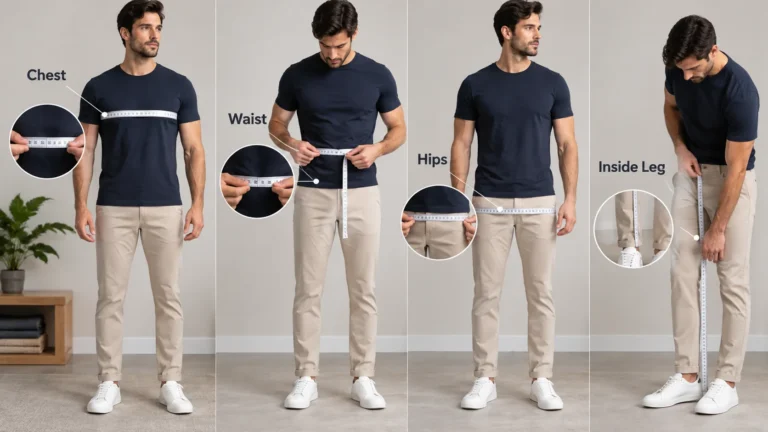
Chest
Wrap the tape around the fullest part of your chest, keeping it level around your back. Stand normally and avoid deliberately expanding or contracting your chest.
For shirts, T-shirts, jackets and similar upper-body garments, this is often one of the most useful measurements to have ready.
Natural waist
Your natural waist is not necessarily where the waistband of your favourite trousers sits.
Find the area where your torso naturally narrows, then wrap the tape around it without pulling tightly. Relax your abdomen and breathe normally while measuring.
This distinction matters because a retailer may use a body waist measurement even when the actual garment is designed to sit higher or lower.
Hips
Stand with your feet in a natural position and measure around the fullest area of your hips and seat. Check in a mirror that the tape is level.
This measurement can be especially useful for trousers and other garments where the lower-body fit matters.
Inside leg
For trousers, an inside-leg measurement can help you evaluate length. Measure from the crotch area down the inside of the leg to the point where you want the trouser leg to finish.
The ideal finishing point can vary with the trouser style and how you intend to wear it, so use the retailer’s garment information alongside your measurement.
Neck
When a shirt is sized by collar or neck measurement, place the tape around the base of your neck where a shirt collar would naturally sit. Keep the measurement comfortable rather than pulling the tape tightly.
Sleeve
Sleeve-measurement methods can differ between retailers and garments. Some size guides measure from the shoulder, while others use another reference point.
That makes this a good example of an important online-shopping rule: follow the measuring method shown by the retailer rather than assuming every size chart uses the same method.
Why the Size Chart Matters More Than the Size Letter
One of the most useful habits you can develop when shopping for clothes online is to treat the size label as a recommendation rather than a universal measurement.
You might normally buy a medium, for example, but that does not automatically make medium the right choice for every item.
Instead, use this sequence:
Your current body measurements → retailer’s size chart → individual garment information → intended fit
That final point matters.
A relaxed overshirt and a close-fitting shirt can have very different silhouettes even when both technically correspond to your body measurements. Product descriptions, garment dimensions where supplied, model information and fit notes can therefore add useful context.
Body measurements and garment measurements are not the same
This distinction can prevent a surprisingly common mistake.
A body measurement records your actual body dimensions. A garment measurement records the dimensions of the clothing itself.
Clothing normally needs some relationship between the two to create its intended silhouette, whether that is close, regular, relaxed or oversized. Therefore, do not compare a garment measurement with your body measurement as though the two numbers should necessarily be identical.
Always check what the retailer says its chart is measuring.
Getting a Better Fit for Different Types of Clothing
Your measurement priorities should change with the garment.
For shirts and T-shirts, chest measurement is particularly useful, while shoulders, neck and sleeve information may become more important depending on the design.
For trousers, pay close attention to the retailer’s waist-measurement method, hips where relevant, and inside-leg or length information. Remember that the labelled trouser size and your physical body measurement are not automatically interchangeable across every brand or sizing system.
For jackets and blazers, chest measurement is a useful starting point, but the intended cut matters too. A structured jacket can behave very differently from a relaxed casual layer.
For knitwear and cardigans, consider both your measurements and the intended silhouette. If the product is deliberately oversized, choosing a larger size simply to achieve looseness may not be necessary.
The principle remains the same: measure first, then interpret those measurements in the context of the specific garment.
Common Measuring Mistakes to Avoid
Accurate numbers are only helpful when they are taken and interpreted correctly. Watch for these easy mistakes.
Using an old set of measurements. Bodies change. If your measurements have not been updated for a while, taking them again can be worthwhile before an important purchase.
Pulling the tape too tightly. You are measuring your body, not trying to create the smallest possible number.
Measuring over bulky clothing. Thick fabrics and layers can distort the reading.
Assuming your usual size is universal. A familiar size label can be a useful reference, but the current retailer’s chart deserves priority.
Ignoring the retailer’s instructions. If its measuring diagram uses a particular reference point, follow it.
Confusing body and garment measurements. Check the heading or explanatory notes beside the chart before comparing numbers.
Choosing a smaller size just because the number feels preferable. Fit is more useful than the label hidden inside the garment.
A Simple Routine Before You Click Buy
Once you have recorded your measurements, online clothing shopping becomes much easier to approach systematically.
Before ordering, run through this quick routine:
- Open the size guide for the exact retailer or product.
- Check whether the chart shows body or garment measurements.
- Compare the measurements most relevant to that type of clothing.
- Read the product’s stated fit or silhouette information.
- Check any available garment dimensions or measuring instructions.
- If you fall between sizes, use the retailer’s guidance and think about where you need the most room and how you want the garment to fit.
- Review the retailer’s current returns or exchange information before purchasing.
It can also be useful to keep a small measurement note on your phone containing your chest, waist, hips, inside leg and any other measurements you frequently need. Add the date they were taken so you know when it may be time to measure again.
The goal is not to find a magical size that works everywhere. It is to give yourself reliable information that you can compare with each retailer’s sizing system.
A few minutes with a measuring tape can turn online sizing from guesswork into a much more informed decision. Measure carefully, read the individual size guide and choose according to the garment rather than the letter printed on its label.
FAQs
How do I measure myself for online clothing shopping?
Use a flexible measuring tape and record the body measurements requested by the retailer, such as chest, natural waist, hips and inside leg. Keep the tape level and comfortably close to your body, then compare your measurements with the retailer’s current size chart.
Should I measure my body or my clothes?
Measure your body when the retailer provides a body-measurement size chart. If it provides garment measurements, compare those using the retailer’s instructions. Always identify which type of measurement the chart uses before choosing a size.
What should I do if I am between two sizes?
Check the retailer’s specific sizing advice, intended garment fit and which body area is most important for that item. Do not automatically size up or down because the best choice can vary by garment.
Can I simply order the size I normally wear?
You can use your usual size as a reference, but it should not replace the current retailer’s size chart. Sizing conventions and garment cuts can differ between brands and products.
How often should I update my body measurements?
There is no universal schedule. Re-measure whenever you suspect your measurements have changed, when existing measurements are old, or before buying an item where accurate fit is particularly important.