
This article may contain affiliate links. We may earn a commission at no extra cost to you.
A dress with a distinctive colour and bold decorative motifs rarely needs a complicated outfit built around it. The smarter approach is often to recognise what already makes the dress interesting, then choose accessories that support rather than compete with it.
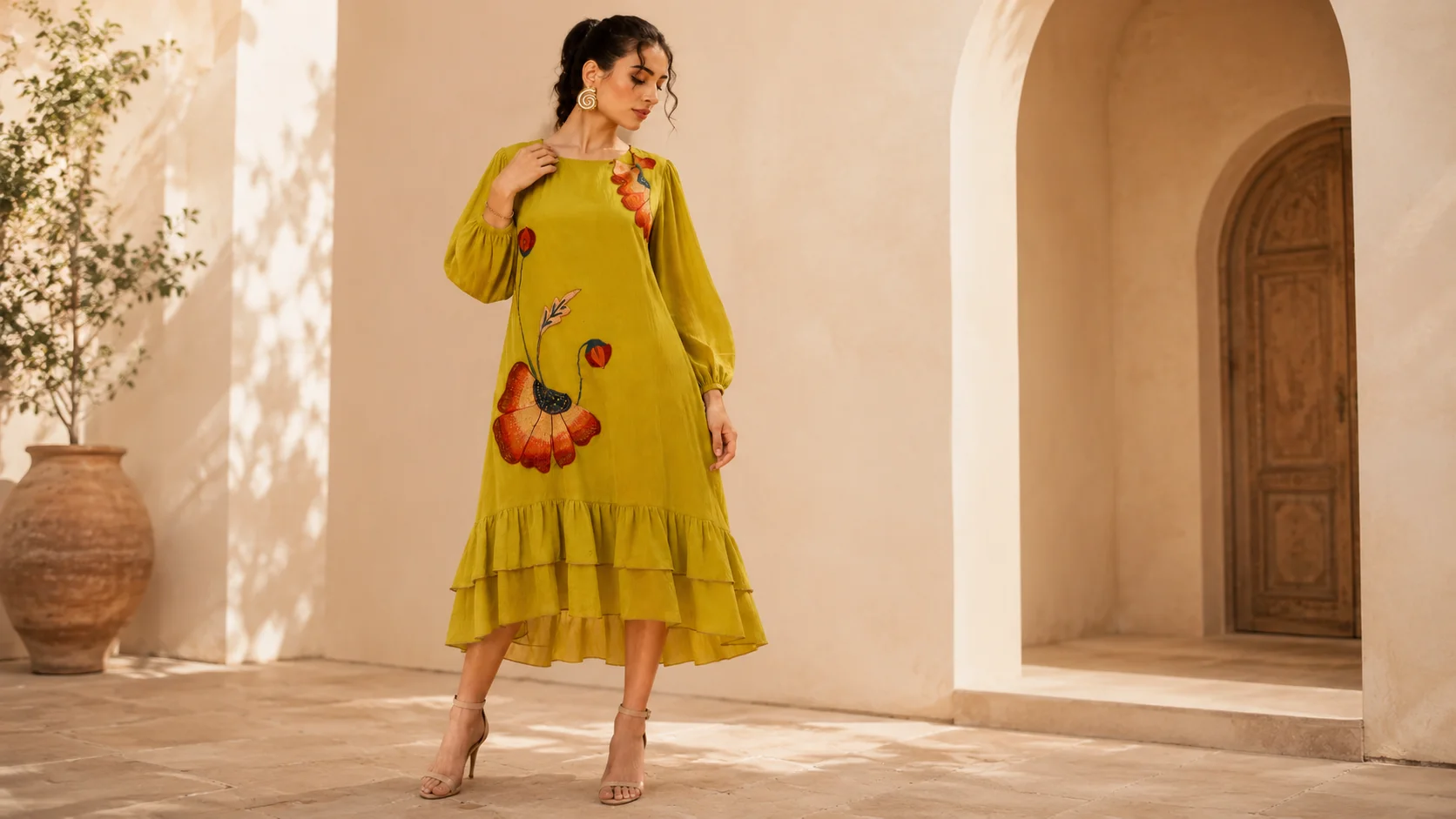
This yellow-green statement dress combines a loose, flowing silhouette with long sleeves, a tiered ruffle hem and prominent floral-inspired motifs in warm orange, red and contrasting blue tones. Those visible details give the dress enough personality to lead the entire look.
If you are looking for statement dress styling ideas, start with restraint: let the dress carry the colour and pattern, then use selective jewellery, neutral footwear and one purposeful accessory to change the mood. The result can feel expressive without becoming visually overloaded.
Table of Contents
Why This Statement Dress Needs Less Styling
There is an easy mistake to make with a visually expressive dress: seeing all that colour and detail and assuming the rest of the outfit needs to be equally decorative.
Usually, the opposite works better.
Here, the dress already provides several strong visual elements. Its yellow-green base creates the first impression, while the oversized floral-inspired motif introduces warmer orange and red shades with smaller contrasting accents. The gathered sleeves and layered ruffle hem add movement to the silhouette.
When a single garment already combines colour, motif and silhouette, giving every accessory its own statement moment can make the outfit feel fragmented.
Instead, think of the dress as the centre of gravity.
A pair of noticeable earrings may be enough around the face. Simple footwear can quietly finish the lower half. If you add a bag, it can either stay neutral or repeat one small colour already present in the dress.
That leaves the garment looking intentional rather than crowded.
Explore This StyleBuild Around the Colours Already in the Dress
One of the easiest ways to style a colourful dress is to stop searching for entirely new colours.
Look at what is already there.
The dominant yellow-green shade is accompanied by warmer orange and red decorative elements and smaller darker accents. That gives you several directions without requiring exact colour matching.
Keep footwear quiet
Neutral sandals or heels are an uncomplicated starting point because they do not create another competing focal point below the dress.
This is particularly useful with a hem that already has visible volume and movement. Strongly patterned footwear could pull attention away from that silhouette, whereas a quieter pair lets the dress remain visually dominant.
Repeat one accent rather than every accent
If you want more colour, choose a single smaller shade from the motif and echo it once.
That might mean a warm-toned bag, a subtle hair accessory or another small detail. You do not need shoes, earrings and a bag all matching the same orange or red accent.
Repetition works best when it feels deliberate rather than literal.
Let warm metallic tones act as a bridge
Warm-toned jewellery can sit comfortably beside the dress’s earthy orange and red details without requiring an exact match.
The principle is simple: connect the colour story rather than trying to duplicate it.
That approach also makes the outfit easier to personalise using pieces you may already own.
Choose Jewellery Without Competing With the Motifs
Statement earrings are a natural possibility with this kind of dress because they can frame the face while leaving the decorative elements across the garment unobstructed.
But once the earrings become noticeable, consider whether you genuinely need another strong jewellery piece.
A large necklace, oversized earrings, stacked bracelets and an expressive dress can all compete for the same attention.
Try creating a hierarchy instead:
Dress first. Jewellery second. Everything else supporting.
If statement earrings are your main jewellery detail, keep the neckline relatively open. If you prefer bracelets, consider how they interact with the gathered sleeves rather than automatically stacking several pieces.
The objective is not minimalism for its own sake. It is allowing every detail enough visual space to be noticed.
This also gives you freedom to change the character of the dress from one outing to another simply by changing the jewellery.
Three Styling Directions Worth Trying
The interesting part of statement dress styling is that the garment does not have to belong to only one fixed look.
A few carefully chosen changes can move it in different directions.
1. The clean statement look
Start with the simplest interpretation.
Let the dress dominate, add neutral strappy footwear and choose one pair of expressive earrings. Avoid introducing another print.
This direction works particularly well when you want the floral-inspired detailing and flowing silhouette to provide virtually all of the visual interest.
It is also the easiest formula to remember:
statement dress + quiet footwear + one jewellery focal point
2. The warm accessory direction
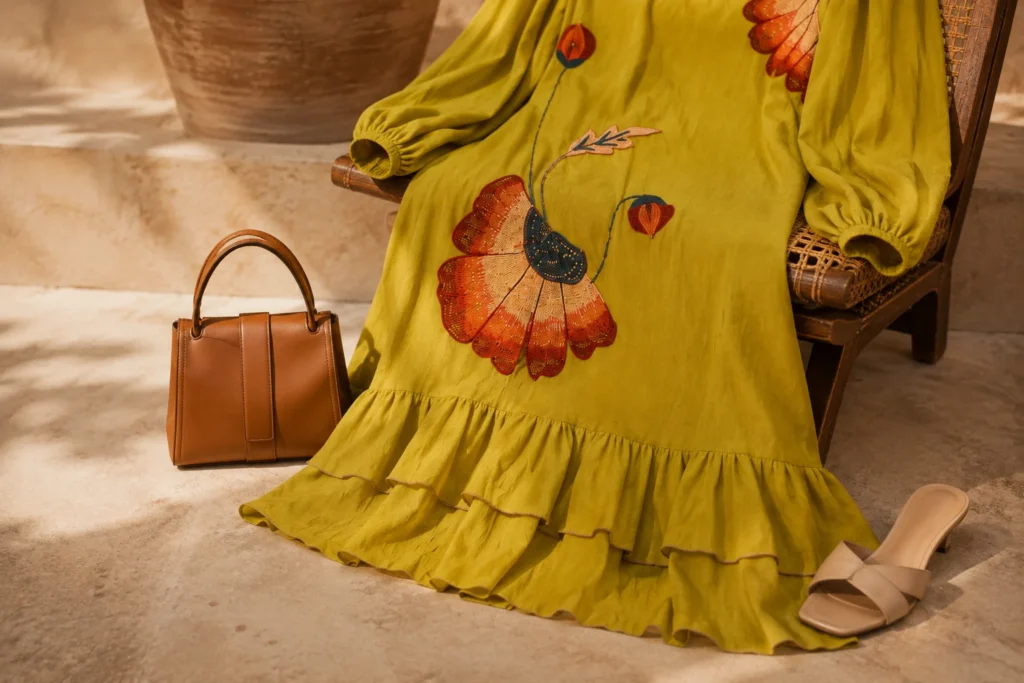
Take one of the warmer tones within the decorative motif and allow it to influence a single accessory.
A bag in a complementary earthy or warm family can make the outfit feel more connected without looking overly matched. Keep footwear quieter so the additional accessory does not compete with the dress.
This creates a slightly richer colour story while preserving the garment as the hero.
3. The relaxed natural direction
For a softer, more casual interpretation, consider natural-looking accessory textures and restrained jewellery.
A simple woven-style bag, for example, can introduce texture without adding another strong colour or pattern. Pair it with understated footwear and keep jewellery edited.
The difference between this and the cleaner version is subtle but useful: accessories contribute more to the mood while the dress still leads.
You can also reverse that balance. Keep the bag simple, choose stronger earrings and allow the jewellery to become the secondary focal point.
That flexibility is what makes an expressive dress interesting to style.
How to Decide Whether This Style Works for You
A striking garment can catch your attention immediately, but that does not automatically mean it deserves space in your wardrobe.
A more useful question is: can you see yourself styling it more than one way?
Look at what you already own.
Do you have neutral sandals or heels that would work without competing with the dress? Could your existing earrings provide the finishing detail? Do you own a simple bag that would let the colour and motif remain prominent?
If several answers are yes, the dress becomes easier to integrate because you are not relying on an entirely new set of accessories to complete it.
Also consider whether you enjoy wearing colour as the focal point of an outfit.
Someone who usually prefers quiet neutrals might use a dress like this as the one expressive element and keep everything else restrained. Someone comfortable with stronger styling might pick up one of the smaller motif colours through an accessory.
Neither approach is automatically better.
The strongest version is the one where the styling still feels like you.
View Product DetailsUltimately, statement dress styling ideas do not need to involve adding more and more elements. With a dress that already brings together distinctive colour, floral-inspired detailing and a flowing silhouette, editing can be more effective than embellishing.
Start with the dress, decide which feature you want to emphasise, and let your accessories support that decision. Sometimes the difference between an outfit that simply attracts attention and one that feels beautifully considered is knowing what to leave out.
Related Blogs
For another approach to balancing a colourful garment with quieter supporting pieces, read Beautiful Statement Top Styling With Effortless Colour Power. The same principle of allowing one expressive piece to lead applies particularly well here.
You may also like Elegant Green Ethnic Wear Styling Made Effortlessly Smart, which explores how selective jewellery, neutral pairings and controlled accessories can keep a visually strong garment balanced.
For more ideas on styling decorative clothing without overwhelming its details, see Effortless Black Kurti Styling Guide for Standout Looks.
FAQs
What are the easiest statement dress styling ideas?
Let the statement dress remain the focal point. Start with neutral footwear, choose one purposeful jewellery element and introduce another colour only when it complements shades already visible in the dress.
What jewellery works with a colourful floral dress?
Statement earrings can work well when the rest of the jewellery stays restrained. Alternatively, choose simpler earrings and add a bracelet. Avoid making every jewellery piece compete with an already decorative dress.
Should my shoes match a colourful dress?
Not necessarily. Neutral footwear can give a colourful dress visual breathing room. If you prefer colour, consider repeating one smaller accent from the dress rather than matching its dominant shade exactly.
How do I stop a statement dress from looking over-styled?
Create a visual hierarchy. Let the dress lead, select one secondary focal point such as earrings or a bag, and keep the remaining elements quieter. Avoid combining several competing prints and statement accessories.
Can I style the same statement dress in different ways?
Yes. Changing jewellery, footwear and a single accessory can shift the mood without changing the dress itself. Try a restrained look first, then experiment with one warmer accent or a natural-textured accessory.