

Tall wardrobes, solid bookcases and heavy wooden cabinets often end up against whichever living room wall has empty space. When that wall sits in the north-east, traditional Vastu Shastra treats the placement as a spatial imbalance rather than a mere decor choice. Shifting heavy furniture in the north-east to the south-west is a practical room rearrangement that restores visual openness, improves daylight circulation and aligns with traditional principles without structural renovation.
In Vastu Shastra, the north-east zone (Ishanya) is traditionally linked with lightness, clarity and morning sunlight, whereas the south-west (Nairutya) represents stability and structural weight. Moving bulky storage out of the north-east and anchoring it along the south-west wall keeps the lighter quadrant airy while giving heavy pieces a grounded home.
Table of Contents
Why Heavy Furniture in the North-East Creates Imbalance
In traditional Vastu principles, each directional zone carries a distinct spatial role. The north-east quadrant is traditionally associated with the water element, openness and morning sunlight, which is why classical texts favour keeping this sector uncluttered. When a tall timber almirah, dense bookcase or solid storage cabinet occupies that corner, it creates both a symbolic and physical obstruction.
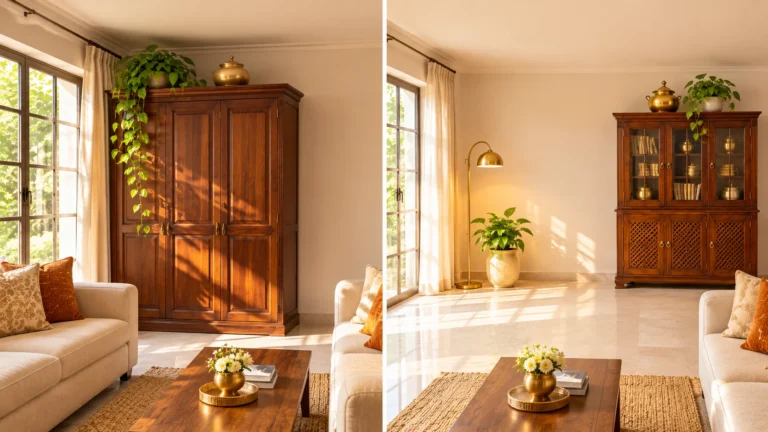
From an interior styling perspective, the effect is immediate. A tall, dark cabinet in the north-east blocks cross-light from nearby windows, casts heavy shadows across the floor and visually lowers the ceiling height. Even where Vastu is followed as a cultural guideline rather than a strict rule, a bulky unit crowding a bright corner makes the room feel narrower.
The south-west quadrant sits at the opposite end of this directional balance. Associated with the earth element and solidity, the south-west is traditionally treated as the natural anchor for mass and height. Placing your heaviest wardrobe or sideboard there grounds the room visually without cutting off daylight or crowding walkways.
How to Check Your Room Directions Before Moving Anything
Never guess room directions from sunlight angles alone or how a room appears in a photograph. Shadows shift across seasons, and modern apartment blocks often sit at an angle to true north rather than aligning neatly with street grids.
Stand near the centre of your living room—or the centre of your home for a whole-flat adjustment—and hold a magnetic compass or calibrated phone compass flat in your palm. Step away from large metal appliances, speakers or reinforced pillars, as metal frames can skew readings, and mark where north, north-east and south-west fall on a quick floor-plan sketch.
Confirm whether the north-east corner sits beside a window or main seating zone, and measure whether the south-west wall has enough uninterrupted width for a tall cabinet without blocking doorways or sockets.
Shifting Heavy Items to the South-West Safely
Moving a solid wooden cabinet or tall bookcase works best as a staged adjustment rather than a hasty push. Empty every shelf and drawer before shifting the piece; removing books, crockery and stored linens reduces weight, prevents frame twisting and protects joinery from strain.
Measure both the furniture footprint and the new south-west wall space before lifting, checking skirting boards and door clearances so the cabinet sits flush without overhanging a doorway. If you are rearranging living room seating at the same time, reviewing practical Vastu seating arrangement rules for living room harmony helps keep sofas and chairs balanced around the relocated storage.
Slide felt pads or smooth gliders under the legs to protect tiled, wooden or marble floors during the move. Once positioned in the south-west, check that the cabinet stands level and anchor tall freestanding units to the wall with anti-tip brackets.
What to Keep in the North-East Corner Instead
Clearing heavy furniture out of the north-east does not mean leaving the corner bare or awkward. Replace visual bulk with low, breathable elements that let daylight travel freely across the room.
A low-profile indoor plant in a ceramic or brass planter, a slim floor lamp casting warm upward light, or a light side table keeps the corner purposeful without adding weight. Healthy greenery—such as a money plant or peace lily—brings freshness while keeping sightlines open to nearby windows. Avoid crowding the space with tangled cables, routers or stacked boxes, as electronic clutter recreates visual heaviness; if devices sit there, these North East Vastu remedies for electronic tech clutter offer practical ways to relocate them.
For households keeping a quiet meditation or prayer space in this quadrant, an open, elevated setup free of closed storage preserves the calm atmosphere that both Vastu tradition and good interior design favour, as covered in this guide to prayer corner Vastu for a peaceful sacred space.
How to Handle Fixed or Built-In North-East Storage
In many rented apartments, a wardrobe, loft or crockery unit is built directly into the north-east wall and cannot be moved without carpentry. Traditional Vastu practice approaches fixed layouts pragmatically: when structural change is impractical, lighten the physical and visual load instead.
Shift the heaviest stored items—winter bedding, bulk files, metalware or seldom-used appliances—out of the north-east unit and into cupboards on the south or west side of the home. Use the north-east shelves only for light, everyday items like soft linens or neatly spaced decor, leaving at least a third of each shelf open.
Keep doors closed, clean and finished in soft, light-reflecting tones such as off-white, cream or pale wood rather than dark veneers. Traditional Vastu guidance varies across regions and practitioners, and while rearranging furniture improves daylight and spatial flow, no placement guarantees specific financial or personal outcomes; consult a qualified Vastu practitioner alongside an architect before making structural changes.
Moving heavy furniture out of the north-east and anchoring it in the south-west is a practical, no-renovation adjustment that brings better light and visual balance to a room. Check your room directions with a compass first, shift the heaviest piece from the north-east corner, and let the opened space breathe.
Related Blogs
- Vastu Weight Principles for Kitchen Layout Balance
- North Wall Vastu Remedies for Balanced Room Energy
- Vastu Remedies for Heavy Built-in Over Bed Cabinets
Frequently Asked Questions
Why should heavy furniture in the north-east be avoided in Vastu?
In Vastu Shastra, the north-east quadrant is traditionally associated with lightness, clarity and morning sunlight. Placing heavy furniture in the north-east is believed to burden this zone, while practically it blocks natural light, casts shadows and makes a room feel cramped.
Which direction is best for heavy wardrobes and cabinets according to Vastu?
Traditional Vastu recommends placing heavy wardrobes, tall cabinets and dense storage units along the south-west, south or west walls. These zones represent stability and earth energy, providing a grounded visual anchor without obstructing daylight from the north and east.
What if my north-east cupboard is built into the wall and cannot be moved?
If a north-east cupboard is fixed, empty heavy items like books, suitcases or appliances into south-west storage. Keep only light items inside, avoid overfilling shelves, and use light-coloured finishes and warm corner lighting to reduce visual heaviness.
What can I place in the north-east corner after removing heavy furniture?
After clearing heavy pieces, keep the north-east corner open with low-profile, lightweight additions. A healthy indoor plant, a slender floor lamp, a floor cushion or a compact prayer corner works well without blocking windows or walkways.
How do I find the exact north-east and south-west corners of my living room?
Stand near the centre of your living room or home holding a magnetic compass or calibrated phone compass flat, away from large metal appliances. Locate true north first, then identify north-east at 45 degrees clockwise and south-west directly opposite at 225 degrees.