
This article may contain affiliate links. We may earn a commission at no extra cost to you.
A colourful lehenga can make a strong impression, but styling one becomes more interesting when its colours, decorative borders and accessories all compete for attention. The trick is knowing which details deserve the spotlight and which should remain understated.
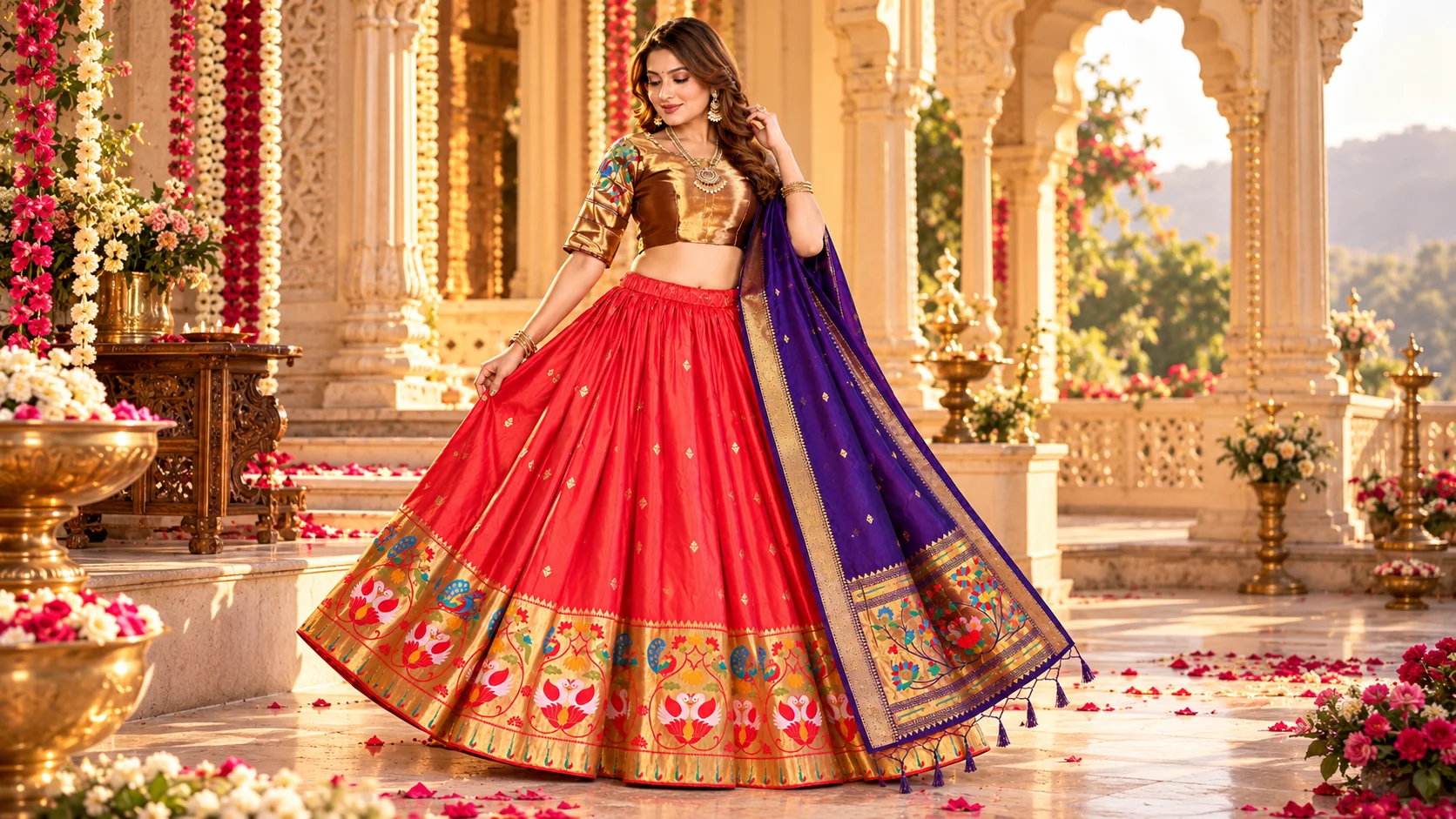
A red flared lehenga with a gold-toned blouse and deep purple dupatta offers an interesting combination of traditional colour and decorative detail. The most effective approach to red lehenga choli styling is to let the outfit establish the visual direction first, then choose jewellery, footwear and accessories that complement rather than compete with it.
Here is how to bring the entire look together for weddings, festive gatherings and special celebrations.
Table of Contents
Table of Contents
1. Red Lehenga Choli Styling Starts With the Colour Story
The first thing to notice about this lehenga is its combination of three prominent colours: red, gold and deep purple.
The red skirt creates the largest visual area, while the gold-toned blouse introduces a contrasting focal point. The purple dupatta adds another strong colour rather than simply blending into the rest of the outfit.
This is why adding several unrelated colours through accessories may make the overall appearance unnecessarily busy.
Instead, use the existing colour combination as your starting point.
- Red: Allow the skirt to remain the dominant colour.
- Gold: Repeat the warm metallic-looking tone through carefully selected jewellery or small accessories.
- Purple: Use the dupatta as the contrasting element rather than introducing several additional bright shades.
The wide decorative hem also deserves attention. Its colourful floral and traditional motifs already provide considerable visual interest. Avoid covering this section with unnecessary layers or accessories.
If you enjoy exploring similar combinations, our Red Lehenga Styling Guide for Elegant Festive and Wedding Looks offers further ideas for building a coordinated ethnic outfit.
For this particular look, the important principle is simple: let the red skirt lead, allow gold to connect the pieces and keep purple as the distinctive contrast.
If you would like to explore the featured design, you can find its product listing here.
Shop the Style2. Choose Jewellery That Complements the Blouse
Jewellery can change the overall character of a traditional outfit, but more decoration does not necessarily create a better result.
This blouse already has a metallic gold-toned appearance and colourful sleeve detailing. The neckline is also an important visual area because it sits close to the face and naturally attracts attention.
A coordinated necklace and earrings can complement this area, but their proportions matter.
For a more traditional appearance: Consider a statement necklace with coordinated earrings. Keep additional neck accessories limited so the blouse remains visible.
For a more understated direction: Let the earrings become the main jewellery feature. A pair of traditional drop earrings with a few coordinated bangles can provide enough detail without making the neckline crowded.
For an evening celebration: You can introduce a more noticeable jewellery feature, but avoid making the necklace, earrings and bangles equally dominant.
The existing gold-toned blouse provides a useful reference when choosing jewellery colours. Warm metallic-looking accents can connect the pieces without requiring an exact match.
For more ideas on balancing statement jewellery with festive clothing, see Festive Lehenga Styling Without Over-Accessorising.
3. Style the Purple Dupatta to Highlight Its Border
The dupatta is one of the most distinctive parts of this outfit. Its deep purple colour contrasts with the red skirt, while its broad decorative border introduces another layer of pattern.
Rather than treating it as an accessory that simply needs to be worn, consider how its placement changes the overall appearance.
One-shoulder drape: Let the dupatta fall from one shoulder, allowing its border to remain visible along the front. This creates a defined vertical line alongside the blouse and skirt.
Across-the-arm drape: Arrange it across the arms to create a more traditional presentation while allowing the skirt and blouse to remain visible.
Open drape: Allow more of the dupatta to fall naturally along one side. This gives the contrasting purple colour a stronger presence.
The important consideration is the decorative border. Avoid folding or gathering so much fabric that its most noticeable design details disappear.
The tasselled edge also contributes to the overall appearance, so allow it to fall naturally rather than arranging several layers over one another.
For another perspective on combining a statement skirt and contrasting dupatta, explore How to Style a Printed Lehenga With a Red Dupatta for Festive Events.
4. Complete the Look According to the Occasion
The same lehenga can create different impressions depending on the occasion and the finishing choices.
The objective is not to change every element of the outfit. Small adjustments to jewellery, footwear, hairstyle and handbag can be enough.
Wedding celebrations
A coordinated necklace, traditional earrings and a decorative clutch can create a more formal direction. Keep the dupatta arranged so that its border remains visible, particularly around the front.
Diwali and Navratri gatherings
The red, gold and purple combination already has a noticeable festive character. Traditional earrings, coordinated bangles and a suitable pair of ethnic footwear can complement the outfit without introducing too many additional decorative elements.
Family functions
A slightly simpler jewellery combination can make the overall appearance feel less elaborate. Let the blouse and dupatta provide most of the visual detail.
Evening celebrations
Consider a more defined hairstyle and a coordinated handbag. If you choose statement earrings, reduce other competing jewellery details.
For a smaller finishing accessory, a potli bag is another option worth considering. Our Potli Bag Styling Guide for Special Occasions explores ways to coordinate this traditional accessory with occasion outfits.
The final choice should reflect the event’s dress code, venue and your preferred level of traditional styling.
A Simple Styling Rule to Remember
A distinctive lehenga does not need an equally elaborate accessory in every part of the outfit. Start with its strongest colours and decorative details, choose one main jewellery feature and arrange the dupatta so that its border remains visible.
That balance allows the red skirt, gold-toned blouse and purple dupatta to work together without competing for attention.
Related Blogs
- Ready-to-Wear Lehenga Styling for a Balanced Festive Look
- How to Style a Green Lehenga for Weddings and Festive Occasions
- How to Style a Gold Kundan Choker for Festive Wedding Looks
Frequently Asked Questions
1. How do you approach red lehenga choli styling?
Start with the dominant colour of the skirt, then use the blouse and dupatta to establish the remaining colour palette. Choose jewellery that complements the neckline and arrange the dupatta so its decorative border remains visible.
2. What jewellery goes with a red lehenga and purple dupatta?
Gold-toned jewellery is a natural styling option for an outfit featuring a gold-toned blouse. Traditional earrings, a coordinated necklace or a restrained bangle combination can work, depending on the blouse detailing and the level of decoration you prefer.
3. Which footwear goes with a red lehenga choli?
Traditional embellished footwear, dressy flats or occasion-appropriate heels can complement a lehenga. Consider the length of the skirt, the venue and how much walking or standing the occasion involves before choosing your footwear.
4. How should I drape a purple dupatta with a red lehenga?
A one-shoulder drape, an across-the-arm arrangement or an open side drape are useful options. Choose a placement that keeps the decorative border visible without covering too much of the blouse or the skirt’s patterned hem.
5. Can I wear a red and purple lehenga to a wedding?
Yes, this colour combination can be considered for wedding celebrations, receptions and other festive functions. The jewellery, footwear and dupatta arrangement can be adjusted to suit the event’s dress code, venue and level of formality.