
A harmonious apartment entrance is less about adding more décor and more about creating a clear, calm transition from the shared corridor into the home. In Feng Shui traditions, entrances are treated as important points of movement and orientation, although methods vary by school. In an apartment, practical safety, building rules and everyday function should always come first.
The useful rule is simple: make the threshold visually clear, keep the corridor unobstructed, and let a few coordinated details create a sense of arrival.
Table of Contents
Understand What Your Apartment Entrance Already Does
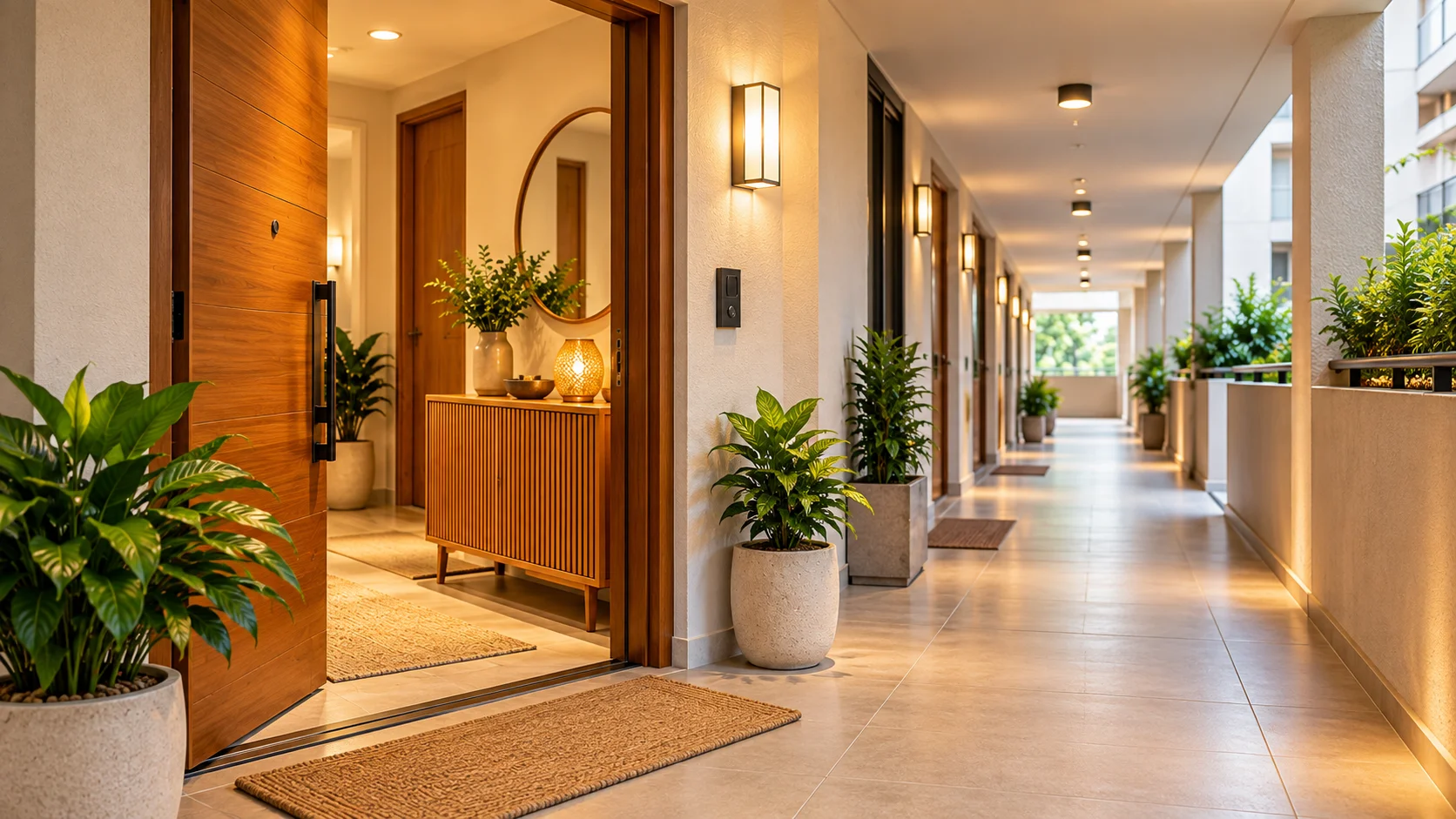
Treat the entrance as a transition rather than an isolated door. The supplied image offers a useful design example: warm timber, a defined doorway, soft lighting, greenery and a slim console create a readable sequence from corridor to interior. No single element has to dominate.
For a Feng Shui apartment entrance, identify the natural focal point first. Usually it is the door or the first intentional feature visible inside. Let that area breathe instead of filling every surface. A clear sightline can make a compact entrance feel more ordered, while too many competing objects weaken the visual hierarchy.
The shared corridor needs a stricter rule. It is communal space, so furniture, planters, ornaments and rugs should never reduce walking space, obstruct doors or interfere with emergency access. Often the best improvement is removing an obstacle before adding a decorative “cure”.
If you also want to explore the threshold through Vastu, see Vastu Main Door Threshold Tips for Wealth as a separate traditional framework rather than treating Vastu and Feng Shui as interchangeable.
Control the Shared Corridor Before Adding Décor
Apartment corridors can become visually noisy because multiple doors, lights, noticeboards and personal objects compete for attention. Your strongest control is therefore the area you own: the doorway, the immediate interior view and the small entrance zone inside the home.
Use repetition rather than quantity. Warm corridor lighting can sit comfortably beside warm wood; a neutral building palette can be softened by one natural texture or restrained accent. The goal is continuity, not a themed display.
Plants can provide a softer visual boundary, but they should remain inside your property unless the building specifically permits corridor placement. One well-scaled plant can establish a focal point; several unrelated pots can turn a narrow passage into an obstacle.
The same applies to hanging or sound-producing objects. A traditional Feng Shui item is not automatically appropriate in shared space. Neighbours, building rules and safe circulation come first. For the traditional use of wind chimes, see Nimon Group’s Feng Shui Wind Chimes Placement guide.
Adapt a Feng Shui Apartment Entrance to a Small Flat
You do not need structural changes to create a more harmonious entrance. In a rental or compact apartment, focus on reversible details such as lighting, a removable runner inside the door, a slim console where permitted, a suitable mirror and a small number of coordinated pieces.
Build the entrance in layers from the door inward: threshold, practical storage, then one visual anchor such as a mirror, artwork or plant. This creates a sequence for the eye instead of a pile of objects.
Scale matters more than quantity. A slim console can define the entrance without dominating it. A mirror can add visual depth, but its position should also account for glare, door movement, sightlines and what it reflects rather than following a universal “good” or “bad” rule.
For a different traditional approach to foyer mirrors, compare Vastu Mirror Placement Tips for Foyer Energy. It is Vastu guidance, not a Feng Shui rule.
Coordinate Light, Colour and Greenery Without Overdoing It
The supplied image uses warm wood, beige neutrals, soft golden lighting and greenery to create continuity. You can borrow that design logic without reproducing the exact arrangement.
Start with light. An entrance should be bright enough for safe movement and easy orientation. Where the space is dim, comfortable warm lighting can define the transition; where daylight is already strong, extra decorative lighting may be unnecessary.
Then repeat one or two colours or finishes. Echo warm timber with a small wooden frame, or repeat greenery with one plant rather than several different botanical displays. This creates rhythm without visual clutter.
Finally, protect negative space. Feng Shui traditions use different ideas about movement and spatial flow, but the practical design lesson is straightforward: an entrance that is easy to enter, navigate and understand generally feels more settled. You do not need a large collection of symbolic objects to achieve that effect.
Further Reading
For academic context on Feng Shui as a historical and cultural practice, see Ole Bruun’s Fengshui in China: Geomantic Divination Between State Orthodoxy and Popular Religion.
Conclusion
A harmonious Feng Shui apartment entrance is built through clarity: a readable threshold, an unobstructed shared corridor, restrained décor and coordinated light, colour and greenery. Remove what interrupts movement first, then add only the details that genuinely improve the transition into your home.
Frequently Asked Questions
1. What is a Feng Shui apartment entrance?
A Feng Shui apartment entrance is an entry area considered through traditional ideas about movement, orientation, balance and spatial arrangement. Because Feng Shui includes different schools and methods, there is no single universal entrance formula. Safety and building rules should always take priority.
2. Should I place plants outside my apartment door?
Only if your building permits it and the placement does not reduce corridor width, obstruct a doorway or interfere with emergency access. For most shared corridors, keeping plants inside the apartment is the safer and more practical option.
3. Is a mirror good for an apartment entrance?
There is no single answer across Feng Shui schools. Practically, consider glare, sightlines, door movement and what the mirror reflects. A side wall may be more useful than a position that creates distraction or an awkward reflection.
4. Can renters apply Feng Shui without changing the layout?
Yes. Focus on reversible choices such as decluttering, lighting, movable décor, colour coordination and rearranging existing furniture. These changes can improve the entrance experience without structural alterations.
5. Do Feng Shui entrance rules guarantee luck or prosperity?
No. Feng Shui is a traditional cultural and spatial practice, and schools interpret entrances differently. Claims that a particular placement guarantees wealth, health, love or success should not be presented as established fact.