
This article may contain affiliate links. We may earn a commission at no extra cost to you.
A festive kurta can look polished or overworked depending on what surrounds it. With a deep red embroidered kurta, the easiest route is to let the embroidery lead, keep the supporting pieces controlled, and change the level of formality through the bottoms and footwear.
For this men’s kurta look, treat the red kurta as the focal point, use beige or cream-toned bottoms for contrast, and choose footwear and accessories that support rather than compete with the embroidered upper section.
Table of Contents
Let the Men’s Kurta Set the Visual Hierarchy
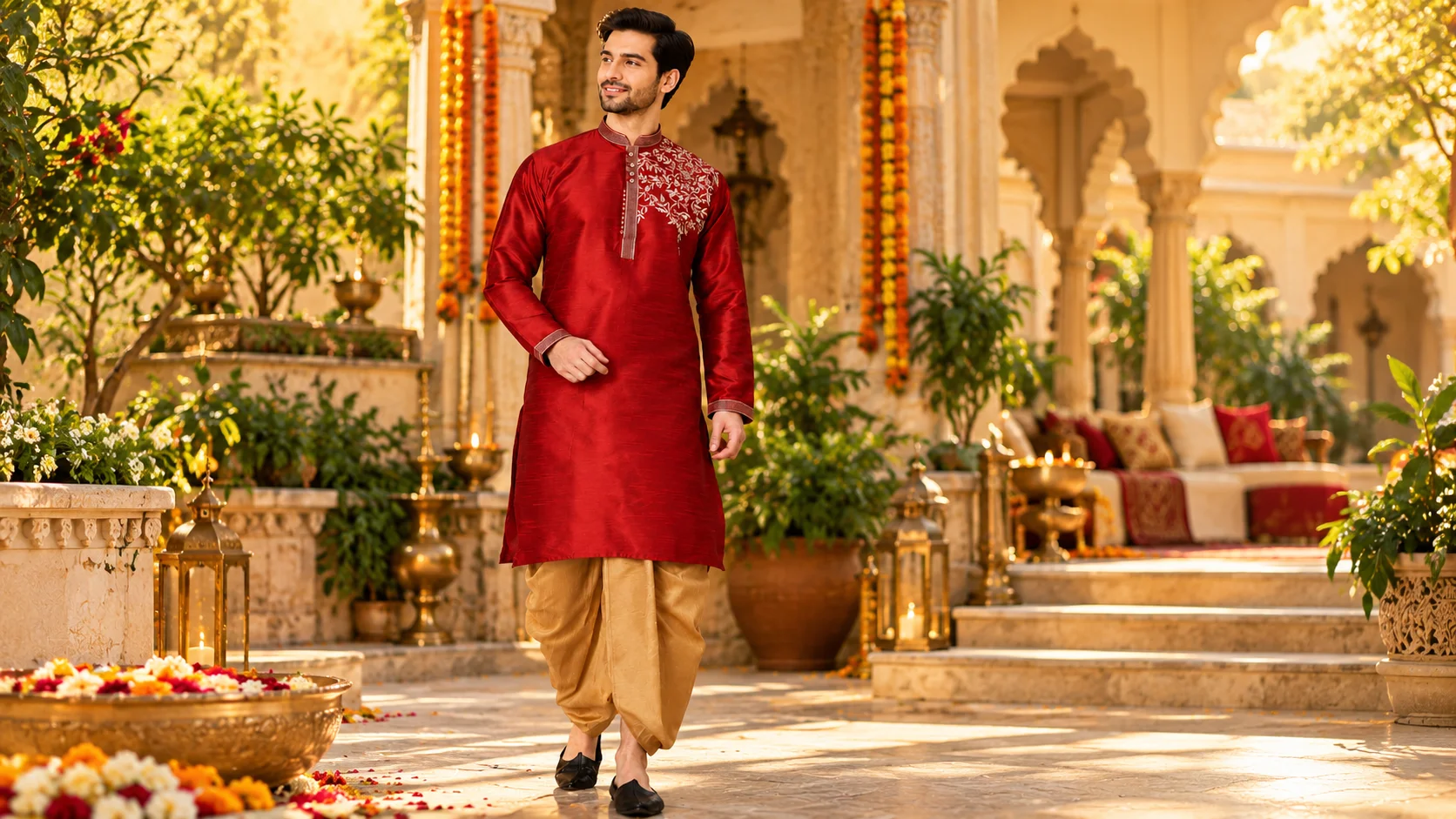
The defining feature of this outfit is not simply its red colour. It is the concentrated floral embroidery around the upper chest and placket, framed by a stand collar and restrained cuff detailing. That creates a natural focal zone. When a kurta already carries this much visual interest, adding another heavily patterned element near the face can make the outfit feel busy.
A useful rule is one focal point at a time: keep the upper layer visually dominant, then use simpler supporting pieces below it. The deep red also works naturally with warm neutrals, which is why beige-gold trousers feel balanced rather than distracting. The Metropolitan Museum of Art’s collection includes an embroidered Indian cotton kurta classified as menswear, offering useful historical context for the garment.
Explore This Kurta StyleChoose Bottoms by the Mood
The same kurta can move between different levels of traditional and contemporary dressing simply by changing the bottom half. The dhoti-style trousers shown with this look reinforce its festive, distinctly traditional character. Their warm beige tone also breaks up the strong red without introducing another competing colour.
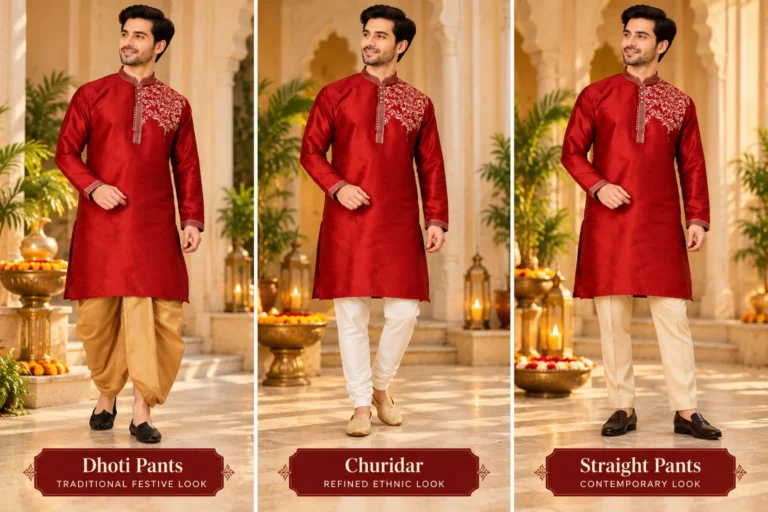
For a more streamlined traditional outfit, a churidar can create a neater visual transition from the longer kurta to the footwear. Straight trousers take the look in a more contemporary direction, particularly when the rest of the styling stays minimal.
Think in terms of mood rather than a fixed rule. Choose dhoti-style bottoms when you want the outfit to feel celebratory and culturally rooted; choose churidar for a refined traditional profile; and choose straight trousers when you want the kurta to sit comfortably between ethnic and modern dressing.
Use Footwear to Change the Formality
Footwear is one of the easiest ways to change how a men’s kurta reads. Traditional juttis or mojaris keep the outfit firmly in festive territory, while a simple ethnic loafer can give the overall impression a more contemporary direction.
With a deep red kurta and warm beige bottoms, black footwear creates a strong grounding contrast. Tan or brown footwear can instead connect more closely with the neutral bottom half. The choice should also follow the setting: an ornate wedding venue can support traditional footwear, while a smaller family gathering may suit a cleaner, less decorative pair.
If you already wear loafers in other parts of your wardrobe, Nimon Group’s guide to styling loafers for men can help you translate the same footwear into other outfits.
Keep Accessories Quiet but Intentional
Accessories should finish the outfit rather than compete with the embroidery. A classic watch, a restrained pocket square or a small kurta pin can add definition without creating another focal area.
Colour repetition is especially useful here. Warm gold or tan details can echo the embroidery and beige bottoms, while black accessories can connect with the footwear. You do not need every accessory to match exactly; repeating one supporting colour once or twice is usually enough to make the outfit feel considered.
If you want to experiment with men’s Jewellery, keep the neckline in mind. A simple chain can work when the placket and embroidery leave enough visual breathing room, but an elaborate necklace may fight with the kurta’s existing detail. Nimon Group’s men’s gold-tone chain styling guide offers a useful next step for understated Jewellery ideas.
Adapt the Look for Weddings and Festive Occasions
For a wedding or formal festive celebration, the full traditional combination is the strongest direction: embroidered red kurta, warm neutral dhoti-style bottoms and traditional juttis. The result feels celebratory without requiring a large number of extra accessories.
For a family function, you can simplify one element. Keep the embroidered kurta but switch to straight trousers and cleaner footwear, or retain the dhoti-style bottoms while reducing accessories. This preserves the festive character while making the outfit feel less ceremonial.
For an evening celebration, lighting and venue can also influence the styling decision. Rich reds tend to feel particularly at home in warm, decorative settings, while beige and cream supporting pieces prevent the overall look from becoming too dark. Dress codes vary by region and event, so use the invitation, venue and local expectations as the final guide.
For another men’s ethnicwear reference, Nimon Group’s festive heritage guide to a men’s jacquard kurta set explores a richer patterned approach to occasion dressing.
The simplest styling rule is also the most useful: let the embroidered kurta lead, then use the bottoms, footwear and accessories to decide how traditional or contemporary the final look should feel. One strong focal point and a controlled supporting palette can take a festive men’s kurta from merely traditional to thoughtfully styled.
Related Blogs
Frequently Asked Questions
What is the best way to style a men’s kurta?
Start with the kurta’s strongest visual feature, then choose simpler supporting pieces. For an embroidered red kurta, warm neutral bottoms, understated footwear and restrained accessories help keep the embroidery as the focal point while allowing the outfit to feel festive without becoming visually crowded.
What colour bottoms go with a red men’s kurta?
Warm neutrals such as beige, cream and tan create a balanced contrast with deep red. The beige-gold bottom shown with this look keeps the outfit traditional and coordinated. White or ivory can create a cleaner contrast, while darker bottoms produce a stronger, more formal visual effect.
Which footwear works with a festive men’s kurta?
Juttis and mojaris are natural choices for traditional celebrations, while simple ethnic loafers can give the outfit a more contemporary direction. Black footwear grounds a red-and-beige combination, whereas tan or brown can connect more closely with warm neutral bottoms.
Can a men’s embroidered kurta work for a wedding?
Yes, an embroidered kurta can suit a wedding when the styling matches the event’s formality. Pairing it with traditional bottoms and refined footwear creates a more ceremonial look, while cleaner trousers and understated accessories can work for a less formal family or pre-wedding gathering.
Should men wear Jewellery with an embroidered kurta?
Keep Jewellery proportional to the kurta’s existing detail. When embroidery is concentrated around the neckline and chest, a simple chain, ring or watch is usually easier to balance than several statement pieces. The aim is to support the outfit’s focal point rather than create a second one.