
This article may contain affiliate links. We may earn a commission at no extra cost to you.
A living room rarely has one job anymore. It may be the place for morning coffee, an evening film, weekend guests, children’s games, reading, or simply putting your feet up after a long day. That makes furniture that can adapt especially useful.
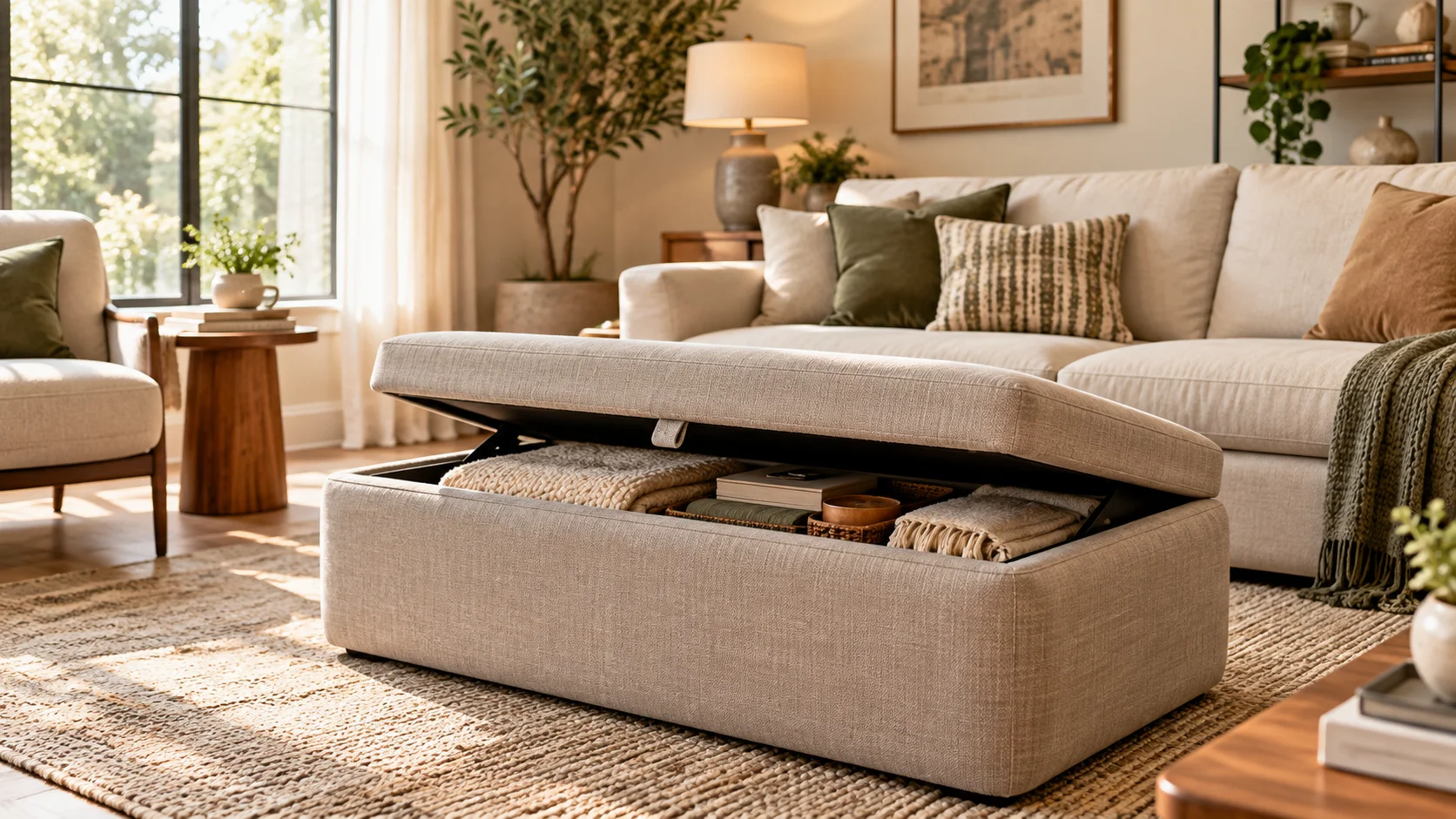
Storage ottomans are one of the simplest ways to add that flexibility without automatically adding another large cabinet. A well-chosen piece can provide concealed storage, a footrest and occasional seating, while also helping the room feel more edited. The trick is choosing one for the way your room actually works rather than buying the biggest storage option available.
Table of Contents
Why Storage Ottomans Work in Flexible Living Rooms
The appeal of storage ottomans is not simply that they hide things. It is that one low piece can support several everyday activities without demanding a permanent new zone.
Design coverage for 2026 is increasingly focused on homes that are adaptable, calm and useful. Houzz highlights integrated and hidden storage, multifunctional living spaces and furniture that supports changing household needs. Its 2026 furniture coverage also points to upholstered storage pieces as a notable direction. This makes the storage ottoman particularly relevant: it combines a soft furnishing presence with a practical function. ℹ️ ℹ️
The most useful role depends on your routine. A living room used mainly for relaxing might benefit from an ottoman that stays in front of the sofa as a footrest. A family room may get more value from a larger lift-top design that can hold throws, board games or cushions. In a smaller flat, a movable piece can be pulled towards the sofa, shifted aside for guests or used as occasional seating.
That flexibility is the real value. You are not just buying storage; you are choosing a piece that can change jobs as the room changes.
Choose Storage Ottomans Around the Room’s Real Job
Start with the items you want to hide.
If the main problem is loose blankets and cushions, look for an interior that is easy to access and large enough for soft, bulky items. If you want to store games, remotes or everyday family clutter, a wider opening may be more useful than a deep but awkward compartment.
Think about access as carefully as capacity. Storage that is technically generous but difficult to open will quickly become storage you stop using.
Match the shape to the furniture around it
A rectangular storage ottoman often works naturally with a longer sofa and can visually echo the sofa’s proportions. A round design can soften a room filled with straight lines, while a pair of smaller ottomans can offer more flexibility than one oversized piece.
There is no universal shape that works for every room. Look at the sofa, rug, coffee table and main walking route together. The ottoman should feel connected to that arrangement rather than dropped into an empty patch of floor.
Think about height before buying
Compare the ottoman’s actual height with the sofa seat and any nearby table. If it is mainly a footrest, visual and practical continuity usually matters more than simply choosing the tallest or softest option.
If you want to use it with a tray, check that the top is sufficiently stable and firm for that purpose according to the product’s own specifications. A tray can create a temporary surface for drinks or books, but it does not turn every upholstered ottoman into a full replacement for a hard coffee table.
Style Storage Ottomans Without Making the Room Feel Busy
The easiest mistake is treating the storage ottoman as an invitation to add more things.
Instead, let it do one clear visual job.
If the room already has patterned curtains, a detailed rug and several decorative cushions, a quieter ottoman in a complementary colour can create balance. If the rest of the room is restrained, a textured or sculptural ottoman can provide the visual interest.
Current 2026 interiors are also leaning towards warmer, tactile materials, with Houzz highlighting earthy colours, natural textures, curves and textured finishes. That gives you room to choose a storage ottoman that feels decorative rather than purely utilitarian.
Keep the top useful
If the ottoman sits where a coffee table would normally go, resist covering its entire surface. A tray can gather a few practical items while leaving part of the top visually open.
The same principle works for styling beside a sofa. One book stack, a small object or a soft throw can be enough. The aim is not to create a showroom arrangement; it is to make the room easier to live in.
For a useful companion approach, see Coffee Table Styling Made Effortless With the Powerful Rule of Three. The article uses visual grouping, height, shape and negative space to keep a central surface useful rather than crowded.
Where Storage Ottomans Earn Their Footprint
In front of the main sofa
This is the most obvious placement, but it still needs planning. Check the ottoman’s footprint against the sofa, rug and walking route. You should be able to move around the seating area without repeatedly shifting the piece.
A movable storage ottoman can be especially useful in a room that changes between everyday lounging and entertaining. Keep it close enough for regular use, but easy enough to move when more open floor space is needed.
Beside an accent chair
A smaller storage ottoman can act as a footrest for a reading chair while keeping a few useful items close by. This works particularly well in a reading corner where a full side table may feel visually heavy.
In a family or multi-use room
This is where hidden storage becomes genuinely practical. Throws, cushions, toys, game accessories and other soft or low-risk items can have a defined home rather than remaining scattered across the room.
The goal is not to hide everything. Frequently used objects should remain easy to reach; the storage ottoman simply gives the room a quicker reset point.
Near an entry to the living area
A compact design can sometimes work near the edge of the room as flexible seating or a temporary landing spot, provided it does not obstruct circulation. Measure the real route people use rather than judging the space from a photograph.
What to Check Before Choosing Storage Ottomans
Before choosing a storage ottoman, use a simple five-part check:
- Measure the footprint. Record the available width, depth and height, then compare them with the product’s exact dimensions.
- Check the opening. A large internal volume is less useful if the lid or access point makes everyday items awkward to reach.
- Consider what will live inside. Soft furnishings, games and everyday accessories may need different internal layouts.
- Check movement. If you expect to reposition the ottoman regularly, weight, handles, castors or an easy-to-lift construction can matter.
- Read the manufacturer’s care and safety instructions. Upholstery, wood, metal and woven materials can have different cleaning requirements. Follow the supplied guidance rather than assuming every finish can be treated the same way.
If children use the room, also think about lid movement, pinch points and whether the product is designed for the way your household intends to use it. For general furniture safety guidance, the U.S. Consumer Product Safety Commission’s Anchor It! campaign explains why manufacturer instructions and appropriate securing matter for top-heavy furniture. U.S. Consumer Product Safety Commission Anchor It! guidance
The biggest buying mistake is choosing storage capacity before considering the room. A bulky piece can create more visual and physical congestion than the clutter it was supposed to solve. In a flexible room, the best storage ottoman is the one that earns its footprint through repeated use.
Related Blogs
- Coffee Table Styling Made Effortless With the Powerful Rule of Three
- Bookshelf Depth and Height Planning Made Effortlessly Practical for Small Homes
A storage ottoman does not need to become the centre of the room to be useful. Sometimes its best quality is that it quietly performs several jobs while the room still feels like a living space rather than a storage zone.
Choose the size around your actual circulation, choose the storage around your actual belongings, and choose the finish around the rest of your room. That simple approach makes a multifunctional piece feel intentional rather than improvised.
Frequently Asked Questions
What are storage ottomans used for?
Storage ottomans combine an upholstered or cushioned seating surface with an internal storage compartment. Depending on the design, they can work as a footrest, occasional seat or temporary surface while keeping selected everyday items out of sight.
Are storage ottomans good for small living rooms?
They can be useful when their footprint is carefully matched to the room. A compact, movable design can add storage and occasional seating without requiring a separate cabinet, but a bulky ottoman can make a small room feel tighter.
Can a storage ottoman replace a coffee table?
Sometimes, but not automatically. A firm, stable ottoman used with a suitable tray can provide a temporary surface, but check the product’s construction and care guidance before using it that way.
What should I store in a storage ottoman?
Good candidates include throws, cushions, board games, controllers and other everyday items that are useful but visually distracting. Avoid storing anything that requires a specific temperature, ventilation or safety condition unless the manufacturer says the product is suitable.
How do I choose the right storage ottoman size?
Measure the available floor area, the sofa and nearby furniture, then check the walking route around the proposed position. Compare those measurements with the exact product dimensions and opening mechanism before deciding.