
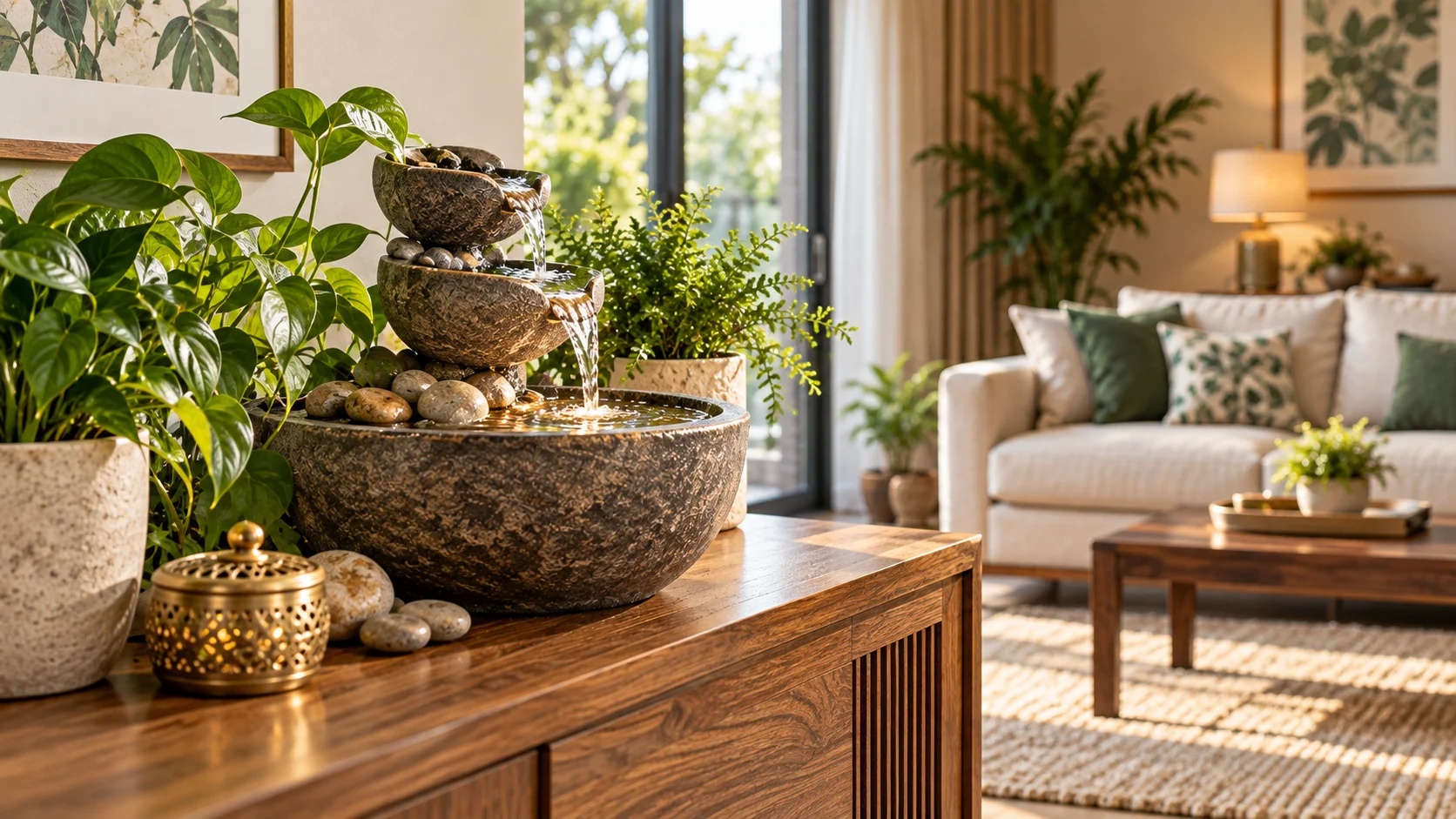
A water feature can add movement, texture and a calming visual focal point to a room. In Feng Shui traditions, water is also interpreted symbolically through ideas of flow, qi and auspicious conditions, but these are traditional cultural frameworks rather than scientifically validated ways to predict wealth, health or success. Cambridge University Press describes feng shui as a form of Chinese geomancy concerned with selecting auspicious sites within a correlative cosmology. 📖
The practical question is not simply, “Which direction is lucky?” There is no single universal placement rule across every Feng Shui school. Compass-based methods and door-oriented approaches can produce different readings, so a thoughtful guide should identify the method rather than present one rule as universal.
Table of Contents
What Do Water Features Symbolise in Feng Shui?
Water has long had an important place in Chinese geomantic traditions. Within Feng Shui frameworks, moving water may be interpreted through ideas of qi, flow and auspicious site conditions. Some modern advice also associates water with wealth or prosperity, but those outcomes should be understood as traditional symbolic interpretations, not guarantees.
For a contemporary home, the symbolism can be approached more simply. Flowing water can become a visual reminder of movement, balance and attentiveness to the way a room feels and functions.
That makes a Feng Shui water feature most useful when it works on two levels: it respects the tradition you are following and genuinely suits the room.
How Should You Choose a Feng Shui Water Feature?
Start with the room, not the symbolism. A small tabletop fountain is usually easier to manage than a large floor-standing feature, particularly in a compact living room, study or entrance area.
Look for a design that has:
- A stable, well-supported base
- A contained water reservoir
- A pump that can be accessed for cleaning
- A gentle flow rather than excessive splashing
- Materials and colours that sit comfortably with the existing décor
- A scale appropriate to the furniture around it
Natural stone, ceramic, glass and wood can all work visually. The important practical consideration is that the feature should look intentional rather than dominate the room.
If you are following a particular Feng Shui lineage, check its placement method before relying on a generic direction chart.
Where Can You Place a Feng Shui Water Feature?
Placement advice varies by school, so avoid treating one compass direction as a universal rule. In compass-oriented practice, directions are measured and interpreted through a particular system; other approaches use the entrance or the visual layout of the home instead.
A sensible starting point is to choose a location where the feature can be seen, maintained and enjoyed without interfering with everyday movement.
Living Room
A living room can be a natural home for a small water feature because it allows the feature to function as décor as well as a symbolic element.
Place it on a stable console, side table or suitable cabinet where the water can circulate without splashing onto books, textiles or electronics. Keep enough space around it that the feature remains visually distinct.
Entrance or Foyer
An entrance can make a water feature an immediate decorative focal point. However, the feature should never narrow a walkway, obstruct the door or create a slipping hazard.
If you are using a specific bagua or compass method, apply that method consistently rather than mixing rules from different schools.
Home Office
A compact fountain can work in a home office when it is quiet enough not to become distracting. Keep it away from computers, power strips, documents and other equipment that could be damaged by moisture.
For a work area, practical positioning matters more than forcing a symbolic placement that makes the desk awkward or unsafe.
For another example of Feng Shui-based placement thinking, see How to Place a Feng Shui Money Frog for Wealth.
Does the Direction Matter?
This is one of the most confusing parts of online Feng Shui advice. Different methods can map a home differently, which means the same room may receive different directional interpretations.
Compass School traditions use measured orientation and systems associated with the luopan, while other modern approaches may align the bagua with the front door. These differences are part of the history and practice of Feng Shui, not a reason to mix several methods into one set of rules.
If a direction matters to your practice, first identify the school or method you are using. Then follow that system consistently.
For everyone else, start with observable considerations: safe placement, clear circulation, proportion, cleanliness, noise level and how comfortably the feature integrates with the room.
Feng Shui Water Features and Everyday Maintenance
A beautiful fountain quickly becomes less appealing if the water is cloudy, the pump is noisy or the basin is neglected.
Build maintenance into the design from the beginning. Choose a feature that allows easy access to the reservoir and pump, and follow the manufacturer’s cleaning instructions for the specific model.
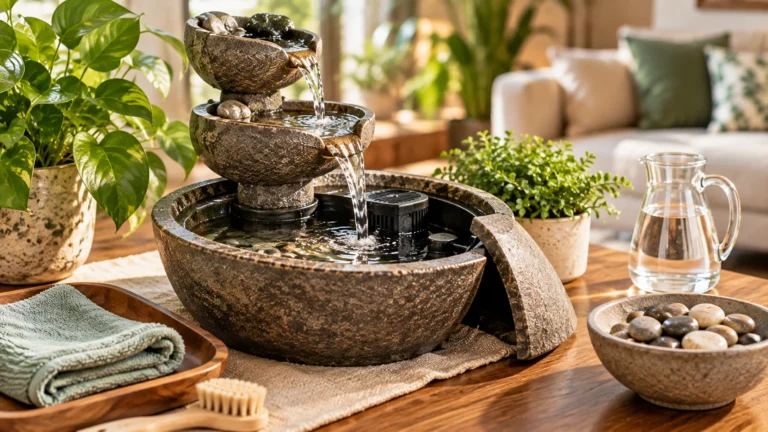
A simple routine can include:
- Checking the water level regularly
- Cleaning the reservoir as recommended
- Removing visible debris
- Inspecting the pump and tubing
- Wiping mineral deposits when appropriate for the material
- Checking for leaks or unusual noise
- Keeping surrounding surfaces dry
If the feature is electric, keep plugs, sockets and power connections away from splash zones and follow the appliance’s safety instructions. Never allow a decorative water feature to compromise electrical safety simply to achieve a particular placement.
Common Mistakes to Avoid
One common mistake is buying a fountain first and deciding where it belongs afterwards. The result can be a feature that is too large, too noisy or difficult to maintain.
Another is treating Feng Shui as a guarantee. Traditional claims about luck, wealth, health or relationships should not be presented as scientific predictions.
It is also worth avoiding mixed-method advice. If one guide tells you to use a compass and another tells you to position the bagua from the front door, do not combine both systems casually. Identify the method behind the advice.
Finally, do not overlook the room itself. A water feature should support the space rather than create clutter, dampness, noise or an awkward circulation route.
A Practical Way to Use Feng Shui Water Features
The most useful approach is to combine cultural intention with good interior practice.
First, decide which Feng Shui method you want to follow. Next, identify locations that are genuinely suitable for the size and type of fountain you own. From those options, choose the placement that keeps movement clear, makes maintenance easy and works naturally with your décor.
Then live with the arrangement for a while. If the pump noise bothers you, the water splashes, or the feature constantly needs attention, the placement is not practical enough — regardless of what a generic placement chart says.
A well-kept Feng Shui water feature should feel like part of the room, not an obstacle placed there simply to satisfy a rule.
Related Blogs
- Feng Shui Wind Chimes Placement: Transform Your Energy
- The Ultimate Feng Shui Desk Rule: How to Position Your Desk for Success
Further Reading
- S. A. Smith, Geomancers and Yin-Yang Masters, Cambridge University Press — a scholarly overview of feng shui and Chinese geomantic traditions. Cambridge University Press chapter
- Ole Bruun, Fengshui in China: Geomantic Divination Between State Orthodoxy and Popular Religion. Google Books reference
Frequently Asked Questions
1. What do Feng Shui water features symbolise?
Feng Shui water features are traditionally associated with ideas such as water, flow, qi and auspicious conditions. Some traditions also connect water with prosperity symbolism. These are cultural and traditional interpretations, not scientifically validated guarantees.
2. Where should a Feng Shui water feature be placed?
Feng Shui water feature placement depends on the school or method being followed. A safe general approach is to choose a stable location with clear circulation, easy maintenance and no risk of water reaching electrical equipment.
3. Should a Feng Shui water feature always face a particular direction?
No single direction should be treated as universal. Compass-based and entrance-based approaches can use different methods, so identify the Feng Shui school before applying a directional rule.
4. How often should a Feng Shui water feature be cleaned?
Follow the manufacturer’s care instructions for the specific fountain. Regularly checking water quality, removing debris and inspecting the pump can help keep the feature clean and functioning properly.
5. Can a water feature be used in a home office?
Yes, a compact water feature can work in a home office if it is quiet, stable and safely separated from computers, documents and electrical equipment. Practical workspace needs should take priority over symbolic placement.