
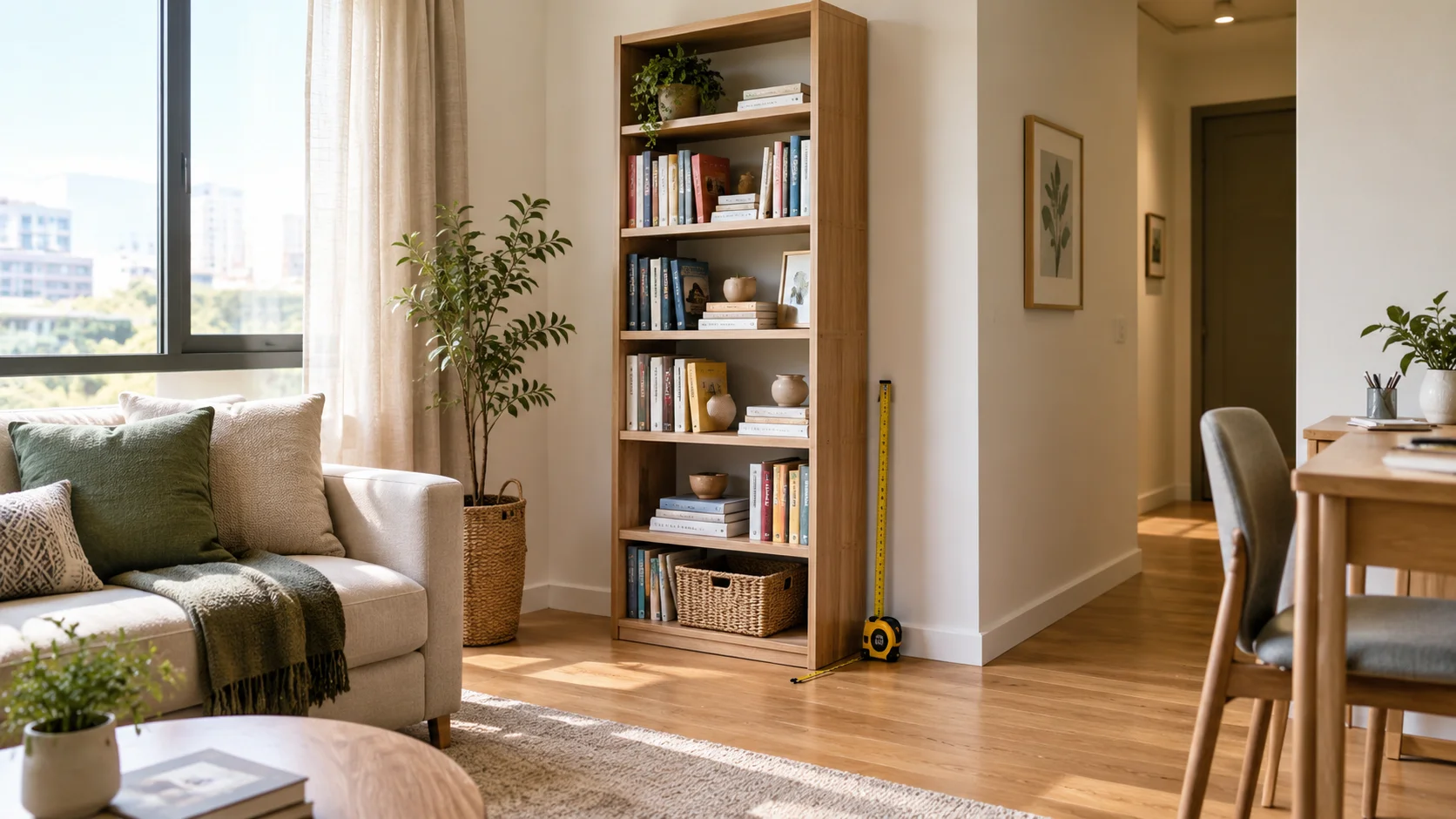
A bookshelf can look surprisingly compact online and still feel oversized once it enters a small room. The problem is often not the style of the bookcase but its depth, height and relationship with the usable floor space around it.
For effective bookshelf depth and height planning, start with what you actually need to store, measure the available wall, and then check how much clear space remains in front of the unit. For many everyday book collections, a bookcase around 25–30 cm deep can be a useful starting reference, but there is no universal ideal dimension—your books, room and product specifications should make the final decision.
Table of Contents
Why Bookshelf Depth Matters in a Small Home
In a spacious room, a few extra centimetres of furniture depth may barely register. In a compact living room, bedroom or home office, those centimetres can influence circulation, visual openness and how comfortably you use the room.
A common mistake is to assume that deeper automatically means better storage. It does not.
Extra depth is useful only when the objects you intend to store actually require it. If most of your collection consists of ordinary books, unnecessarily deep furniture may consume valuable floor area without creating equally useful storage.
As a broad reference, current bookshelf dimension guides commonly place general-purpose residential bookcases around 25–30 cm or 10–12 inches deep, although real products vary and larger books or storage objects can require considerably more depth. 📖 📖
The practical rule is therefore simple: measure your belongings before choosing the furniture.
Plan Bookshelf Depth Around What You Store
Bookshelf depth and height planning becomes much easier when you stop thinking about a bookshelf as an empty rectangle and start thinking about its contents.
Take a representative sample of the largest items you expect to store regularly. Measure their depth and height rather than relying on labels such as paperback, hardcover or coffee-table book.
This is especially important if your shelves will contain a mixture of:
- novels and standard books;
- large-format or illustrated books;
- folders and magazine files;
- storage baskets or boxes;
- decorative objects.
If ordinary books make up most of the collection, buying a substantially deeper unit simply because it offers a larger headline dimension may not be the most space-efficient choice.
Conversely, choosing an extremely shallow shelf for oversized books can leave them projecting beyond the front edge.
Think of usable depth, not maximum depth.
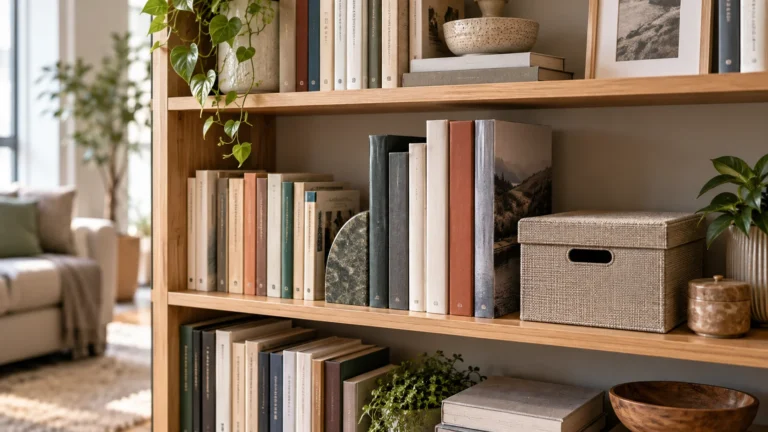
Do not forget the skirting board
There is another measurement that is easy to miss: the wall itself.
A skirting board or baseboard can prevent the rear of a bookcase from sitting completely against the wall. Depending on the furniture design, this may slightly increase its effective projection into the room.
Measure the actual installation position rather than assuming the advertised furniture depth will equal its final footprint.
How to Choose the Right Bookshelf Height
Height presents a different trade-off.
A taller bookcase can exploit vertical space and provide more storage without increasing its footprint. That makes vertical storage particularly attractive in smaller homes.
But maximum height is not automatically the best height.
Consider whether you can comfortably reach the shelves you intend to use frequently. Everyday books and objects generally make more sense in easily accessible zones, while less frequently used items can occupy higher shelves.
Also look at the room as a whole. A tall, narrow unit may use floor space efficiently, but its visual effect will depend on ceiling height, surrounding furniture and the width of the available wall.
Instead of asking, “What is the tallest bookshelf that fits?”, ask:
“What height gives me useful storage without making everyday access or room balance awkward?”
That question usually produces a better small-space decision.
Measure the Room, Not Just the Empty Wall
Finding a wall wide enough for a bookshelf does not mean the bookshelf fits the room.
You also need to account for what happens in front of and beside it.
Before choosing a unit, record:
- available wall width;
- floor-to-ceiling height;
- maximum practical furniture depth;
- nearby door swings;
- drawers, cupboards or furniture that need clearance;
- the route people use to move through the room;
- switches, sockets, radiators or other fixed features that should remain accessible.
This is where a simple floor plan can be more useful than repeatedly looking at product photographs.
Mark the proposed bookcase footprint on the floor with removable painter’s tape or another non-damaging temporary marker. Then walk through the room normally.
Can a nearby door still open comfortably? Can you reach the shelves without blocking the main route? Does the remaining floor area still feel functional?
That quick test gives you information that a furniture photograph cannot.
Make a Tall Bookshelf Safer and More Practical
Space efficiency should not come at the expense of stability.
The U.S. Consumer Product Safety Commission advises consumers to secure furniture such as bookcases to a wall to help prevent tip-over incidents. It also recommends keeping heavier objects on lower shelves and avoiding objects that may encourage young children to climb. 📖
For detailed furniture tip-over guidance, see the CPSC’s Anchor It! resource.
Always follow the bookshelf manufacturer’s installation and anchoring instructions because wall construction, furniture design and supplied hardware vary.
Put visual weight lower down
Even beyond safety considerations, arranging heavier-looking books and storage towards the bottom can make a tall bookshelf feel visually grounded.
Higher shelves can then hold lighter reading material or restrained decorative pieces where appropriate.
The result can feel calmer than filling every shelf equally.
Avoid turning every centimetre into storage
A small home often benefits from efficient storage, but efficient does not mean completely filled.
Leaving some breathing room around objects can make shelves easier to scan and reduce visual clutter. It also gives you a little capacity for future additions instead of making the bookcase feel full on day one.
A Simple Bookshelf Measurement Checklist
Before buying a bookshelf for a compact home, check these measurements in order.
1. Measure the largest regular items.
Their dimensions determine the useful shelf depth and vertical clearance you actually need.
2. Measure the usable wall.
Exclude areas required for doors, switches, sockets or other permanent features.
3. Check the floor footprint.
Pay particular attention to depth in narrow rooms.
4. Test circulation space.
Make sure the unit does not create an awkward bottleneck.
5. Consider reach.
Decide which shelves need to remain comfortably accessible for everyday use.
6. Check installation requirements.
Review the manufacturer’s assembly and anchoring instructions before choosing the final location.
7. Recheck the exact product dimensions.
General dimension guides are useful for planning, but the manufacturer’s specifications for the actual bookshelf should determine whether that model fits.
The most successful bookshelf for a small home is therefore not necessarily the narrowest, shallowest or tallest model available. It is the one whose dimensions closely match your belongings, your wall and the way you move through the room.
Good bookshelf depth and height planning turns measurement into a design tool. Instead of squeezing furniture into whatever space appears available, you choose a unit whose storage capacity earns the floor area it occupies.
FAQs
What is a good bookshelf depth for a small home?
For bookshelf depth and height planning, roughly 25–30 cm (10–12 in) is a common general-purpose depth reference for residential bookcases. Your actual books and storage items should determine the final depth.
Should a small room use a tall or low bookshelf?
Either can work. A tall bookcase uses vertical space efficiently, while a low unit can preserve a more open sightline. Choose according to storage needs, wall proportions, accessibility and safe installation.
How do I know whether a bookshelf is too deep?
Measure its proposed footprint and the remaining usable space in front. If the extra depth does not accommodate items you actually need to store but noticeably reduces circulation, a shallower option may be more efficient.
Should tall bookcases be attached to the wall?
Follow the manufacturer’s installation instructions. The CPSC specifically recommends anchoring furniture such as bookcases to help prevent tip-over hazards.
What should I measure before buying a bookshelf?
Measure your largest books or objects, usable wall width, ceiling height, available floor depth, door clearance and nearby fixed features. Then compare those measurements with the exact manufacturer’s dimensions.