
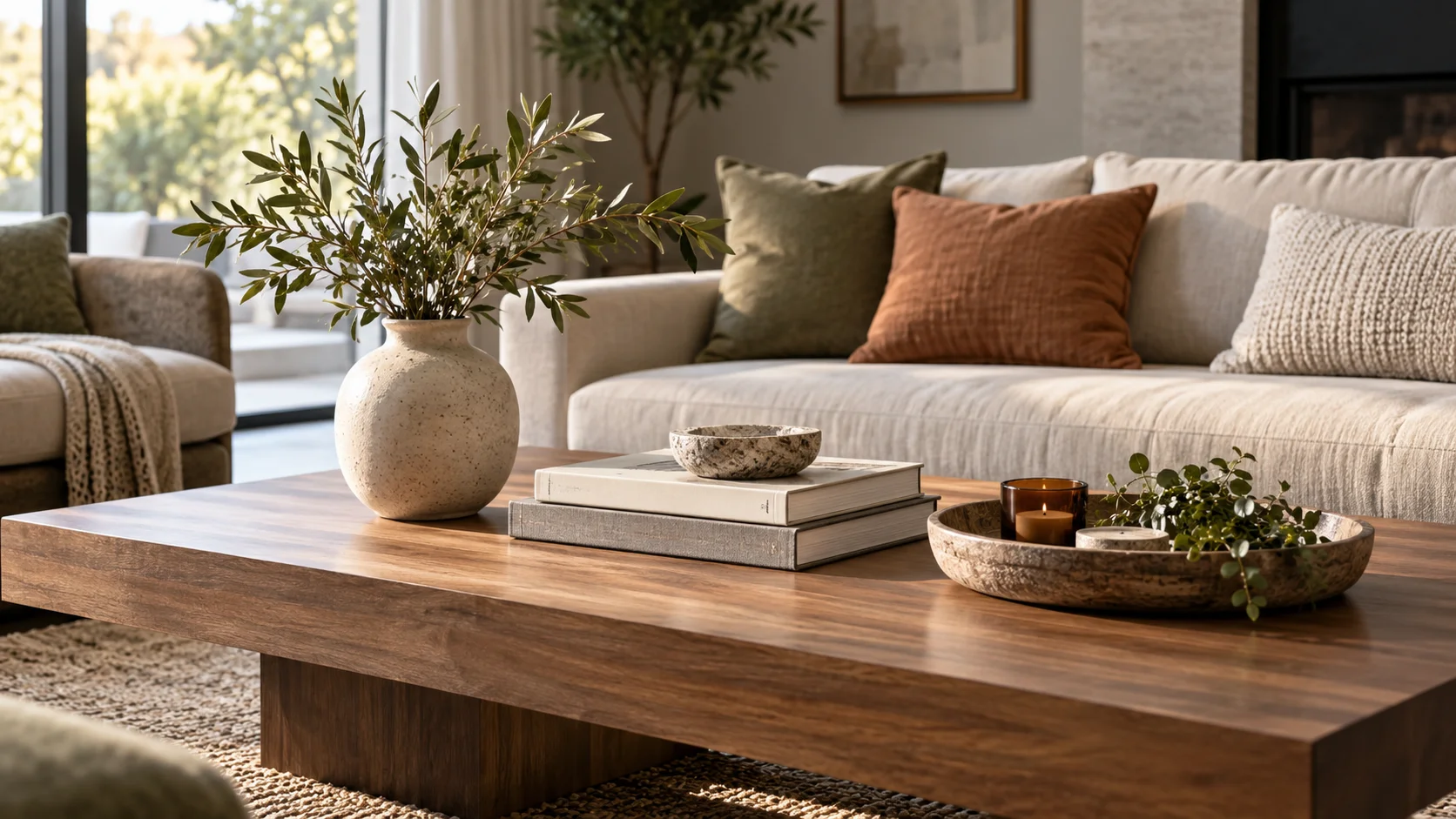
A coffee table can be one of the smallest pieces of furniture in a living room, yet visually it often sits right at the centre of everything. When its surface is empty, the room may feel unfinished; when it is covered with decorative objects, it can quickly look cluttered.
Coffee table styling with the rule of three offers a simple middle ground. Instead of trying to fill every corner, think in three visual groups and give each one a different role. Varying height, shape and texture can then create interest without sacrificing useful surface space.
The important part is that the “three” does not have to mean exactly three individual objects. It can mean three visual zones or three grouped elements, making the principle flexible enough for round, rectangular and compact coffee tables.
Table of Contents
Why the Rule of Three Works on a Coffee Table
Odd-numbered arrangements are a long-standing decorating technique because they can create rhythm and visual interest without relying on rigid symmetry. Designers frequently use groups of three when arranging objects on tabletops and other surfaces. Homes & Gardens, for example, describes the rule of three as a way of creating visually appealing decorative groupings and also recommends dividing a coffee table visually into three sections. 📖
That does not make the rule a mathematical law. Think of it as a starting framework.
Imagine three identical candles lined up at equal intervals. There may technically be three objects, but the arrangement can still feel flat. Now imagine a low stack of books, a medium-height decorative bowl and a taller vase. Your eye has several levels to explore, while the arrangement still reads as one composition.
The difference comes from variation.
A useful rule is therefore:
Three gives you the structure; variation gives the arrangement character.
Build Three Visual Zones Instead of Counting Objects
One of the easiest mistakes in coffee table styling is interpreting the rule too literally.
You do not need to place exactly three objects on the table. Instead, mentally divide the surface into three loose zones.
For example:
Zone one — height
Use something that gently draws the eye upwards, such as a vase, sculptural object or modest arrangement of foliage.
Zone two — structure
A small stack of coffee-table books can introduce horizontal lines and create a platform for a smaller decorative object.
Zone three — function or personality
A tray, bowl, small keepsake or other useful decorative piece can complete the composition.
This interpretation is particularly practical because a “zone” can contain more than one item while still reading visually as a single group.
Coffee-table books are useful for precisely this reason. They can introduce height and structure while also reflecting interests such as travel, architecture, art or fashion. Decorative trays can similarly corral smaller pieces into one visual unit rather than leaving them scattered across the tabletop. 📖
Try this simple formula
Start with:
one tall element + one low horizontal element + one contrasting element
Then stop and look at the table from the sofa rather than immediately adding more.
You may discover that it already feels complete.
Use Height, Shape and Texture to Create Balance
Good coffee table styling with the rule of three is less about buying matching accessories and more about creating contrast between the pieces you already have.
Vary the height
If every object finishes at approximately the same height, the display can form a flat visual line.
Instead, create a gentle high-medium-low progression.
A taller vase might establish the high point. A decorative object or candle could occupy the middle. Books, a tray or a shallow bowl can create the lowest layer.
The result does not need to form a perfect triangle. Slight irregularity often makes the display feel more relaxed.
Mix shapes
Shape is equally useful.
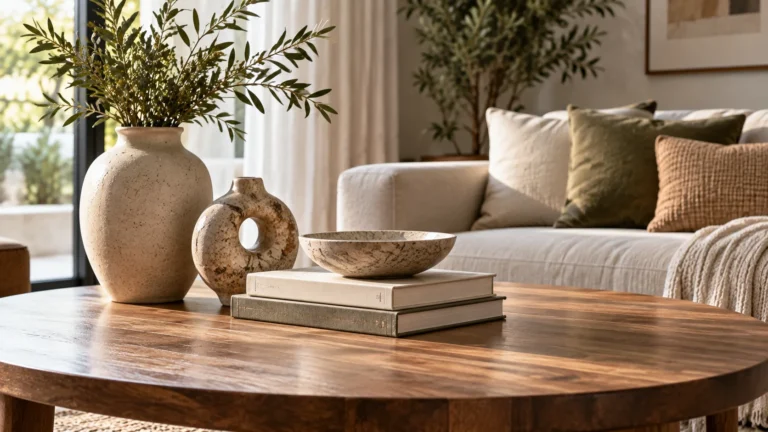
If your table and books are strongly rectangular, consider introducing a round bowl or curved vase. If the coffee table itself is round, a rectangular book or tray can create contrast.
This interplay of curves and straight lines can make a restrained arrangement more interesting without adding extra clutter.
Layer different textures
Texture becomes especially important in neutral interiors where several objects may share similar colours.
Consider combinations such as:
- smooth ceramic with textured book covers;
- clear or tinted glass with wood;
- stone-like surfaces with woven accents;
- glossy finishes beside matt objects.
The aim is not to use every material at once. Two or three complementary textures are usually enough to make a small arrangement feel layered.
Current coffee-table styling guidance similarly emphasises mixing materials and varying texture, height and shape rather than simply filling the surface with objects. 📖
Adapt Coffee Table Styling to the Shape of Your Table
The rule of three becomes more useful when it responds to the actual table rather than forcing the same arrangement everywhere.
Rectangular coffee tables
A rectangular surface naturally lends itself to three loose sections.
Try placing the tallest element slightly off-centre rather than directly in the middle. Balance it with a horizontal stack of books and a smaller object or tray towards the opposite side.
Most importantly, leave some tabletop visible.
Negative space is part of the composition.
Round coffee tables
A round table works well with a triangular arrangement.
Imagine three visual points rather than three straight sections. Place the tallest element towards one point and use two lower groupings to complete the triangle.
The arrangement can then be viewed more naturally from different seats around the room.
Round-table styling guidance also commonly recommends grouped objects with different heights and textures while retaining enough open surface for practical use. 📖
Small coffee tables
A compact table needs restraint.
Instead of three separate decorative clusters, make one cluster containing three visual layers — perhaps a book, a small bowl and a modest vase.
Another option is to use a tray as the boundary of the arrangement. Everything decorative stays within that zone while the remaining surface stays available.
Recent small-table styling advice continues to favour trays, books and one stronger statement element as a way to create interest without overcrowding a limited surface. 📖
Keep Your Coffee Table Beautiful and Useful
A beautifully arranged coffee table that cannot hold a cup is not particularly successful.
Function deserves a place in the composition.
Leave enough clear surface for the way the room is actually used. That might mean space for drinks, a book, reading glasses, a remote control or simply somewhere to put things down temporarily.
A decorative tray can be particularly useful here. It visually groups small pieces and can make it easier to clear part of the table when extra surface space is needed.
You can also make practical objects part of the styling rather than hiding all of them.
A small attractive box, for example, can hold frequently used items. Coasters can sit inside a tray. Books can be genuinely readable rather than selected purely for their covers.
The strongest arrangements therefore combine three qualities:
visual interest + personal relevance + everyday function
That balance is more valuable than achieving a picture-perfect but impractical display.
Make the Arrangement Feel Personal
Once the basic composition works, personality is what stops it from looking like a showroom.
Instead of choosing three fashionable objects simply because they coordinate, consider including something connected to your interests or memories.
It could be a favourite book, a small piece collected while travelling, a handmade ceramic object or another meaningful item.
This is also where the rule of three becomes flexible.
If three groups feel crowded, reduce the number of individual pieces inside them. If the arrangement feels too sparse, layer a small object over a book rather than creating an entirely new cluster.
You can also refresh a single component seasonally instead of replacing the entire arrangement. Changing foliage, a small decorative accent or a book near the top of a stack may be enough to alter the mood.
The goal is not to make the coffee table look permanently staged.
It is to make it look considered.
A final editing test
When you think the arrangement is finished, remove one object.
Look again.
If the display immediately feels cleaner and stronger, leave that object out. If the arrangement now looks noticeably incomplete, put it back.
This simple edit helps prevent the rule of three from turning into the rule of “three groups plus everything else”.
Coffee Table Styling Can Be Simple
Coffee table styling with the rule of three works because it gives you a framework without demanding perfect symmetry.
Begin with three visual zones. Vary height, shape and texture. Keep useful space open. Then add something personal enough to make the display belong to your home rather than a catalogue.
Most importantly, treat the rule as guidance rather than a restriction. If your table looks balanced, functions comfortably and reflects the room around it, the styling is already doing its job.
Further Reading
For additional coffee-table styling examples, see Homes & Gardens coffee table styling guide. It includes professional advice on proportion, texture, levels and the rule-of-three approach.
FAQs
What is coffee table styling with the rule of three?
Coffee table styling with the rule of three means arranging décor in three visual elements or zones to encourage balance, rhythm and interest. The groups do not need to contain exactly one object each.
Do I need exactly three items on my coffee table?
No. Three can refer to individual objects, groups or visual zones. A stack of books, for example, may function visually as one element.
What three things can I put on a coffee table?
A simple combination is a vase or other taller object, a stack of books and a tray, bowl or personal decorative piece. Adapt the combination to the table size and how you use the room.
How do I use the rule of three on a round coffee table?
Arrange three visual elements in a loose triangular formation and vary their height and shape. Keep some surface visible so the table remains functional.
How can I stop my coffee table from looking cluttered?
Reduce the number of individual objects, group small items on a tray and preserve deliberate negative space. If necessary, remove one piece and reassess the arrangement before adding anything else.