
This article may contain affiliate links. We may earn a commission at no extra cost to you.
Some jewellery sits quietly within an outfit. Other pieces immediately make you wonder how you would build the entire look around them.
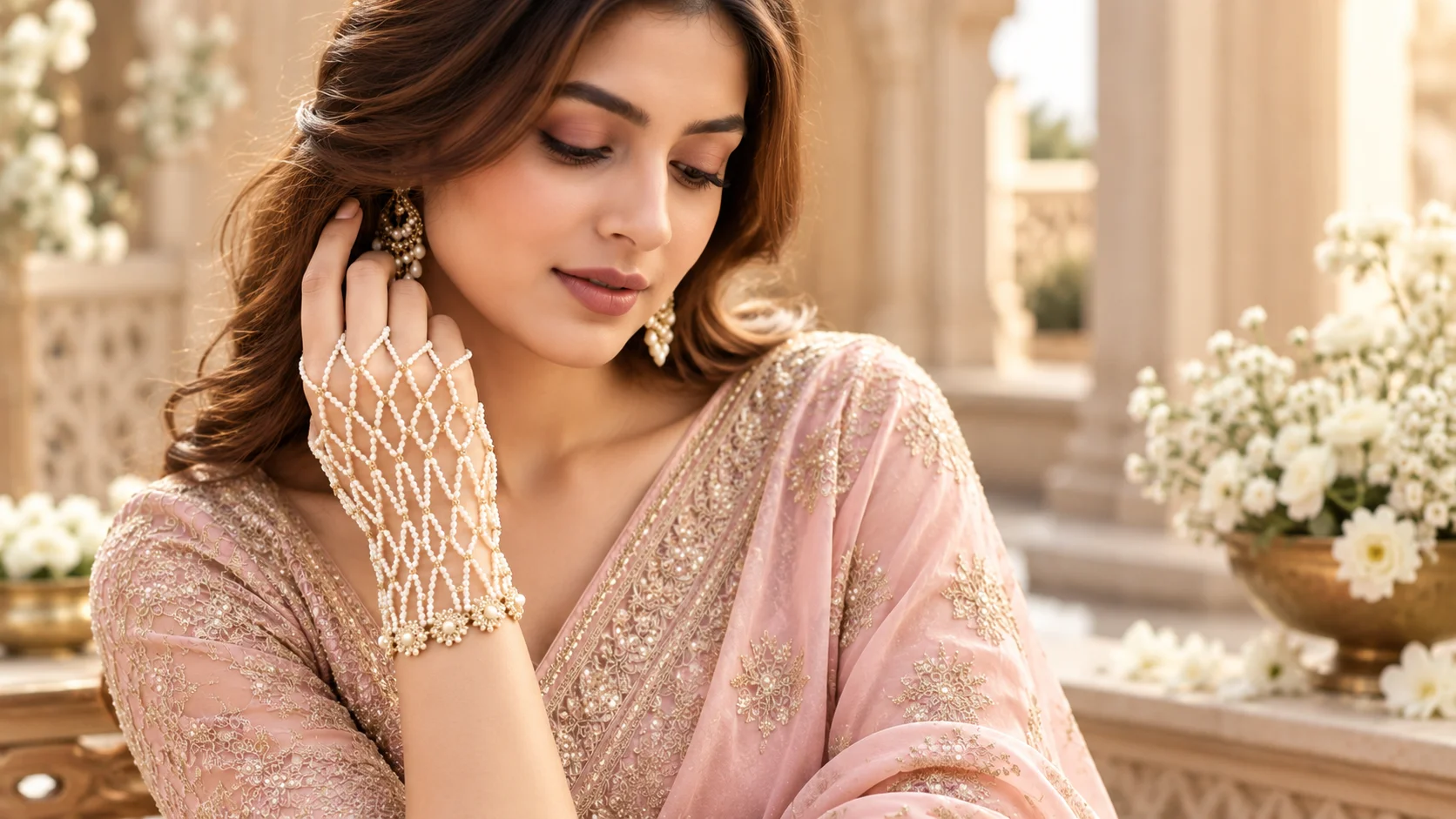
Pearl-style hand jewellery belongs firmly in the second category. With strands of small pearl-like beads creating an open lattice across the hand and decorative detailing around the wrist, this type of statement accessory can introduce texture, movement and a distinctly occasion-ready mood without relying on a necklace to do all the work.
The simplest way to style an ornate pearl hand piece is to let the hand jewellery become one of the focal points. Pair it with traditional or occasion dressing, repeat its soft ivory tones selectively, and resist the temptation to make every other accessory equally elaborate.
Table of Contents
What Makes Pearl Hand Jewellery So Striking
The visual impact comes from something quite different from a conventional bracelet or bangle.
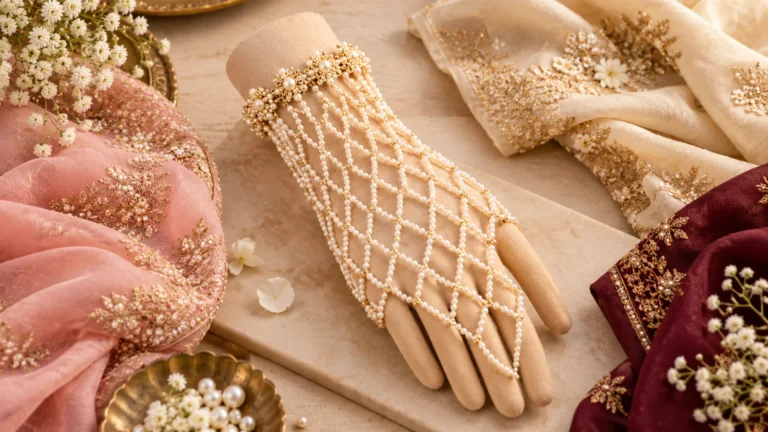
Instead of concentrating all the detail at the wrist, multiple strands extend across the back of the hand and towards the fingers. The open lattice creates a decorative surface while still allowing the hand itself to remain visible.
That changes the role of the accessory.
A bracelet normally creates a defined accent around the wrist. An elaborate hand piece extends that decorative interest much farther, so it can become noticeable in photographs, while holding a clutch, adjusting a dupatta or simply resting the hand naturally.
The pearl-like appearance also gives the design a softer character than a heavily coloured accessory might have. Creamy ivory tones can sit naturally alongside blush pink, champagne, beige, warm neutrals and many traditional colour palettes.
Yet this is still visually expressive jewellery.
The combination of multiple strands, geometric lattice work and decorative wrist detailing means it does not need several other bold pieces nearby simply to make the styling feel complete.
A useful rule is to treat it as statement jewellery first and a finishing accessory second.
Explore This StyleBuild the Outfit Around the Hand Jewellery
An ornate hand piece becomes easier to style when you stop asking, “What else can I add?” and start asking, “What should support it?”
Traditional clothing offers an obvious direction.
A saree with a graceful drape can work particularly well because the movement of the fabric creates a softer background for intricate hand jewellery. A lehenga, anarkali, sharara or elegant kurta set could create a similar relationship depending on the occasion and your personal style.
The outfit does not have to reproduce the jewellery’s detailing.
In fact, deliberately leaving some visual breathing room around the hands and wrists can make the accessory more noticeable.
If your outfit has elaborate embroidery everywhere — neckline, sleeves, borders and dupatta — consider whether the hand jewellery needs equally elaborate bangles beside it. Sometimes the stronger styling decision is to remove something rather than add another layer.
Sleeves matter as well.
Three-quarter sleeves, shorter sleeves or sleeveless traditional silhouettes naturally leave more of the hand and wrist visible. Full sleeves can still work, particularly when the cuff is relatively clean, but very ornate cuffs may compete with an intricate hand piece.
Think of the accessory and sleeve as one composition rather than two separate decisions.
Choose Colours That Complement the Pearls
Pearl-like jewellery gives you an unusually flexible starting palette because ivory and creamy tones can interact with both delicate and richer colours.
Blush pink for a romantic traditional look
Soft pink creates a gentle relationship with creamy pearl-like detailing.
It works particularly well when you want the overall impression to feel refined rather than sharply contrasting. Embroidery in champagne, muted gold or similar warm tones can add depth without pulling attention away from the hand accessory.
Ivory and cream for tonal elegance
A largely tonal combination can be surprisingly effective.
Instead of using strong colour contrast, allow differences in texture to create interest: flowing fabric, embroidery, bead-like details and a subtle warm-toned border.
The result can feel detailed without becoming visually chaotic.
Burgundy, maroon or deep red for contrast
Darker traditional colours create a much stronger backdrop.
Against burgundy or maroon, a pale pearl-style hand piece can become immediately more visible because of the light-dark contrast.
There is no need to repeat the ivory everywhere. Let the jewellery provide the lighter accent.
Sage, emerald or deeper green for a fresh direction
Green can also work beautifully with creamy jewellery, particularly when the clothing itself carries warm or neutral embroidery.
A softer sage creates a gentler effect, while deeper green makes the pale hand detailing more prominent.
The important principle is coordination rather than exact matching.
You want the jewellery and outfit to feel as though they belong in the same visual conversation — not as though every colour was copied mechanically from one item to another.
Balance Earrings and Other Jewellery
This is where a statement hand accessory can become either beautifully considered or unnecessarily crowded.
If the hand jewellery already creates substantial visual detail, decide which other jewellery deserves equal prominence.
Statement earrings can certainly work.
In traditional and occasion dressing, long earrings paired with decorative hand jewellery can create an intentionally dressed-up combination. The easiest way to keep that pairing balanced is to give the neckline some breathing room.
A large necklace, dramatic earrings, heavily embellished neckline and elaborate hand jewellery can all look attractive individually, but together they may compete for attention.
Try establishing a hierarchy instead:
Hand jewellery + statement earrings + restrained neckline
or
Hand jewellery + necklace + simpler earrings
Neither is a rigid rule. The point is to decide where you want the strongest visual moments.
The same thinking applies to bangles.
Because this type of hand jewellery already creates decoration around the wrist, a large bangle stack is not automatically necessary. A restrained supporting bracelet or a few carefully chosen bangles may be enough — and in some looks, adding nothing beside the hand piece can make its shape easier to appreciate.
The strongest styling often comes from recognising when the accessory has already finished the job.
Make the Hand Jewellery Visible
There is little point choosing intricate hand jewellery and then hiding most of its character.
Consider how your hands naturally appear throughout an occasion.
Holding a clutch, carrying a small potli bag, arranging a saree pallu or dupatta, or simply keeping one hand relaxed near the waist can make the accessory visible without creating an exaggerated pose.
This matters particularly for photographs.
A hand piece has a different visual relationship with the camera from earrings or a necklace. Its detail becomes clearer when the hand is relaxed and the back of the hand is naturally visible.
Avoid building every styling decision around posing, though. The accessory still needs to make sense as part of the overall outfit rather than existing only for a photograph.
Sleeves and bags deserve another look here.
A large handbag constantly covering the hand may hide the accessory, while a smaller clutch can leave more of the design exposed. Likewise, heavily embellished cuffs may visually merge with the jewellery, whereas cleaner sleeve edges can provide useful separation.
Small choices can determine whether an intricate accessory reads clearly or simply disappears into an already elaborate ensemble.
Is This Statement Style Right for You?
Beautiful statement jewellery can be easy to admire and harder to evaluate.
Before choosing an elaborate hand accessory, start with your wardrobe rather than the accessory itself.
Can you immediately imagine it with two or three outfits you already own?
Perhaps you have a blush saree, an ivory festive outfit or a deeper-coloured lehenga that could provide contrast. If several combinations come naturally to mind, you already have a better indication of how the piece could fit into your occasion wardrobe.
Next, consider your normal jewellery style.
If you enjoy layered, decorative traditional looks, a hand piece can become another expressive part of that aesthetic. If you usually prefer one statement accessory at a time, you may want to make the hand jewellery the hero and simplify your earrings, necklace or bangles accordingly.
Also look carefully at the product information before purchasing.
Photographs can help you judge visible design, colour relationships and overall appearance, but they cannot reliably confirm material composition, bead or pearl authenticity, dimensions, fastening, weight, durability or other specifications.
Those details should come from the retailer’s verified information.
Finally, think about the occasion.
Statement hand jewellery naturally lends itself to moments when accessories are meant to be noticed: wedding celebrations, festive gatherings, engagement-related events, traditional functions and other dressed-up occasions.
That does not mean there is only one correct way to wear it.
The interesting part is how dramatically the mood can change around the same jewellery. Blush and ivory can take it in a softer direction; deeper colours create stronger contrast; restrained additional jewellery makes it the focal point; more elaborate accessorising produces a richer ceremonial mood.
View Product DetailsThe most elegant approach to pearl hand jewellery styling is not to make every part of the outfit equally decorative.
Give the hand piece room to be noticed. Choose clothing that supports its pale, intricate appearance, consider how much additional jewellery the look genuinely needs, and make sure sleeves and accessories do not accidentally hide the detail you wanted in the first place.
A statement piece becomes much easier to wear once you decide exactly what role you want it to play.
Related Blogs
For more jewellery-styling inspiration:
- Elegant Kundan Statement Earrings for an Effortless Festive Look — useful if you are pairing an ornate hand accessory with statement earrings and want to balance the neckline, hairstyle and remaining jewellery.
- Elegant Chandelier Earrings With Standout Styling Ideas — explores how expressive traditional-style earrings can work with festive and wedding-guest outfits without making every accessory compete.
- Elegant Statement Earrings Styling Guide With Essential Ideas — a useful next read for controlling jewellery scale, colour and visual hierarchy in a dressed-up ethnic look.
FAQs
How do you style pearl hand jewellery with traditional outfits?
For pearl hand jewellery styling, let the hand piece become a focal accessory. Sarees, lehengas, anarkalis and elegant kurta sets can all work; choose a complementary colour palette and avoid surrounding the hand jewellery with too many equally elaborate accessories.
Can I wear statement earrings with hand jewellery?
Yes. Statement earrings and decorative hand jewellery can work together for occasion dressing. A relatively uncluttered neckline and restrained additional jewellery can help prevent the accessories from competing with one another.
What colours work well with pearl-style hand jewellery?
Blush pink, ivory, cream, champagne and other warm neutrals create soft combinations. Burgundy, maroon and deeper green can provide stronger contrast against pale pearl-like detailing.
Do I need bangles with a decorative hand piece?
Not necessarily. Because hand jewellery already adds detail around the wrist, additional bangles may be unnecessary. If you want them, consider a restrained selection rather than automatically adding a large stack.
What should I check before buying hand jewellery online?
Check the retailer’s current information for composition, dimensions, fastening or attachment method, care guidance and other specifications important to you. Product photographs can show appearance but should not be used to assume material, authenticity, weight or durability.